
Indonesia’s Climate Strategy in Flames as Global Summit Nears
Less than a week before the world’s nations gather to accelerate the fight against climate change, Indonesia is walking into the 31st UN Climate Change Conference (COP31) with a paradox at its core. The country is defending its ambitious climate commitments even as its own land burns, sending emissions soaring to record levels that threaten to unravel the very foundation of its plan. Environment Minister Jumhur Hidayat laid out six priority areas for Indonesia’s negotiations in Turkey, including accelerating the energy transition and securing greater climate financing. Yet, he stressed a familiar condition: the country’s climate ambitions cannot come at the expense of its development agenda.
“Our priorities are energy affordability, workers’ welfare and protection of local communities. We also oppose unilateral measures that disadvantage developing countries,” Jumhur told a press conference on Wednesday. It’s a statement that sets the stage for what is expected to be a tense global negotiation, one where the 1.5 degrees Celsius warming limit of the Paris Agreement is now seen as almost certainly breached. “The world is entering COP31 with the reality that the threshold for global warming of 1.5 degrees Celsius is almost certainly going to be exceeded,” said Martin Krause, Director of the Climate Change Division at UNEP. “The next challenge is to keep the temperature rise as small and brief as possible.”
The Pillar Under Fire: Indonesia’s Net Sink Goal
At the heart of Indonesia’s climate strategy is a single, towering ambition: to turn its forestry and other land-use (FOLU) sector into a net carbon sink by 2030. This means the country’s vast forests and peatlands would absorb more greenhouse gases than they release. This target is not just an environmental goal; it’s the central pillar supporting Indonesia’s entire nationally determined contribution (NDC), its pledge to reduce greenhouse gas emissions by 2060. The government has long counted on this natural carbon absorption to offset emissions from its continued reliance on fossil fuels to fuel economic growth.

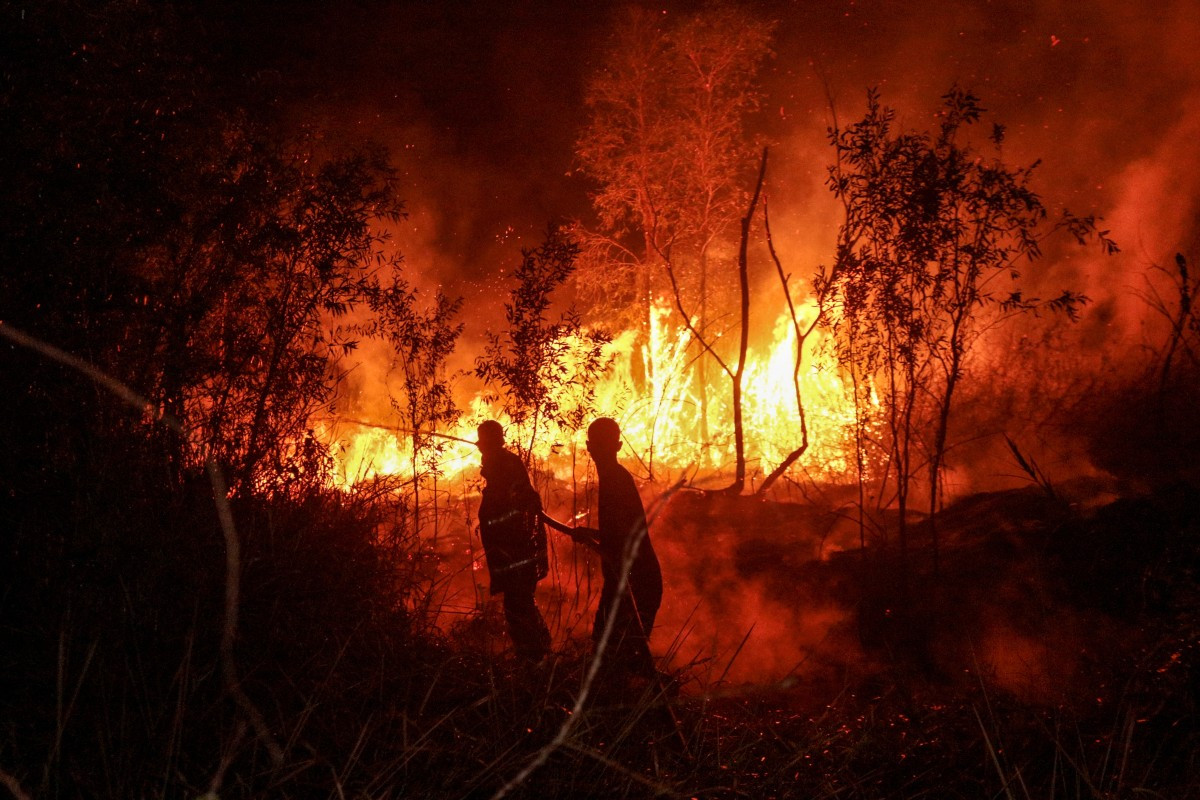
But this year, that pillar is cracking under the heat. Wildfires are ravaging forests and peatlands across Kalimantan, Sumatra, and Papua, releasing a torrent of greenhouse gases. The data is staggering. As of Wednesday, Indonesia’s fire emissions for 2026 had reached 195.15 megatonnes (Mt) of carbon. According to the Europe-based Copernicus Atmosphere Monitoring Service (CAMS), this accounts for roughly one-third of the global total from fires. To put that number in perspective, it’s equivalent to the annual emissions of 189 coal-fired power plants. CAMS data provides a clear, undeniable picture of the scale of the problem.
The crisis has immediate human and economic stakes. The smoke chokes cities, disrupts air travel, and causes widespread respiratory illnesses. For communities living on the forest’s edge, the fires destroy homes, livelihoods, and ancestral lands.
The government’s 8-percent growth target inherently relies on resource exploitation that will drive forest loss, leaving the 2030 FOLU net sink target far out of reach.
Patria Rizky Ananda, climate campaigner for the Indonesian Forum for the Environment (Walhi)
A Tug-of-War Between Ambition and Reality
Indonesia’s overall climate action remains “critically insufficient” to meet the 1.5°C target, according to the independent Climate Action Tracker. The IESR, a leading Indonesian think tank, echoed this sentiment, noting that outside of the forestry sector, the country’s emissions are showing an upward trend and are expected to continue rising towards 2030.
The Indonesian government, however, is not backing down from its commitments. Officials acknowledge the immense challenge posed by the wildfires but insist they are exploring solutions in other sectors. “But we are trying to find sectors that could reduce the emission from forest fires,” Irawan Asaad, the Environment Ministry’s director general for resource mobilization on climate change, told The Jakarta Post. MPR deputy speaker Eddy Soeparno pointed to two key pathways: forest restoration and the expansion of renewable energy. “So there’s a significant amount of carbon emissions that will be reduced as a result of this energy transition, which would actually also support our targeted NDCs,” Eddy said.
Here lies the central tension in Indonesia’s climate dilemma. Indonesia’s progress on the energy transition has been painfully slow. As of April 2026, renewables accounted for just 17.89 percent of the country’s energy mix, well below the government’s initial target of 23 percent for 2025. While President Prabowo Subianto announced an ambitious plan to develop 100 gigawatts-peak of solar power over the next three years, the pathway to achieving this and how it will accelerate the shift away from fossil fuels remains unclear. The IESR emphasizes that credibility cannot be built on targets alone; it must be supported by real progress in implementing climate policies.
The Global Stage and a Nation’s Defiance
As Indonesia prepares for its delegation to COP31—led for the third consecutive year by the president’s brother, Hashim Djojohadikusumo—the country is also setting its terms for the global conversation. Soeparno, speaking at a media briefing organized by the Government Communication Agency, signaled a defensive posture. He stated Indonesia is ready to address its forest fire control efforts on the international stage, pushing back against what it perceives as unfair scrutiny. “We appreciate the support from the general public. We also appreciate the support extended by our friendly neighboring countries. However, we are making every effort to extinguish forest and land fires and prevent them from occurring in the future,” he said.

In a move to deflect criticism, Soeparno noted that Indonesia is not alone in facing this problem. He pointed to similar fire occurrences in Australia and the Republic of the Congo, framing the issue as a global challenge. The government’s stance, as outlined by Jumhur, is that climate action must be equitable and cannot place an undue burden on developing nations still fighting poverty and pursuing growth.
This argument, however, runs up against the hard reality of the numbers. Indonesia’s fires are not just a local or regional problem; they are a significant contributor to the global climate crisis. The emissions released today affect weather patterns, sea levels, and agricultural yields worldwide. The question COP31 must grapple with is whether a nation can credibly ask the world for financial and technical support for climate action while its own domestic policies and environmental enforcement are failing to deliver on its most crucial promises.
The path forward for Indonesia is fraught with contradiction.

ICAI CA Foundation September 2026 Results Out
ICAI CA Foundation September 2026 Results Out: Kansika, Mahek Gupta Tie for Top Rank The wait is over...

Experts Warn of Risks in ‘Sun, Sea and Surgery’ Cosmetic Tourism
A Record Half a Million Seek Cheap Surgery Abroad, Ignoring Life-Altering Risks The numbers are staggering. In 2024,...

Julie Andrews credits lifelong learning for staying sharp at 91
Julie Andrews, 91, Swears by One Habit Linked to 18% Lower Dementia Risk At 91, Julie Andrews feels...

Harvard Study Links Exercise Variety to Longer Life
A landmark Harvard study of 110,000 Americans has revealed that the variety of exercise, not just the volume,...