
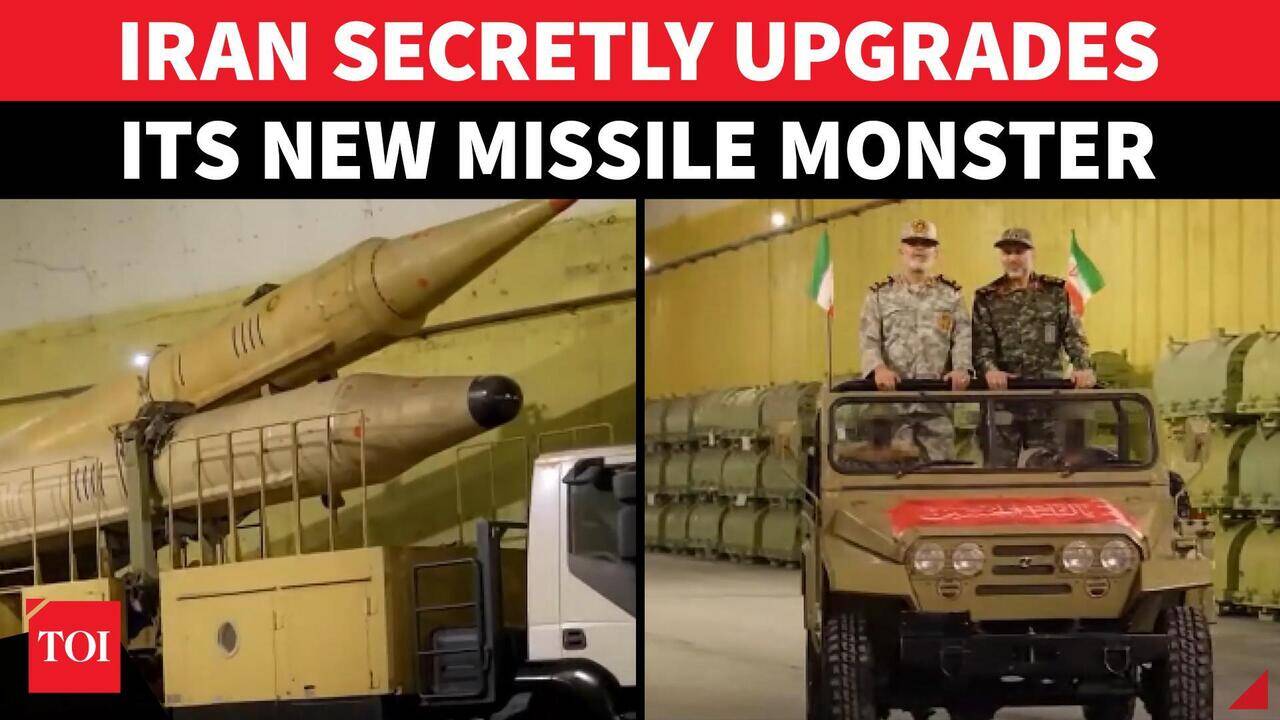
Iran’s Revolutionary Guard Corps unveiled a new underground missile facility and a dual liquid-fuel launcher on Saturday, with IRGC commander Ahmad Vahidi and aerospace chief Seyyed Majid Mousavi touring the site and declaring the force’s capabilities had expanded since the June 2025 war with Israel and the United States.
State television broadcast footage of the commanders riding through a sprawling subterranean complex in an open-top tactical vehicle, surrounded by rows of missiles and launchers. The facility was described as “one of the tens or maybe hundreds of IRGC missile cities”, a network designed to protect missile production, storage and launch capabilities from aerial strikes.
The IRGC aerospace force had announced the new site on November 10, according to the semi-official Tasnim News Agency. Al Jazeera reported that Vahidi’s tour followed that announcement, while The National noted the footage aired Saturday and showed Vahidi and Mousavi together underground.
Iran reveals new liquid-fuel launcher
The centerpiece of the display was a launcher capable of firing two liquid-fuelled missiles simultaneously — a first for Iran’s public arsenal. Previous dual launchers, including one demonstrated on April 7, fired solid-fuel missiles. Liquid-fuel systems offer greater flexibility to adjust speed and trajectory mid-flight.
حضور فرماندهکل سپاه در شهر موشکی سپاه برای اولینبار pic.twitter.com/80VDYFlGNZ
The underground basing makes detection and pre-launch targeting harder for US and Israeli forces. The New York Post highlighted that the launcher’s underground location could complicate any future strike campaign by protecting weapons that survived earlier attacks.
Defence analyst Eva Renon, speaking to The Telegraph, downplayed the leap in raw capability. “It is not an increase in capability,” she said. Liquid-fuelled missiles take hours to prepare and performed poorly in Iran’s April 2024 attacks on Israel — about half failed and almost all the rest were intercepted. “What it answers is a war fought over launchers, not missiles,” Renon added.

“Launchers limited each Iranian salvo, so a vehicle carrying two doubles what each surviving truck fires.” She argued the display was aimed less at Washington or Jerusalem and more at Gulf states, particularly the UAE, to discourage them from continuing the conflict as American protection diminishes. The Telegraph carried her assessment.
Foreign firms supplied tunnel machines for Iran projects
The unveiling has revived scrutiny over how Iran built its extensive underground network. German firm Herrenknecht confirmed to The National it supplied tunnel-boring machines for subway and water projects in Iran from the late 1990s until it withdrew from the market in 2018. It stated it “always fully complied with applicable national and European regulations” and informed the Federal Office of Economics and Export Control about every project.
Aker Wirth and Italy’s Seli were identified among foreign tunnelling companies that supplied equipment or technology for Iranian projects. The UN Security Council has described Khatam Al Anbiya, the IRGC’s engineering arm, as a prime contractor for Iran’s missile and nuclear programmes. The National detailed the corporate links and the regulatory trail.
Open-source analysts caution against drawing a direct line from civilian tunnelling contracts to specific missile sites. Antonios Vlachos, founder of Athena Glaux Intelligence, told The National his team logged 71 reports on Iran’s missile cities from 25 outlets in 15 countries since early November. Only 19 mentioned tunnel-boring machines and nine named Khatam Al Anbiya. “Equipment transfers and military end-use require separate evidence. A civilian tunnelling contract does not establish diversion,” he said.
The National quoted his caution. Satellite imagery analyzed by CNN in May showed Iran had reopened 50 of 69 tunnel entrances struck at 18 underground missile sites during Israeli and US strikes. “On significance, the fact that Iran reopened most entrances within weeks of the strikes tells you these sites were built to survive, not just to hide,” Vlachos added.
IRGC commanders assert control over battlefield escalation
IRGC commanders framed the unveiling as proof Tehran controls the escalation ladder. Mousavi said the aerospace force’s capabilities had “expanded significantly” in the interval between the two wars, with “new surprises and effective systems” added to its combat organization.
“The field is in Iran’s hands and we determine the battlefield,” he declared, according to Tehran Times. Vahidi echoed the theme: “What is happening to the enemy is only the beginning. We will see the enemy humiliated and disgraced more than ever.” Tehran Times reported the rhetoric from Saturday’s visit.
The same day, the IRGC claimed its air defences shot down a US MQ-9 Reaper drone over the Strait of Hormuz — the 58th such downing Iran says it has achieved. The US disputed the claim.
Meanwhile, the UK Maritime Trade Operations centre reported two tankers struck by projectiles while exiting the Gulf through the strait early Saturday, with no casualties. Iran’s navy said a third tanker hit a mine and caught fire. This could not be independently verified.
US naval blockade halts Iranian oil exports completely
The military display unfolds against a tightening US naval blockade that has halted Iranian oil exports. By September, tanker loadings at Kharg Island had fallen to zero for the first full month since the 1979 revolution. Production dropped to roughly 1.8 million barrels a day — half the pre-war level.
US Treasury Secretary Scott Bessent said Iran’s economy would contract by more than 25%, according to Iran International. Iranian officials, including Foreign Minister Abbas Araghchi, have vowed to break the blockade. Some hardliners urge tanker convoys to China under IRGC escort.

President Donald Trump, asked about renewed strikes, said on Friday: “They want to make a deal, but they don’t want to make a deal that’s acceptable to me.” “We want to make a real deal, not a fake deal.” He added: “Iran will never have a nuclear weapon, ever,” and signaled he would decide on military action after the beginning of 2027.
Hindustan Times and Times of India both covered the missile launcher unveiling. The IRGC, for its part, declared it would not accept an indefinite state of “neither war nor peace” and warned the confrontation would either be resolved on the battlefield or Washington would have to accept Tehran’s conditions.
US and Israel track Iranian air activity
The Iranian Army said its indigenous air defence systems in the south, operating under the country’s integrated network, detected and tracked a US F-16 fighter over the Persian Gulf on Friday evening, according to the Army Public Relations office as reported by Tehran Times. The US disputed the drone claim.
Iran’s navy said a third tanker hit a mine and caught fire. This could not be independently verified. The attacks keep the world’s main oil chokepoint at the centre of the war between Iran and the US, DNE Africa noted.
Araghchi vows to break blockade and pursue negotiations
Foreign Minister Abbas Araghchi told the ILNA news agency on Friday that Iran would make every effort to export oil and pursue negotiations, saying the blockade must be broken. Iran International reported this. Al-Monitor reported more than 14 Iranian tankers gathered near Kharg Island with tracking transponders switched off. US Treasury Secretary Scott Bessent said Iran’s economy would contract by more than 25%.
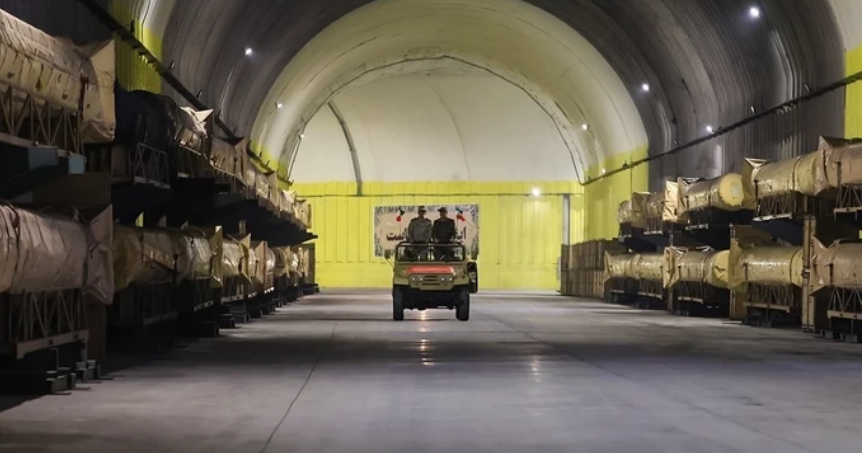
Ahmad Vahidi, as IRGC commander-in-chief since 1 March 2026, led the unveiling of this missile facility, showcasing the force’s expanded capabilities since the June 2025 war with Israel and the United States. His role as the public face stems from his long-standing command history within the IRGC, including leading the Quds Force from 1988 to 1998, where he specialized in unconventional warfare and military intelligence operations.
Iran signals capabilities to US and Israel
Rami Khouri, a public policy fellow at the American University of Beirut, told Al Jazeera that Iran has been planning underground storage for spare parts, raw materials and chemicals for decades, not just finished missiles.
“Iran has taken a gradual approach to showing its technical and military capabilities as well as its political will to strike back,” he said. “[This is] all designed to show the US and Israel … that Iran has very sophisticated capabilities that can both evade the Western defence forces and defence systems … and at the same time reach targets that it wants to hit.” Rob Geist Pinfold, a lecturer in international security at King’s College London, added that Iran feels backed into a corner by the blockade and needs to escalate to restore deterrence. Al Jazeera cited both analysts.
Related reading

Russian Corvette Hit in Suspected Ukrainian Drone Strike at Benghazi, Officials Say
A Russian navy corvette erupted in flames at Benghazi naval base on Sunday after what Libyan officials and...

Iran Dismisses Trump Yalta Comparison as Delusion, Yemen Strikes Saudi Targets
Iran's top security official dismissed President Trump's historical comparison as delusion on Sunday, declaring the United States a...

UN Talks Agree Two-Year Process to Negotiate Autonomous Weapons Rules
United Nations talks in Geneva ended Saturday with 128 countries agreeing to spend two more years discussing rules...

Taiwanese Comedian Huang Yi-hao Draws Sellout Crowds in Taipei
Taiwanese comedian Huang Yi-hao is playing to full houses at Taipei's Two Three Comedy Club weeks after prosecutors...