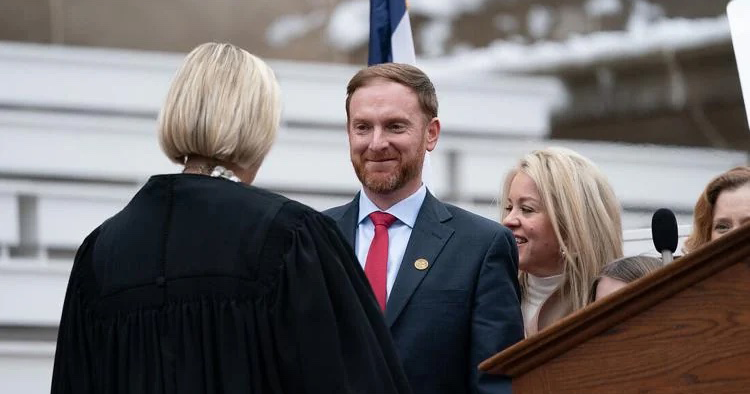
West Virginia AG’s Probe of Climate Groups Paused by Federal Court
Just a week before a temporary restraining order was set to expire, a federal judge has hit pause on West Virginia Attorney General John McCuskey’s sweeping investigation of environmental nonprofits. On October 29, U.S. District Court Judge Joseph Goodwin issued the order, blocking McCuskey from compelling groups like the West Virginia Rivers Coalition and 350.org to turn over a decade’s worth of internal documents related to climate change advocacy. The Chesapeake Bay Journal reported that the move, which freezes the probe until at least November 12, came after the groups argued the subpoenas were a blatant attempt to silence their First Amendment-protected speech.
AG McCuskey is suing OpenAI, the maker of ChatGPT, for misleading West Virginians about the safety of its product. He announced the suit today with AGs from @AGIowa, @KSAGOffice and @NEAttorneyGen. Arizona, Idaho, and Montana have also sued. pic.twitter.com/lZBhzz3Icw
The Legal Battle Over Subpoenas and “Fishing Expeditions”
The heart of the legal fight centers on subpoenas issued by McCuskey’s office in September. These demands were broad, seeking any and all documentation from the last decade—including communications, strategies, and donor information—that supported claims linking extreme weather events to greenhouse gas emissions from West Virginia’s fossil fuel industry. The attorney general framed the inquiry as a consumer protection matter, alleging the groups might be violating the West Virginia Consumer Credit and Protection Act by making misleading claims that harm the state’s energy producers and, by extension, its residents.
Energy production is, in McCuskey’s view, the bedrock of the state’s economy and a direct factor in the daily affordability of life for every West Virginian. This isn’t just political rhetoric; the numbers back it up. According to the U.S. Energy Information Administration, West Virginia ranked fourth in the nation for total energy production in 2023. McCuskey argues that the nonprofits’ advocacy, which encourages consumers to boycott fossil fuels and attempts to prevent producers from selling them, constitutes deceptive commercial speech that directly impacts the state’s economic vitality.
The environmental groups, however, saw the subpoenas as something else entirely: a “fishing expedition.” Jennie Smith, executive director of the West Virginia Rivers Coalition, called it an attempt to stifle their collective voice in advocating for clean water and healthy communities. The legal battle escalated when the Sierra Club, after being served a similar subpoena, informed the attorney general’s office of its intent to file a federal lawsuit. McCuskey quickly withdrew that subpoena. Loren Blackford, the Sierra Club’s executive director, characterized the investigation as a tactic designed to drain their resources and attention, a “blatant attempt to chill our speech and silence us.”
“Here, McCuskey has abandoned both the fishing pole and the net. Instead, he has brought dynamite to the lake.”
It was in response to these actions that the West Virginia Rivers Coalition and 350.org, represented by Appalachian Mountain Advocates, filed for a restraining order and a permanent injunction on October 22. They argued the subpoenas violated their civil rights. In a colorful and pointed ruling, Judge Goodwin agreed with the groups’ core claim that the investigation was overly broad. He noted that while the consumer protection act is a powerful tool, it doesn’t apply here because McCuskey failed to identify any specific consumers who were actually deceived. The judge added that allowing such a broad inquiry could set a dangerous precedent, potentially enabling the attorney general to subpoena any protest leader whose activism impacts a company’s sales simply by casting doubt on their cause. He concluded, “Here, McCuskey has abandoned both the fishing pole and the net. Instead, he has brought dynamite to the lake.”
A Constitutional Clash Over Speech and Regulation
Underpinning this entire dispute is a fundamental clash between consumer protection and free speech. Jeffrey Mehalic, a consumer protection lawyer, explained that state attorneys general have broad powers to protect the public from deception. However, he also emphasized that First Amendment protections are exceptionally strong. “Even though he’s the attorney general, I think he has a heavy burden in proving [any deception],” Mehalic said, “because the presumption is that the groups have extensive free speech rights and that those should not be infringed on [except under] a very narrowly tailored exception to the First Amendment.”
In his court filings, McCuskey pushed back, arguing that “the First Amendment is not a license to lie or knowingly deceive or mislead, especially not when that deceptive commercial speech directly implicates trade or commerce within the ambit of [the consumer protection act].” He specifically cited the groups’ reliance on the RCP 8.5 fossil fuel emission model as a point of deception. This model, one of four used in the 2014 Intergovernmental Panel on Climate Change’s Fifth Assessment Report, was designed as a worst-case scenario projection. Scientists later retired the model, a fact McCuskey’s office points to as evidence of misleading claims. However, Judge Goodwin’s ruling made it clear that the subpoenas went far beyond just claims tied to that single model.
The legal arguments are now set for a more formal hearing, though Judge Goodwin has not yet scheduled one for the preliminary injunction, which would permanently halt the investigation. For now, the environmental groups can breathe a sigh of relief. They have argued that the mere threat of the subpoenas caused “irreparable harm,” forcing them into self-censorship and pausing smaller projects. The temporary pause in the legal storm gives them a window to regroup, but the fundamental question remains: where is the line drawn between holding powerful groups accountable for potentially misleading speech and protecting the core constitutional right to advocate for change?
Related reading

Denver Rescue Mission to Lay Off 71 Employees as 48th Avenue Shelter Contract Ends
Denver Rescue Mission to Depart 48th Avenue Shelter, Citing Strategic Shift The landscape of homeless services in Denver...

Alaska bipartisan coalitions name House and Senate leadership
Alaska’s Bipartisan Legislators Lock in Leadership as Vote Counts Continue As election tallies continue to stream in across...

Tech stocks fall as US midterm results Trigger AI regulation anxiety
Global equity markets are reeling as a synchronized sell-off in technology stocks cascades from Wall Street to London...

Comprehensive List of Global States, Provinces, and Countries
Central Wyoming College Opens Jackson Campus Central Wyoming College has officially expanded its footprint into Teton County, opening...