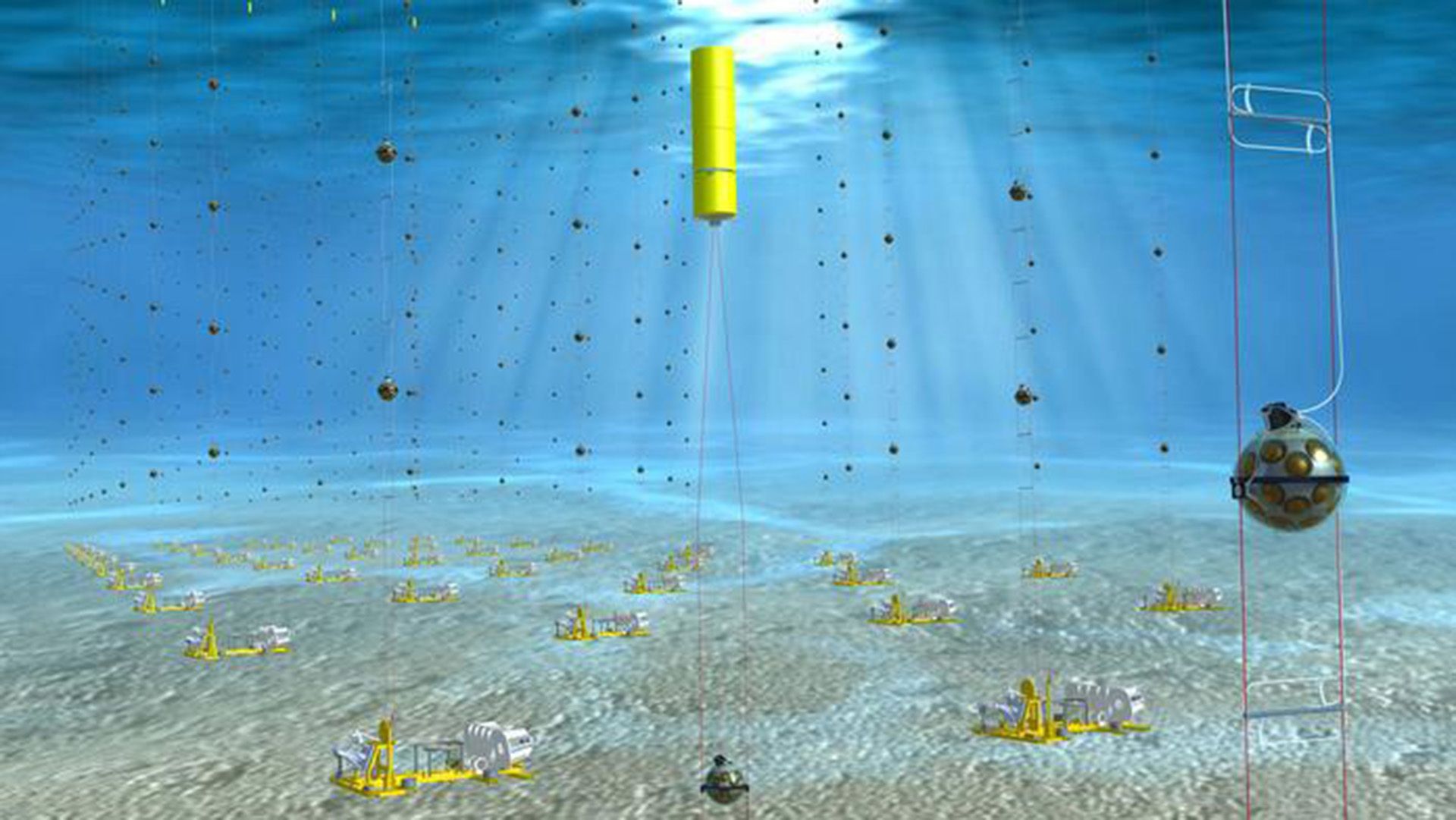
Only the neutrinos can get through,
says Lukas Hennig, a doctoral student at Erlangen-Nürnberg. This capability to bypass matter has allowed the KM3NeT collaboration to use a telescope buried 1.5 miles under the Mediterranean Sea to test a foundational rule of Einstein’s relativity, finding no evidence that the principle is broken.
Testing Lorentz Invariance With Atmospheric Neutrinos
The study, published November 4 in the Journal of Cosmology and Astroparticle Physics, focused on Lorentz invariance—the assumption that the laws of physics remain consistent regardless of orientation or speed. While general relativity and the Standard Model of particle physics both rely on this principle, certain theories of quantum gravity suggest that spacetime might consist of discrete units at the smallest scales, potentially causing subtle violations of this rule.
Researchers at the KM3NeT/ORCA telescope in France identified 5,828 candidate atmospheric neutrino events collected between 2020 and 2021. Because neutrinos rarely interact with matter, they serve as ideal probes for these violations. By analyzing particles that traveled upward through the Earth, the team used the planet itself as a filter to exclude atmospheric background interference.
Competitive Limits From a Partial Detector
Although the results showed no deviations from standard physics, the data allowed the team to establish new, competitive limits on the strength of potential Lorentz invariance violations. These findings are particularly notable because they were derived from only the first six detection units of the ORCA array.
The collaboration also set the first direct limits on specific effects involving the oscillation between muon and tau neutrinos. These results demonstrate KM3NeT/ORCA’s potential to test fundamental principles of physics, even with a relatively small detector,
said Lukas Hennig. The team noted that if a theoretical model predicts a violation stronger than these new limits, the data effectively rule that model out.
Expanding Research Toward ARCA
The KM3NeT collaboration intends to continue this research as the detector grows. With 44 units currently in the water and a goal of 108 units by 2030, the team expects to increase the sensitivity of their search. Alba Domi, a researcher at the Erlangen Centre for Astroparticle Physics (ECAP), noted that while Lorentz-violating effects should become more pronounced over longer distances and higher energies, the current data set lacks enough high-energy astrophysical events to perform a definitive analysis.
Future investigations will shift toward the ARCA detector, situated off the coast of Sicily, which is specifically designed to capture higher-energy neutrinos from distant space. ARCA could be especially well suited to this kind of research, but we do not yet have enough astrophysical neutrino events to carry out such an analysis,
Domi explained. Researchers remain focused on the potential for these cosmic travelers to reveal whether spacetime is truly continuous or composed of discrete units.
Keep reading

McGill University Researchers Build Biocomputer Using Bacteria
Researchers at McGill University have built a biocomputer that runs on living bacteria, using their ability to multiply...

HOXA10 Gene Preserves Lifelong Supply of Bone Stem Cells, Study Finds
A study published online November 4 in Science Advances identifies the gene HOXA10 as the brake that keeps...
NASA Swift Observatory Faces Uncontrolled Reentry After Failed Rescue
The Neil Gehrels Swift Observatory is on a collision course with Earth after two decades in orbit, following...
NASA Simulated Mars Mission Crew Emerges After 378 Days
Four volunteers exited a sealed 1,700-square-foot habitat at NASA's Johnson Space Center on October 31, 2026, successfully concluding...