Latvia’s parliament approved Prime Minister Andris Kulbergs‘ new coalition government by a 57-to-34 vote on Tuesday evening, capping a seven-hour debate that stretched past the November 18 Independence Day deadline the premier had set for himself.
The razor-thin margin — just one seat above the 51-seat majority held by Kulbergs' United List and the nationalist National Alliance — shows how fragile a government already facing a EUR 2.9 billion fiscal consolidation plan over the next four years is, Morningstar DBRS reported. Nearly 80 percent of the planned EUR 2 billion in spending cuts depends on restructuring public administration and reforming key sectors, measures the rating agency noted remain largely unspecified.
“They say you can’t step into the same river twice. Well, I’m stepping in a second time.”
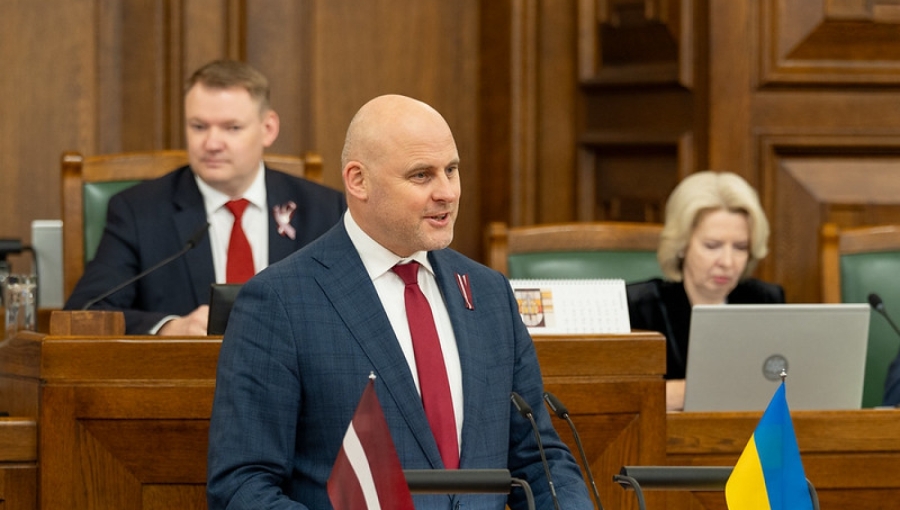
Kulbergs told the Saeima
Kulbergs, a businessman and former automotive association leader who first took office in May after the previous coalition collapsed over undetected Ukrainian drone incursions, acknowledged the historic low voter turnout in October’s election as a warning. His United List captured 35.3 percent of the vote — the strongest single-party result since Latvia regained independence in 1991 — yet half of eligible voters stayed home.
A cabinet of technocrats and loyalists
The 13-member cabinet blends party loyalists with non-partisan specialists. Citadele Bank chief economist Kārlis Purgailis takes the finance portfolio, while Amber Beverage Group board member Normunds Staņēvičs leads the health ministry. Career diplomat Ģirts Jaunzems, formerly ambassador to Uzbekistan, becomes foreign minister. Raivis Melnis stays on as defence minister.

National Alliance holds three portfolios: Jānis Dombrava at interior, Nauris Puntulis at culture, and Ilze Indriksone at welfare. Indriksone is the cabinet’s sole woman, a fact IntelliNews highlighted in a country where women outnumber men by roughly 130,000. The male-dominated lineup drew criticism during Tuesday’s debate, as did the number of “non-partisan” ministers who happen to be Kulbergs’ former classmates or private-sector colleagues.
“Kulbergs’ desire to involve familiar and loyal people in his team is understandable, provided they are professionally qualified and suitable for their positions.”
political scientist Lelde Metla-Rozentāle told LETA
Metla-Rozentāle, a lecturer at Riga Stradiņš University, said that non-partisan ministers may be more willing to make bold, unpopular decisions without political career ambitions. But she warned the rushed final stage of government formation — Kulbergs revealed his cabinet at 10:00 a.m. Tuesday before the Saeima session was even confirmed — undermined his earlier emphasis on process quality over speed.
Defence spending and the fiscal cliff
Kulbergs pledged to maintain defence spending at 5 percent of GDP, a commitment that sits awkwardly alongside the ambitious consolidation targets. Morningstar DBRS flagged medium-term risks including AirBaltic’s restructuring and Rail Baltica financing needs as potential budget pressure points.
The government’s zero-based budgeting approach aims to spur private-sector growth and reduce the public-sector headcount, but the rating agency’s analysis suggests the unspecified nature of most cuts makes the EUR 2.9 billion target highly uncertain.
Latvia’s economy has underperformed its Baltic neighbours for more than a decade. Kulbergs campaigned on cutting red tape and attracting investment. “We’ve neglected economic issues, and that’s where we need to place our emphasis,” he told reporters in Riga after the vote.
Opposition dynamics and the Latvia First wildcard
The opposition Latvia First party, led by businessman Ainārs Šlesers, supplied the extra votes that pushed the confidence tally to 57. But the party's 17 deputies split their ballots — some voting for, some against, some abstaining — showing that their support will be transactional rather than guaranteed. One United List deputy, Pēteris Dimants, declined to vote for his own leader’s government.
Pro-Russian parties increased their parliamentary representation in October but remain sidelined. The ECR Group in the European Parliament welcomed the outcome, with co-chairmen Nicola Procaccini and Patryk Jaki praising the coalition’s commitment to security, economic responsibility, and Latvia’s “firm place in the West.”
Kulbergs, born in Riga in 1979, built a career in the automotive sector before entering politics, serving as president of the Latvian Authorised Automobile Dealers Association since 2006 and holding senior roles at Lattelecom, Auto Torino, Auto Group Baltic, Baltic Motors, and Inchcape Latvia. He entered the 14th Saeima in 2022 as a non-party United List member, chairing the Innovation Ecosystem Development Subcommittee and sitting on the economy and audit committees.
As an MP he warned that the Rail Baltica project risked becoming the “problem of the century” and opposed the government’s emergency AirBaltic loan during the 2026 Strait of Hormuz crisis, advocating full restructuring instead. He ran on the United List ticket for the European Parliament in 2024 but was not elected.
The Saeima vote concluded at 22:27 local time. A ceremonial government meeting with President Edgars Rinkēvičs followed before midnight.

Microneedle Patch Tracks Troponin in Mice, Aims to Detect Silent Heart Injury After Surgery
About 300 million people undergo non-cardiac surgery every year, and most go home the same day — yet...

Teen Charged After Stealing Garda Car, Ramming Two Patrol Vehicles in Wrong-Way N25 Pursuit
A 19-year-old man has been charged with seven offences after allegedly stealing an electric Garda patrol car from...

University of Utah Researchers Identify BLST Protein Protecting Spinal Discs From Aging
University of Utah researchers have identified a previously uncharacterized protein that protects spinal discs from age-related damage, offering...

PM Announces ASEAN, Philippines Trade Deals; Poll Shows Low Canadian Familiarity
Prime Minister Mark Carney announced the conclusion of negotiations for two free trade deals with Southeast Asia on...