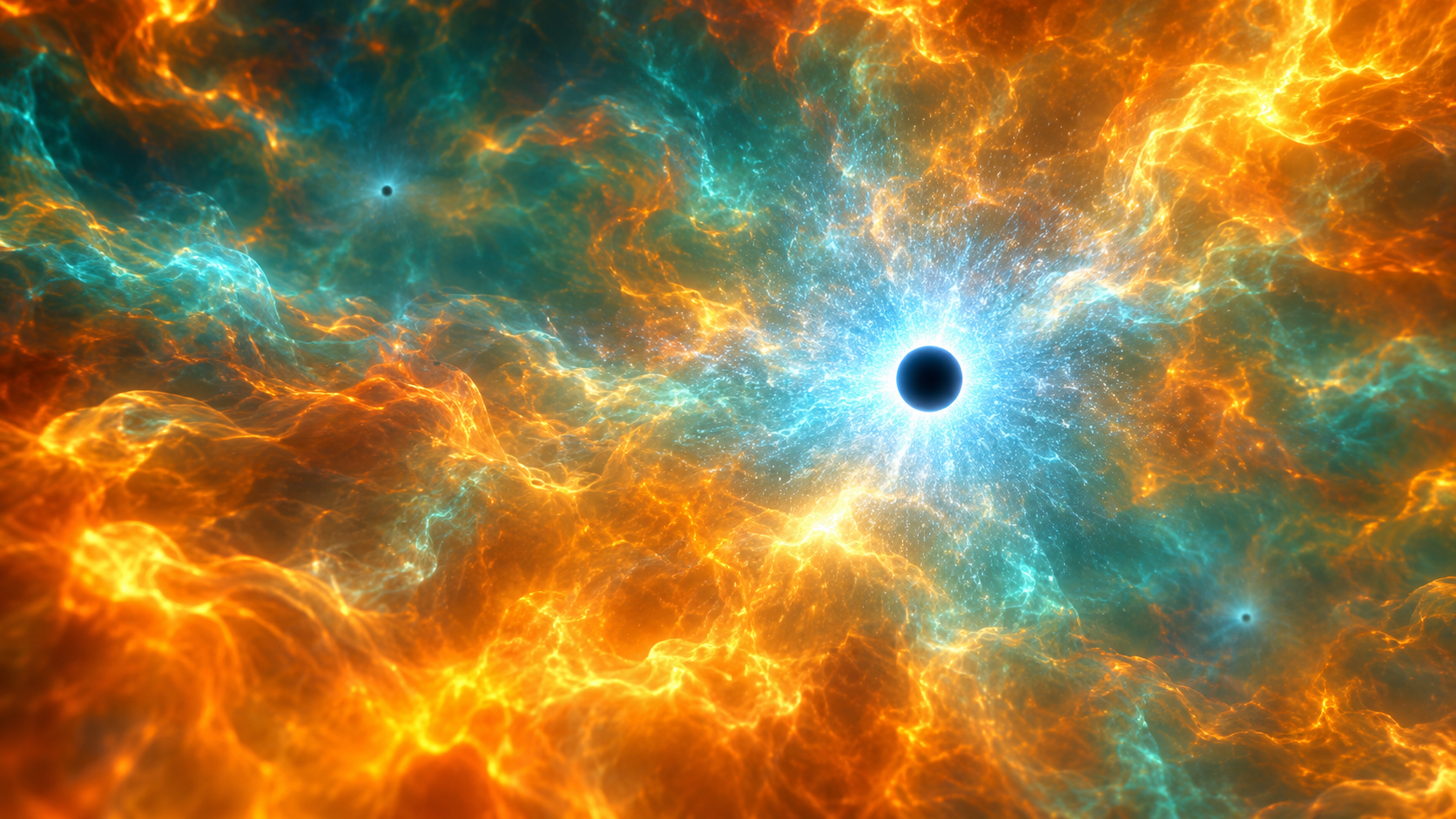
New modeling from Johannes Gutenberg University Mainz suggests microscopic primordial black holes could have reheated the early universe, challenging previous assumptions about cosmic evolution.
Black Holes Reheat the Early Universe
The research, published in Physical Review Letters, proposes ultra-light black holes formed after cosmic inflation dominated the early universe. As these objects evaporated at different times due to their varied masses, their gradual explosions reheated the cosmos a second time. This generated the hot plasma from which all matter formed.
“The smallest primordial black holes may have been smaller than an atom,” said Leister.
The Poltergeist Signal Problem
Earlier theories struggled to explain how primordial black holes could have driven reheating without producing an intense gravitational wave signal. This signal, known as the “Poltergeist,” would be far stronger than what has been detected in the cosmic gravitational wave background.
The Mainz team identified a critical flaw in the assumption that primordial black holes were uniform in size. Such homogeneity is incompatible with Einstein’s theory of general relativity, which predicts a spectrum of black hole masses.
Gradual Evaporation Suppresses Waves
By modeling black holes with different masses—respecting Stephen Hawking’s upper limit of 10^9 grams (1,000 metric tons)—the researchers found that staggered evaporation prevents a single powerful burst. Lighter black holes explode first, spreading energy release over time and keeping gravitational waves faint enough to avoid disrupting cosmic chemistry.
Cosmic Timeline Gap Filled
The study addresses a major observational blind spot in cosmology: the period between the initial reheating after cosmic inflation and the formation of the first atomic nuclei. The model demonstrates that an early universe dominated by primordial black holes remains physically viable. This offers a new pathway to understanding cosmic evolution.
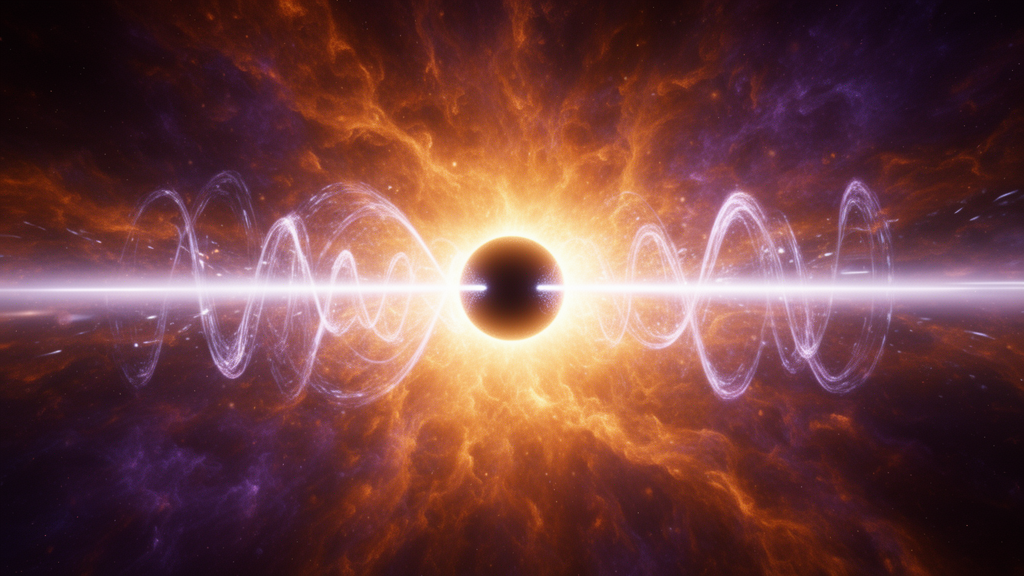
Schwaller explained that while inflation describes a proposed period of extraordinarily rapid expansion near the universe’s beginning, there is a substantial gap in observational knowledge between this reheating and the earliest processes that can be traced today, such as the formation of the first atomic nuclei.
“But between this reheating and the earliest processes we can trace today, such as the formation of the first atomic nuclei, we know surprisingly little about what happened,” Schwaller, theoretical physicist at JGU and PRISMA⁺⁺ Cluster of Excellence, said.
The research, titled “Opening the Window of Ultra-Light PBHs by Exorcising the Poltergeist,” was conducted by researchers at Johannes Gutenberg University Mainz and the Institut d’Astrophysique de Paris. Their modeling showed that these ultra-light singularities, with the smallest measuring smaller than a single atom, would have contained virtually all the energy of the early universe.
This energy shift caused these singularities to dominate the early universe. They created an intermediate phase where the cosmos existed as expanding spacetime populated almost entirely by black holes.
After this inflation, the universe was supercooled. It had to be reheated to fill it with hot matter and radiation.

In the framework analyzed by the Mainz team, the relevant objects were ultra-light primordial black holes.
Study Published in Physical Review Letters
The team has published their findings in the latest edition of Physical Review Letters.
However, the period immediately following this expansion remains poorly understood.
Future Gravitational Wave Experiments Unlikely to Probe Theory
The research, which also appeared in Physical Review D, develops the connection between near-threshold collapse and an extended distribution of primordial black hole masses.
Instead, the theory anticipates a spectrum of masses among primordial black holes. This would have led to their gradual evaporation over time.
A Spectrum of Masses
Near the threshold for collapse, the resulting mass depends on how strongly a region exceeds that threshold. Slightly different starting conditions therefore produce different black hole masses.
Related reading
Purdue Researchers Build Aerogel From Moon Dust, Cardboard
Purdue University researchers have developed a lightweight aerogel from simulated moon dust and recycled cardboard fibers that could...
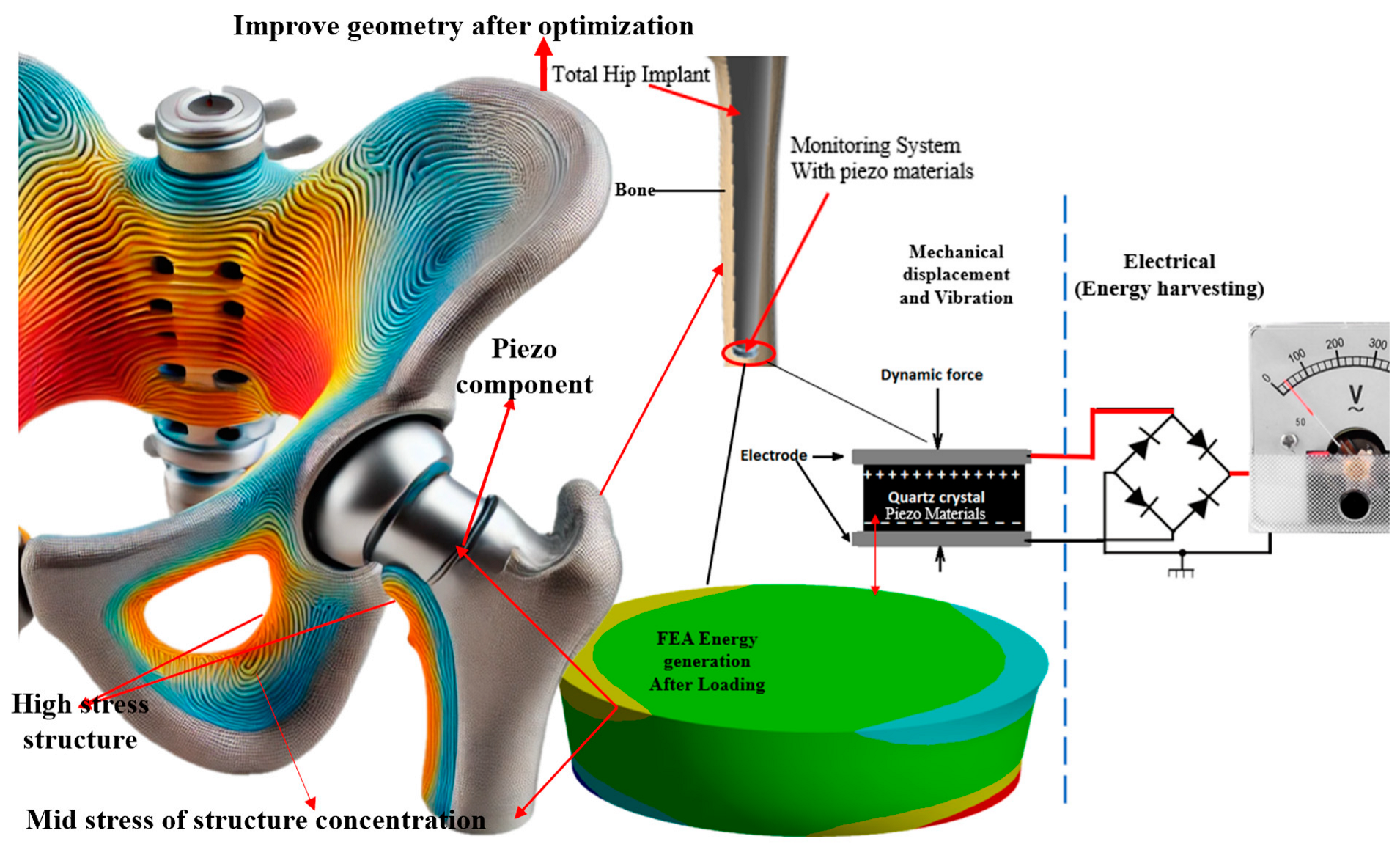
Study Finds Piezoelectric Implant Position Affects Performance Significantly
A study has found that the position of a piezoelectric bone conduction implant significantly affects its performance, altering...
Scientists Discover Sunken Atoll Thriving With Life
Scientists have found a 5-million-year-old sunken coral atoll, its peak nearly 3,000 feet beneath the Atlantic, thriving with...
New Study Proposes Quantum-Resistant Hybrid Framework for Secure IoT Healthcare Systems
A new hybrid framework merges blockchain, software-defined networking, and post-quantum cryptography to secure medical device networks against current...