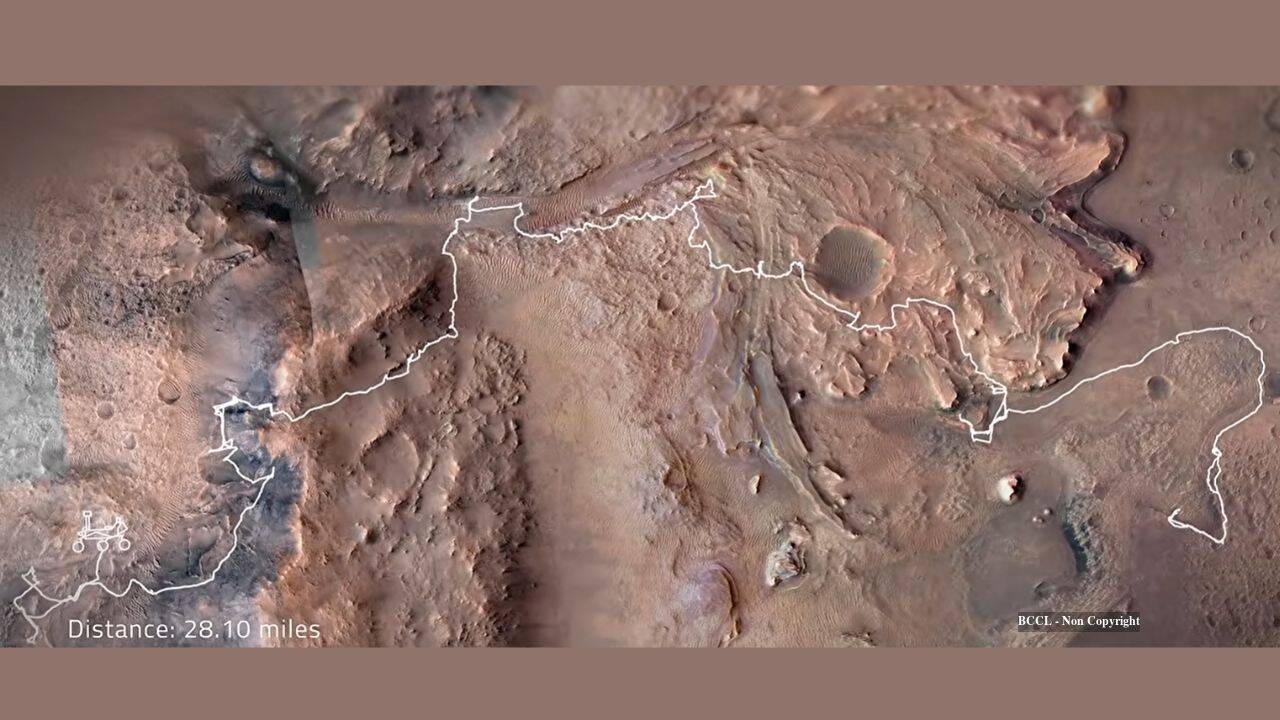
NASA’s Perseverance rover has shattered the off-world driving record, traveling 28.1 miles across Mars in just five and a half years. The milestone eclipses Opportunity’s benchmark, driven largely by an autonomous navigation system that allows the robot to steer past obstacles on its own.
Perseverance Reaches Odometer Milestone in Jezero Crater
On October 11, 2026, the six-wheeled Perseverance rover’s odometer reached 28.10 miles, or 45.22 kilometers, during its exploration of Mars. That reading edged past the 28.06-mile record set by the Opportunity rover in 2014.
Opportunity spent 14 years traveling across the Martian surface before falling silent during a planet-wide dust storm in 2018. Perseverance covered a slightly greater distance in less than half that time, crossing the threshold on its 2,006th Martian day, or sol, while operating in and around Jezero Crater.
Alongside mission leadership, this milestone was acknowledged by Mark Maimone. He is the Perseverance Robotic Operations Deputy Team Chief at NASA’s Jet Propulsion Laboratory. He created and built the autonomous navigation software utilized by Mars rovers Spirit, Opportunity, Curiosity, and Perseverance.
AutoNav and Onboard AI Drive the Record Pace
The speed of the record-breaking journey comes down to software. Unlike earlier missions that required manual route planning from Earth for nearly every movement, Perseverance steered itself for more than 90 percent of its total distance.

The rover uses a system called AutoNav, which employs artificial intelligence and image recognition to identify bedrock, outcrops, boulder fields, and sand ripples. Where earlier missions depended heavily on human operators reviewing images and sending turn-by-turn commands, AutoNav allows the vehicle to map hazards and plan safe routes while in motion. In a single Martian day, the rover can cover as much as 1,351 feet.
According to Steven Lee, the mission’s project manager, the rover has long since surpassed its original mission requirement of no more than 12.4 miles. NASA recently approved Perseverance’s first mission extension, which carries exploration of the crater rim through roughly the end of 2028.
The original mission called for no more than 12.4 miles of driving. We’ve blown well past that, and with all mobility systems fully operational and favorable extended-ground-life test results, we expect Perseverance to keep adding to this record for many years to come.
Steven Lee, Perseverance and Curiosity project manager, JPL/NASA
Planetary Odometers Compared Across Decades
The new mark places Perseverance ahead of every other vehicle ever operated on another world, including historic lunar vehicles.
Among active machines, NASA’s Curiosity rover remains the closest contender, having traveled 23.7 miles inside Gale Crater since its 2012 landing.
Ancient Rock Formations and Extended Mission Goals
Vivian Sun, the acting deputy project scientist, explained that Perseverance offers a view into very early solar system history, particularly the first half a billion years. Along the way, the rover found a potential biosignature in a rock called Cheyava Falls.
The team plans to examine various outcrops and complex terrains to search for traces of ancient hydrothermal systems and potential biosignatures.
Matthew Wallace is an engineer at the NASA Jet Propulsion Laboratory. He noted how dramatically different the work is today compared with early off-world driving, contrasting the complex manual planning required for the tiny Sojourner rover with what Perseverance can accomplish independently using AutoNav.
Mark Maimone also highlighted operational goals regarding sunlight and camera glare, noting that overcoming navigational glare could eventually extend daily working hours for future rovers operating on Mars.
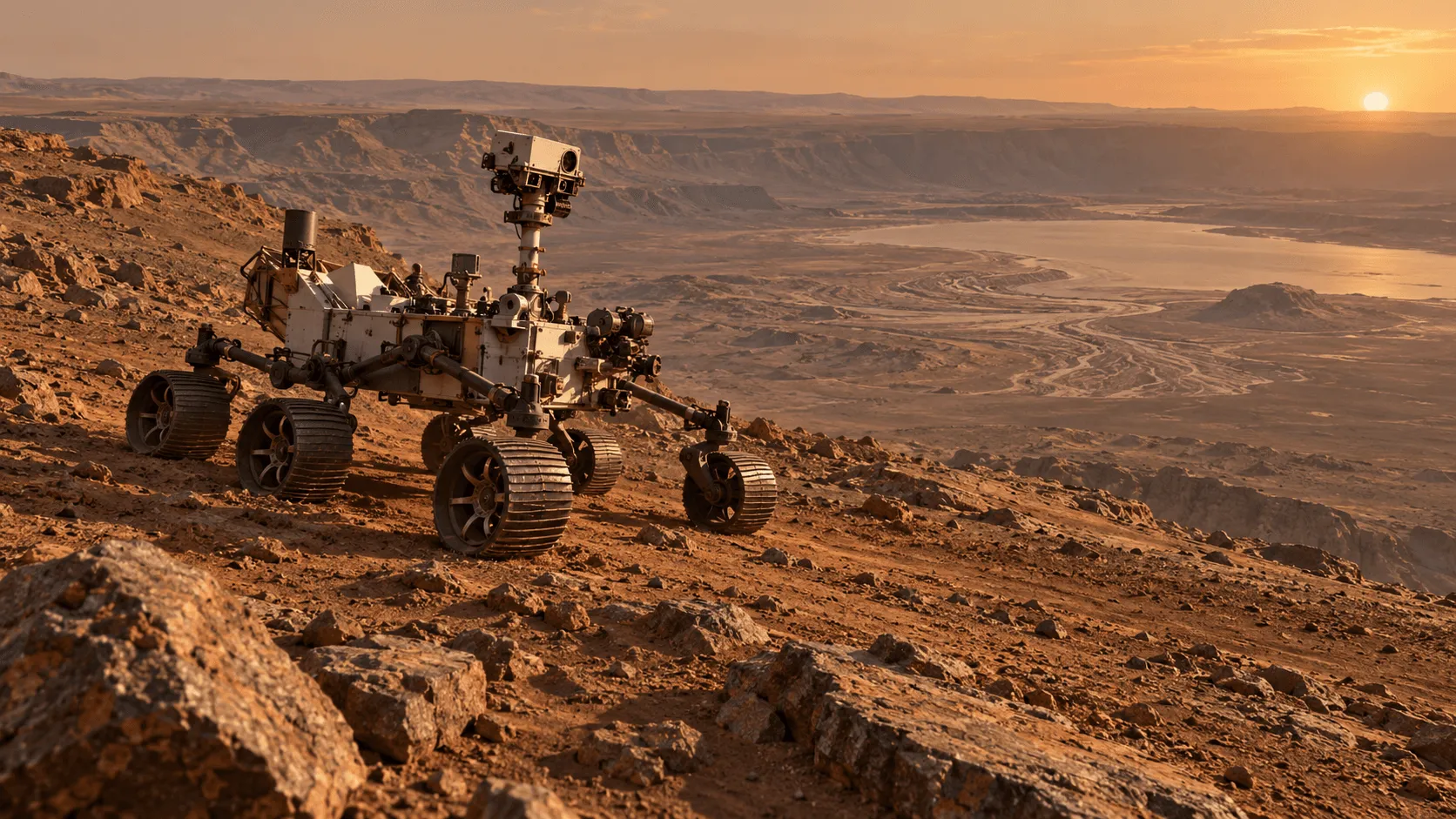
Perseverance has successfully gathered 29 samples of rock and regolith across the ancient river delta, crater floor, and crater rim as of the milestone date.
Today, Perseverance’s Earth-bound twin, OPTIMISM, remains stationed at the JPL campus in Pasadena, California, serving as a testbed for the mission.
The lineage of off-world rovers stretches back to the Soviet Union. That lineage began with Lunokhod-1, which touched down in the Mare Imbrium on the Moon’s near side on November 17, 1970. It continued with NASA’s Sojourner in 1997, which traveled about 330 feet during its 83-sol mission.

Apple CEO John Ternus on Design and Foldable Innovation
Apple’s newly appointed Chief Executive Officer, John Ternus, has landed the cover of TIME magazine's Best Inventions of...
Indian textile workers record tasks to train AI robot replacements
Textile and domestic workers across southern India are wearing GoPros and smart headsets to record daily chores, capturing...

Nvidia CEO Unveils Digital Twin Vision For Manufacturing
As industrial automation shifts from digital screens to the physical world, specialized robotics and edge compute systems are...

Publishers Pivot to AI, Subscriptions, and Team Reorgs
Publishers are aggressively rewriting their strategies to survive the Google Zero post-search era by launching LLM subscriptions, reorganizing...