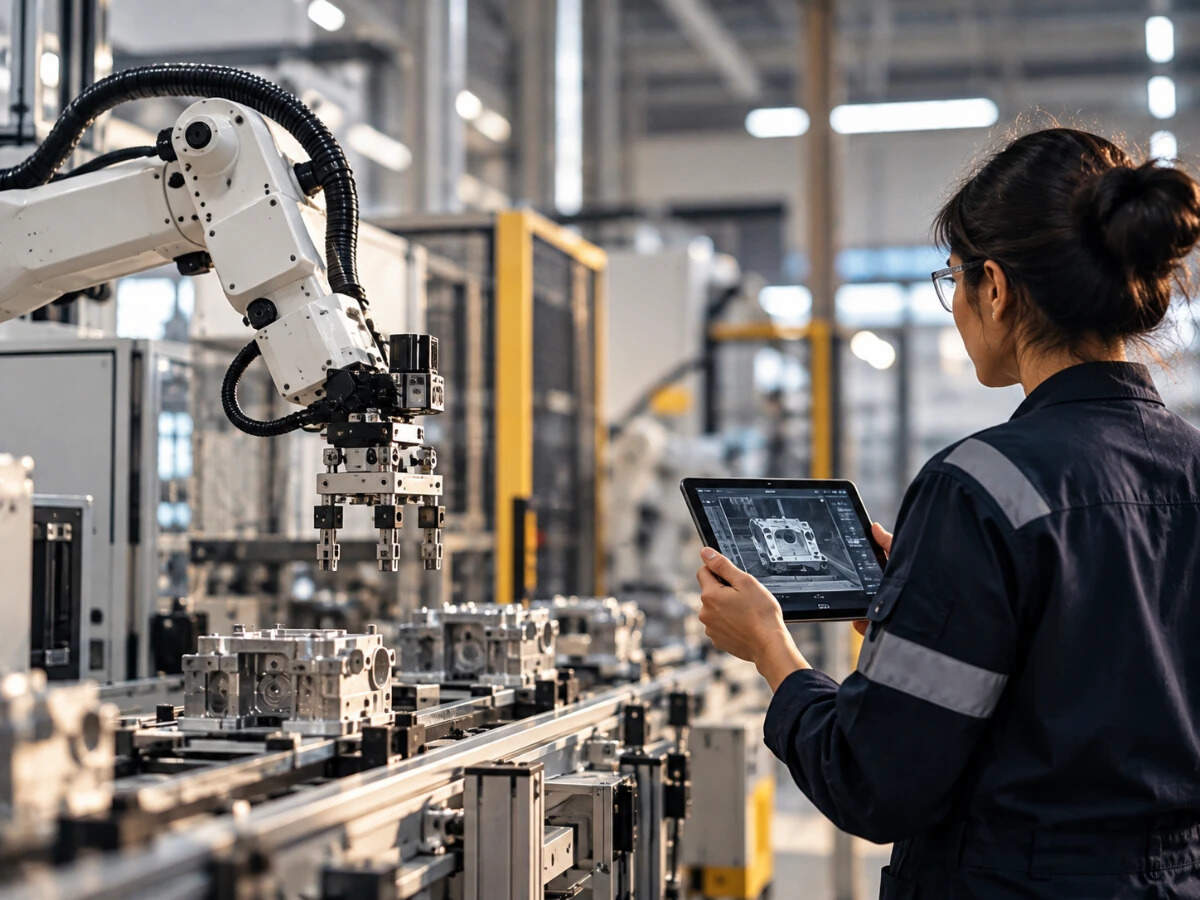
As industrial automation shifts from digital screens to the physical world, specialized robotics and edge compute systems are driving massive market growth, even as high-profile humanoid demonstrations spark debate among executives and analysts over practical deployment timelines and system-level performance.
Artificial intelligence is moving beyond software and cloud servers into factories, warehouses, and farms, creating a fast-growing sector known as physical AI. While humanoid robots frequently capture public attention with athletic feats, industry experts and market reports emphasize that near-term commercial value is concentrated in specialized, task-specific automation. According to a report from Arthur D. Little, the wider market for physical AI is growing rapidly, while humanoids make up only about 10% of the market today, though both segments are scaling as companies adopt adaptive automation.
Jensen Huang’s Digital Twin Vision at the Invest in Germany Summit
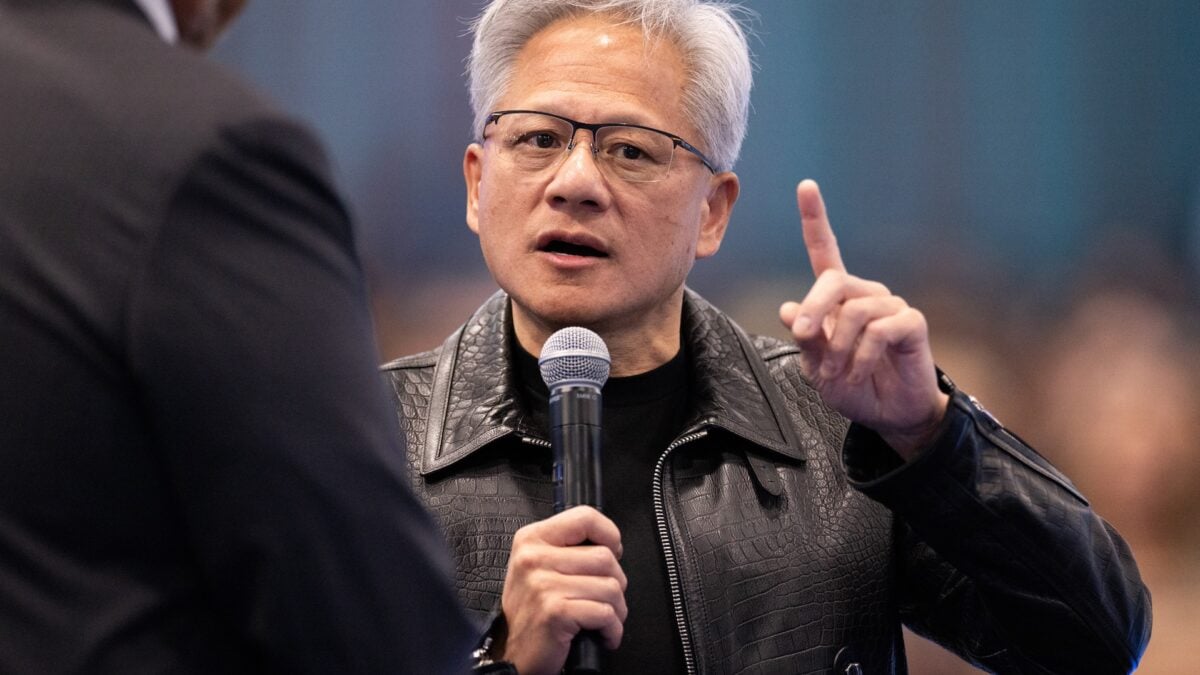
The strategic direction of this technological pivot drew global attention during the Invest in Germany Summit in Berlin, where Nvidia CEO Jensen Huang outlined a sweeping vision for future manufacturing alongside German Chancellor Friedrich Merz. Speaking at the former power station Kraftwerk Berlin, Huang described a software-driven industrial environment where physical factories are mirrored by exact digital counterparts.
Every single company in the future will have two factories: the factory that is real, and the factory that is digital, and the factory that is digital will be so real that it might as well be real. If it manifests itself when you create the digital twin of your company—of your car company—that digital twin might as well be real.
Jensen Huang, CEO, Nvidia
The concept relies on simulation tools such as the Nvidia Agent Toolkit called Omniverse, which allows engineers to test robot workflows in virtual environments before deploying them to physical factory floors. While the remarks drew mixed reactions from observers over their expansive scope, Chancellor Merz expressed support for Nvidia’s expanding footprint in Germany.
Engineering Real-World Autonomy and Edge Compute Realities
Moving artificial intelligence out of the data center and into physical machines introduces severe engineering hurdles. Unlike digital models that can pause to calculate answers, physical systems operate under strict timing constraints where a delayed control decision can cause collisions or system instability. Industry leaders stress that hardware architecture must adapt to these demands.
Jensen Huang: The next wave of AI is physical AI and it’s coming for the world’s largest industries.“Most AI today doesn’t understand the laws of physics, friction, inertia, or cause and effect.”“These are physical reasoning abilities that children and even our pets have.”… pic.twitter.com/czR5NCilKM
IoT was largely about connecting and monitoring things. Physical AI is about giving machines the ability to perceive and act autonomously in unstructured environments. This is a completely orthogonal engineering problem, and it requires a step-change in system-level content — more sensing, more real-time compute, more sophisticated power management, and more safety considerations per device.
Brad Rex, head of physical AI, UX at Renesas Electronics
To manage these workloads, hardware designers are pairing throughput-oriented processors with deterministic real-time compute engines. For instance, AMD adaptive SoCs and x86 platforms combine programmable logic for safety monitoring with AI reasoning accelerators, aiming to deliver predictable responses under rigorous industrial safety standards.
Adoption Metrics Across Global Supply Chains and Industrial Floors
Commercial deployment is accelerating across multiple sectors, moving past initial proof-of-concept trials. Arthur D. Little projects that the physical market could reach up to $100 billion by 2030, with a compound annual growth rate exceeding 20%, while PwC estimates the broader global market will surpass €430 billion by 2030. Meanwhile, Deloitte reports that 58% of companies already utilize physical AI to some degree, a figure projected to rise to 80% within two years.
- Global humanoid robot installations reached approximately 16,000 units in 2025, driven heavily by adoption among industrial manufacturers, as reported by Nasscom.
- Venture capital investment in robotics reached nearly $28 billion in 2025, reflecting strong investor backing for specialized hardware and AI orchestration platforms, as noted by Consultancy.
Aligning with Safety Certification Frameworks
As machines work more closely alongside human employees—performing precision welding, adhesive dispensing, and material transport—system-level safety certification remains paramount. Manufacturers are aligning new architectures with established industrial safety frameworks, including IEC61508, ISO26262, and ISO13849, alongside emerging standards like ISO/CD 25785-1 designed for dynamically stable industrial robots.
The practical decisions involved in deploying these technologies into enterprise operations will be examined further during a scheduled masterclass on November 19, 2026, which will also feature the ET Most Innovative AI Product Awards 2026 to recognize advancements delivering verified business value.

Publishers Pivot to AI, Subscriptions, and Team Reorgs
Publishers are aggressively rewriting their strategies to survive the Google Zero post-search era by launching LLM subscriptions, reorganizing...

Retired Penn professor emeritus arrested for blocking Uber Eats delivery robots
A 78-year-old professor emeritus at the University of Pennsylvania was arrested in Center City Philadelphia after repeatedly blocking...

Google DeepMind’s Gemini 4 agents defeat Minecraft’s Ender Dragon after 605 deaths
Four autonomous artificial intelligence agents powered by Google's Gemini 4 Argon model have successfully completed Minecraft from scratch...
Alfozan Received Extensive Saudi Backing
Federal prosecutors allege an ex-OpenAI engineer accused of planting a hidden audio recording device in a San Francisco...