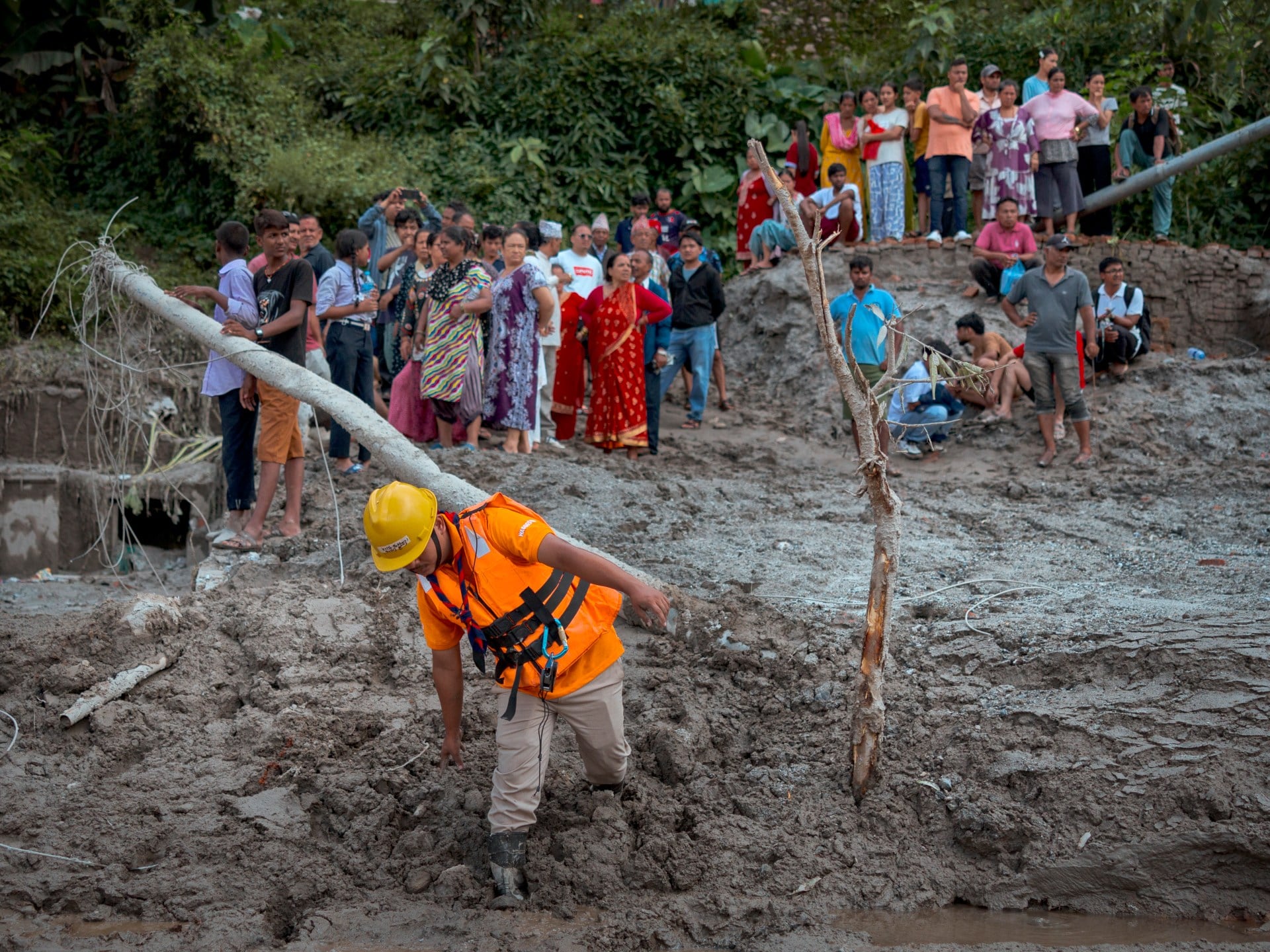
Following a catastrophic glacial collapse along the Nepal-China border on August 26, 2026, the death toll from widespread flash floods and mudslides has climbed to nearly 800. As over 3,000 people remain missing, overwhelmed local morgues and surging summer temperatures have forced authorities to initiate mass burials.
An ice-rock avalanche in the Himalaya mountains triggered massive torrents of water, mud, and debris down the Bhotekoshi and Trishuli river systems, obliterating villages and destroying vital infrastructure. Emergency services face unprecedented logistical hurdles. Rescue operations and body recovery efforts have spread across multiple districts, pulling remains hundreds of kilometers downstream.
Chitwan District Mass Burials and Forensic Strain
In south-central Nepal’s Chitwan district, roughly 200 kilometers from the hardest-hit valleys, authorities began executing mass burials after hundreds of bodies washed ashore. In the Devghat forest, where morning walking trails once wound through trees, excavators dug wide trenches to temporarily inter victims whose remains had become unrecognizable after days submerged in floodwaters.
Local health infrastructure buckled immediately under the influx. At Bharatpur Hospital, a temporary morgue designed for 50 bodies was overwhelmed by roughly 125 remains stacked inside on bunk beds and the floor.
“We were left with no other option and had to take this step. Our concern was the risk to public health posed by the rapid decomposition of the bodies.”
Ganesh Aryal, chief district officer of Bharatpur, Chitwan
Facing intense public health risks, officials from the Federal Home Ministry coordinated mass interments in Kathmandu as well, mirroring the actions taken in Chitwan where roughly 250 bodies were recovered. While forensic teams struggled with the sheer volume, Inspector Anil Thapa explained that authorities photographed distinguishing facial features, recorded identifying markers both above and below ground, and assigned reference numbers to every site.
Tradition Versus Emergency Protocol
The rush to bury unidentified victims has stirred deep distress across the predominantly Hindu nation, where traditional funeral rites dictate cremation on riverbanks surrounded by immediate family. Several public figures and grieving relatives argued that authorities moved too quickly without securing proper consent or exploring emergency cold storage options.

Former Prime Minister Baburam Bhattarai publicly criticized the hurried interments on social media while search operations remained active, stating that authorities should have mobilized emergency resources instead of disposing of bodies before families could offer input. Ruby Chaudhary, who is searching for two missing relatives, voiced anguish over the denial of traditional dignity in death while crowds gathered outside temporary registration centers at the Chitwan Expo Center.
Authorities emphasized that genetic data was preserved from every interred individual. International assistance arrived to bolster these efforts, with India dispatching a team of medical professionals and tunnel-rescue specialists, alongside forensic experts to support DNA sample analysis.
Hydropower Sites and Ongoing Rescue Bottlenecks
Beyond the crisis in morgues and temporary cemeteries, search efforts remain intensely concentrated on hydropower infrastructure buried beneath thick layers of mud and stone. According to the Independent Power Producers’ Association, approximately 933 workers remain missing across 11 project sites and tunnels in the heavily impacted Rasuwa and Nuwakot districts.
Prime Minister’s office statements confirmed that joint teams comprising 82 personnel from the Nepali Army, Armed Police Force, and civil police have worked continuously to clear blocked tunnel entrances. Adverse weather conditions and secondary hazards have severely hampered progress. At the 22-megawatt Chilime Hydropower project, executive director Baburaj Maharjan noted that the tunnel was completely choked with mud, forcing officials to mobilize specialized rock-climbing rescue units.
Meanwhile, remote valley communities face fresh isolation after new rains triggered landslides that repeatedly closed major transit corridors, including the primary highway linking Kathmandu to Chitwan just as relief supplies and forensic teams attempted passage. While Chinese monitoring teams using satellites, radar, and drones reported that upstream barrier lakes near Gyirong County had stabilized with an estimated 30-minute warning window, thousands of families continue their daily vigil outside registration tents, awaiting news of relatives trapped beneath debris or swept across the border.
Worth a look
Marjan Monfared Develops PrevenTherm System to Detect Pressure Injuries
Marjan Monfared, a fellow of the 2026 Women Who Empower Innovator Awards, has developed the PrevenTherm Monitoring System...

Researchers at the University of Washington’s David Baker lab develop working molecular scissors
Researchers at the University of Washington Institute for Protein Design have used artificial intelligence to engineer synthetic proteases...

Young Adults’ Stroke Risk Nearly Doubles Over Three Decades
Medical data tracking Greater Cincinnati and Northern Kentucky over nearly three decades reveals stroke rates among adults aged...

Continuous Glucose Monitors Benefit Type 2 Diabetes Patients Not on Insulin
Adults with type 2 diabetes who do not take insulin spent approximately five additional hours daily within their...