
In the nation’s second-largest city, challenger Nithya Raman has pulled ahead of incumbent Mayor Karen Bass in the mayoral vote count. As of Wednesday afternoon, Los Angeles City Councilmember Nithya Raman held a narrow but growing advantage over incumbent Mayor Karen Bass in the race to lead a city grappling with homelessness, the aftermath of the deadly 2025 Palisades Fire, and the looming 2028 Olympic Games.
The shift in momentum became clear as election officials processed mail-in and drop-off ballots cast in the final hours before polls closed Tuesday. Early returns showed Bass with a slight lead, but each subsequent update saw Raman gain ground until she slipped ahead and held a slim advantage by early Wednesday. By 4 p.m. Wednesday, with 72% of votes counted, the New York Post reported Raman at 51.67% (405,193 votes) compared to Bass’s 48.33% (379,069 votes)—a margin of 26,124 votes that erased the incumbent’s election-night lead.
The Late Ballot Dynamic
Younger voters, who form Raman’s base, tend to cast ballots at the last minute, meaning their votes are counted last.
“Young people vote late, so their votes get counted last,” veteran California political strategist Dan Schnur told the New York Post. “And given a system like California’s, that means we don’t see those results until well after the election.”
Veteran Los Angeles political consultant Michael Trujillo echoed the assessment, predicting a Raman victory to the California Post. “She’s gonna be your next mayor,” Trujillo said, attributing the widening margin to younger voters who cast ballots the way they pay utility bills—at the last minute. Paul Mitchell, who heads polling data firm PDI, told the Los Angeles Times that Tuesday’s early returns represented “probably Karen’s best set of voters”—older, more conservative constituents who vote earlier.

A City Divided by Fire, Homelessness, and Change
The race has exposed deep fractures in a city of 3.8 million struggling with overlapping crises. Bass, 73, continues to face fallout from the 2025 Palisades Fire, which became the most destructive blaze in city history after igniting while she was abroad on a diplomatic mission. The fire caught the department unprepared despite days of warnings about powerful winds and dry conditions. Compounding the damage, a June fire at a massive frozen-food warehouse east of downtown caused weeks of foul smells, while homelessness remains visible in encampments and rusting RVs across neighborhoods. Hollywood jobs have fled for cheaper locales for years, and residents complain of unpaved streets and broken streetlights.
Raman, 45, an urban planner who first entered City Hall in 2020 with DSA-LA backing, campaigned on the argument that “we cannot afford another four years of decline, of mismanagement, of excuses.” She told supporters at the Greek Theatre plaza that Los Angeles has stopped “being a place where we could build things, where we could open things, where we could film things.”
“Hopelessness can be fatal for a city,” Raman said. “But this campaign refused to accept that.”
Bass, who served in Congress and the state Legislature before becoming mayor in 2022 and was considered for Joe Biden’s 2020 ticket, argued she had made enough progress to merit another term. She branded Raman “not ready for primetime” after only six years on the council, and warned that replacing the police chief—which Raman has proposed—would be reckless ahead of the Olympics.
Establishment vs. Progressive Insurgency
The contest pits Los Angeles’s political machinery against a rising progressive movement. Bass has lined up support from Gov. Gavin Newsom, former Vice President Kamala Harris, former House Speaker Nancy Pelosi, nearly every city council member, the Los Angeles County Federation of Labor, and the county Democratic Party. Billionaire developer Rick Caruso, who lost to Bass in 2022, said he was voting for the incumbent without formally endorsing her.
Raman, by contrast, has rallied newer advocacy groups including the Democratic Socialists of America, Our Revolution (founded by Bernie Sanders), the Sierra Club, and Streets For All. She has few endorsements from prominent local politicians but secured a widely publicized meeting with former Gov. Arnold Schwarzenegger. A Raman victory would place her alongside democratic socialist mayors Zohran Mamdani in New York, Janeese Lewis George in Washington D.C., and Katie Wilson in Seattle—a vanguard of left-wing municipal leadership.
Policy Divides on Safety and Shelter
Public safety and homelessness dominated the campaign’s final days. Bass has pushed to hire more police officers and criticized Raman’s past positions, including a 2020 social media post calling to “defund the police” and opposition to the mayor’s 2023 police contract. Raman has since said the department should remain at its current size, but she has opposed ordinances prohibiting homeless encampments within 500 feet of schools and daycare centers, though she later indicated she would not block no-camping zones if elected. She has pledged to reduce the number of people sleeping in tents by at least 50% by 2028 through expanded medical teams and housing placements.
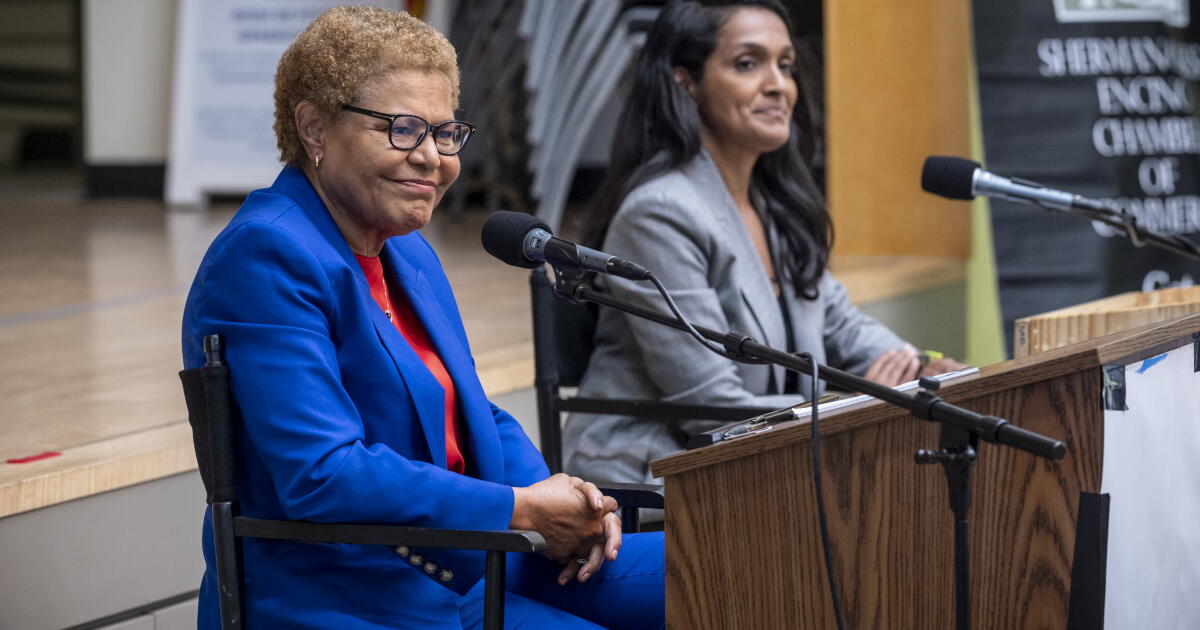
Bass stresses that her administration has cleared dozens of encampments and moved thousands into shelter, though data show nearly half of those placed in shelter dropped out and presumably returned to the streets. A Berkeley IGS/LA Times poll conducted October 19-25 found about 4 in 10 likely voters considered reducing homeless encampments a top priority, while roughly 3 in 10 prioritized public safety or affordable housing.
What Remains Unknown
With an estimated one-third of ballots still uncounted as of Wednesday evening, the outcome is not final. The direction of supporters of former candidate Spencer Pratt—a Republican reality personality who lost his home in the Palisades Fire and captured about a quarter of the primary vote but did not advance—remains an open variable. Whether Bass can overcome the late-ballot trend that has favored Raman, or whether the remaining votes break differently, will determine if Los Angeles follows New York’s path toward democratic socialist leadership or retains its current administration as it prepares to host the 2028 Olympics.

Governor Newsom Appoints 23 Superior Court Judges Across California
Twenty-three. That is how many Superior Court judges Governor Gavin Newsom put on the bench Wednesday in a...

Bachelor of Arts in Journalism at ASU | Cronkite School of Journalism
More than 1 million households across Arizona tune in to live evening newscasts produced by Arizona State University...

Arkansas Democrats Break Republican Supermajority in State House
Ten seats. Democrats flipped 10 Arkansas House seats on Tuesday night, breaking the supermajority Republicans have held for...

Mary Peltola leads Dan Sullivan in Alaska Senate race as results take weeks
Alaska's U.S. Senate race remains unresolved one day after the midterms, with Democrat Mary Peltola holding a lead...