
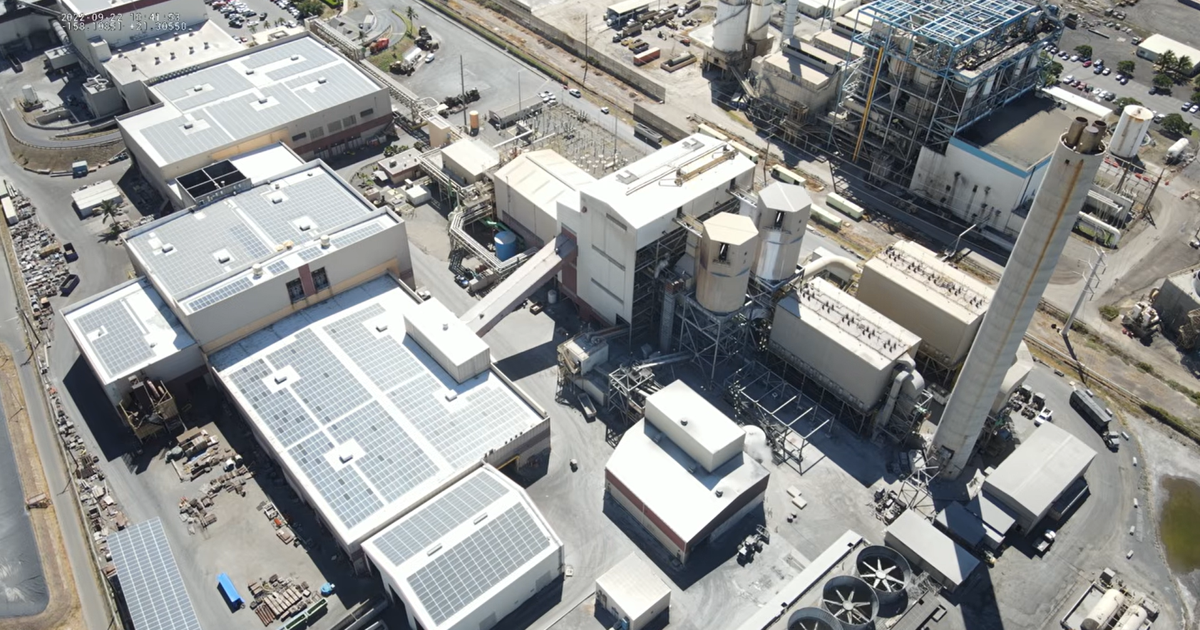
Four hundred thousand gallons of diesel fuel leaked underground at the city’s waste-to-energy plant between January and May, and the mayor did not find out until mid-November.
The spill at H-POWER in Kapolei’s Campbell Industrial Park began months before anyone noticed, Reworld, the private contractor that has run the facility since 1990, told Aloha State Daily.
A 2.5-millimeter hole in a buried steel supply line — smaller than a grain of rice — let fuel seep six to seven feet down, atop the aquifer, for roughly four months before an operator spotted a tank-level discrepancy and a stained patch on May 4.
“This is a major breakdown in communications,” Mayor Rick Blangiardi said Thursday. “It’s a failure to the public — not just a communications failure — and we owe the city and the people of our island an apology and that starts with me.” Reworld briefed Blangiardi on November 17, six and a half months after the discovery and five months after the company’s own revised estimate jumped from 6,500 gallons to 400,000 gallons.
“To say that I’m deeply disturbed over this is an understatement,” Blangiardi told reporters. “I’m deeply sorry here that an incident of this magnitude is being reported the way it’s being reported or the timeline that’s being reported. To me there’s no excuse for that.”
The Department of Environmental Services learned of the leak in May and received the higher estimate in September, Director Roger Babcock acknowledged. “We should’ve informed the mayor sooner,” he said.
Gov. Josh Green was briefed only on Wednesday, acting Lt. Gov. Keith Regan confirmed, and the state has reconvened its water committee — led by Transportation Director Ed Sniffen — to coordinate the Department of Health, the Board of Water Supply, the Attorney General, and ENV on the cleanup.
Board of Water Supply Chief Engineer Ernie Lau said the plume poses no threat to drinking water. The nearest municipal well sits 4.5 miles northeast in Makakilo, at a higher elevation and on the mauka side of the Underground Injection Control line, while H-POWER sits makai of that line where groundwater is not classified as a drinking source.
Reworld Michael Van Brunt said there is “no indication” marine life has been affected, and the company believes impacts to the proposed Kalaeloa Seawater Desalination Facility, more than a mile away, will be minimal.
Still, the contamination has migrated west and south beyond the H-POWER property line, reaching the footprint of the former AES Hawaiʻi coal plant. Reworld has drilled 26 soil borings and installed 22 monitoring wells; fuel has turned up in 15 of those wells.
Nine outer borings show no contamination. Crews have recovered about 5,000 gallons so far — roughly one percent of the revised total — through daily pumping at the affected wells. The underground line has been replaced with an above-ground pipe, and the plant remains fully operational.
The volume disparity is staggering. Reworld’s initial May notification to the state Department of Health and ENV cited 6,500 gallons. By July, after reviewing purchase records and tank logs back to 2025, the company raised the figure to 400,000 gallons.
State Health Director Kenny Fink told KITV the department “was unable to verify that significant increase in reported volume” and still cannot confirm the exact amount released. Fink added that because staff determined at the time there was no risk to public health, the matter was not escalated within the department.
“I’ll be very clear in that this is our responsibility to manage this,” Van Brunt said. “This is not a cost that’s going to be borne by the taxpayers.” Reworld’s $60 million annual contract with the city runs through 2032. The company says it is developing a long-term remediation plan and will add three more monitoring wells.
“I am especially concerned for the hundreds of Westsiders who work at H-POWER and throughout Campbell Industrial Park,” Councilmember Andria Tupola, who represents West Oʻahu, said in a statement. “They have been going to work every day on or near this site, and they deserved to know what was happening in May, not November. Learning about this months later does not give anyone confidence.”
H-POWER, the Honolulu Program of Waste Energy Recovery, began service in 1990 and is owned by the City and County of Honolulu. A $300 million expansion dedicated on Oct. 9, 2012, raised its capacity to 90 megawatts, enough to supply up to 10% of Oahu’s electricity. The plant processes up to 3,000 tons of municipal refuse daily, reducing landfill volume by 90% and recycling metals from the waste stream. It has been operated by Covanta Energy Corp. since 1993.
The cause of the pinpoint hole remains unknown. Reworld has not estimated remediation costs or a completion timeline. Regan warned the cleanup “could take years, and the public deserves clear answers and regular updates for as long as it takes.”
Keep reading

IRS Sets 2026 IRA Limit at $7,500; You Have Until April 2027 to Max Out
The IRS has set the 2026 IRA contribution limit at $7,500, with a $1,100 catch-up provision for savers...
Magnitude 5.0 Quake Hits Central California Near Pinnacles National Park; 4.4 Tremor Strikes Southeast of Downtown LA
Central California absorbed a magnitude 5.0 earthquake and more than a dozen aftershocks near Pinnacles National Park late...

Cardinals Set for Fourth QB in Four Weeks as Beck’s Back Spasms Put Josh Johnson in Lineup
Arizona’s quarterback carousel keeps spinning, and Sunday in Kansas City the Cardinals will likely trot out their fourth...

Patriots’ Playoff Odds Drop With Drake Maye Out, But Past Upsets Show Path
Drake Maye is likely done for the season with a broken ankle, leaving the 5–5 Patriots needing a...