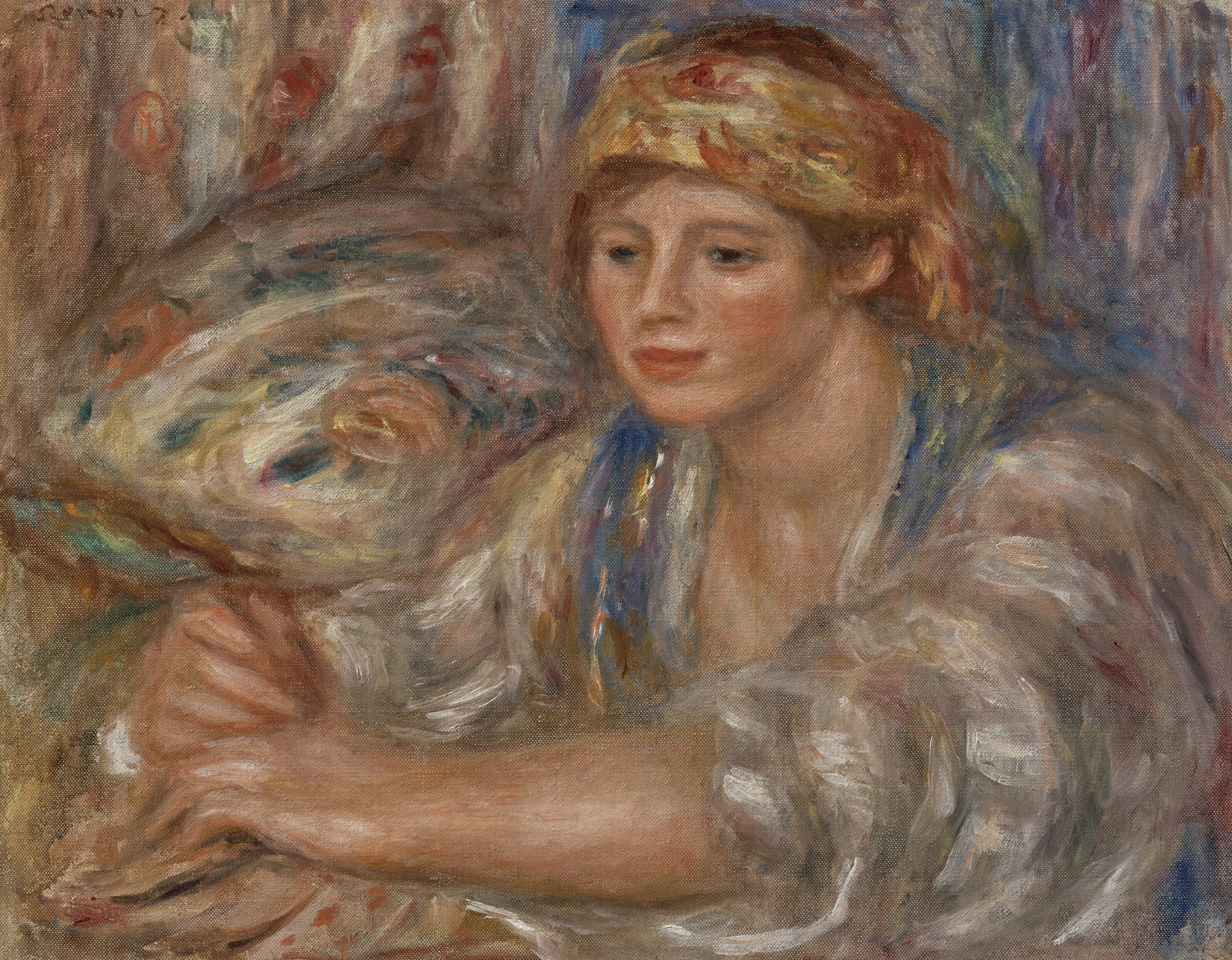
Painted around 1917, Pierre-Auguste Renoir’s Femme jouant aux cartes captures a moment of quiet intensity, featuring a young woman in a richly draped interior.
Christie’s reports that the model is widely identified as Andrée Heuschling, known to the artist as “Dédée.” Her arrival at Renoir’s home in Cagnes in 1915 marked a significant transition in the painter’s life, as she stepped into the role previously held by Gabrielle Renard, who had recently married.
Dédée brought a youthful energy to the household that profoundly influenced the aging master. Jean Renoir, the artist’s son and a future film director, later described her impact in his biography, Renoir, My Father.
“She was sixteen years old, red-haired, plump, and her skin ‘took the light’ better than any model that Renoir had ever had in his life,” Jean recalled. “She sang, slightly off-key, the popular songs of the day, told stories about her girlfriends, was gay, and cast over my father the revivifying spell of her joyous youth.”
In this composition, Dédée appears suspended in a space that feels detached from the ticking clock of the outside world. Her hands are occupied with a card game, yet she seems to merge with the floral bouquet positioned behind her.
The artist’s technique creates a sense of unity, where the rosy flush of the subject’s cheeks mirrors the vivid hues of her headscarf, and the folds of her garment echo the delicate texture of petals. It is a work defined by a warm, luminous palette of pink, red, and gold, applied in fluid, animated strokes.

This period of Renoir’s career signaled a departure from the Impressionist focus on the fleeting instant. As art historian John House observed, Renoir was moving toward “a more timeless vision of woman” in his technique, composition, and subject matter. This shift toward monumental, sensuous forms resonated deeply with the next generation of modern artists, including Pierre Bonnard, Henri Matisse, and Pablo Picasso.
Matisse held a profound reverence for these late works, once stating, “I’ve always felt that recorded time holds no nobler story, no more heroic, no more magnificent achievement than that of Renoir.” Even Picasso, who pursued a radically different path through Cubism, found himself drawn to Renoir’s exploration of the physical body.
Following a trip to Italy in April 1917, Picasso entered what historians describe as a “Renoirian crisis.” During this period, he sought to meet the older master, began copying his paintings, and eventually acquired seven of his works.
The transition from Gabrielle to Dédée was not merely a professional change for the artist; it was an infusion of vitality that sustained his output during his final years. While Dédée was immortalized by the brush, her presence extended into other mediums as well. Jean Renoir would eventually cast her in several of his own films under the name Catherine Hessling, before the two were married.
The painting shows Renoir’s enduring ability to find harmony in the human form. By simplifying contours and expanding volumes, he crafted a visual language that transcended the fragmentation of his contemporaries. It is this specific approach to light and presence that continues to invite study, bridging the gap between the Impressionist era and the rise of 20th-century modernism.
Keep reading

Wyoming LIEAP Manager Says Heating Costs Are Rising for Families
Heating Bills Surge as Wyoming Families Face Cold Weather Costs As winter temperatures settle across the state, many...

Madison Common Council to Meet on 2027 City Budget on Nov 10
As the city prepares to finalize its financial roadmap for the coming year, Madison residents are looking toward...
Ancient Olympia Hosted the Panhellenic Olympic Games
Archaia Olympia, a small town nestled in the Elis region of the Peloponnese peninsula, stands today as the...

Woodberry Forest and St. Michael Game Ends After Sideline Chaos
A routine high school football game in Virginia descended into chaos Friday night, ending abruptly with 84 seconds...