
The actual cost of the Rail Baltica railway project is expected to be announced in September, according to Latvian Transport Minister Rihards Kozlovskis. As the project faces escalating budget concerns and technical challenges, officials are relying on hired consultants to develop a new management model and clarify the financial outlook.
A Shifting Financial Landscape
The financial projections for the project, which aims to connect the Baltic states to the European rail network via a standard-gauge line from Tallinn to the Lithuanian-Polish border, have increased significantly over time. A 2017 cost-benefit analysis estimated the total project cost at €5.8 billion. Recent estimates suggest the total cost for the three Baltic countries could reach €23.8 billion. For the first phase of the project, costs in the Baltic region are projected at €14.3 billion. Latvia’s portion of this phase is estimated at €5.5 billion, though officials note that with indexing, this figure could rise to approximately €6 billion. Minister Kozlovskis noted that he does not wish to speculate on costs, as they are subject to constant change, but emphasized that the September estimate will be a key stage in determining how the project aligns with available funding.
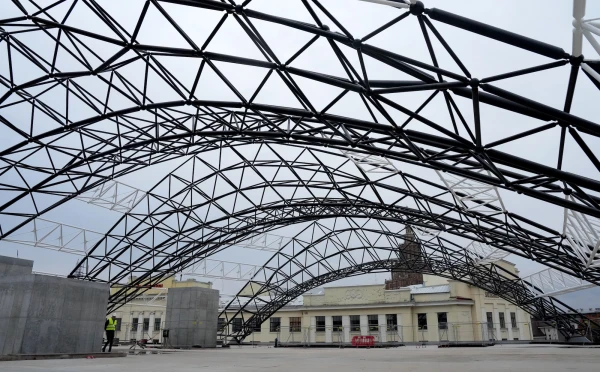
Challenges in Scope and Management
Minister Kozlovskis acknowledged that the initial vision for the project no longer aligns with the reality following the procurement process. He noted that it is currently difficult to reconcile existing commitments with the technical requirements already underway. Consequently, the Ministry of Transport is working with consultants to determine a way forward. While a 2011 study predicted 3.4 million passengers by 2050, more recent projections estimate 53 million. Kulbergs has advocated for basing the project on more realistic calculations to ensure feasibility.
Proposed Cost-Reduction Strategies
In an effort to manage the budget, officials are exploring various cost-cutting measures. Prime Minister Kulbergs suggested revising the project’s technical standards, including lowering the target train speed from 249 kilometers per hour to 180–200 kilometers per hour. According to the Prime Minister, this adjustment could potentially reduce the construction cost per kilometer from approximately €27 million to €15 million. Other proposals to reduce expenditures include: * Making broader use of existing railway infrastructure. * Avoiding the construction of the most expensive bridges where possible. * Reducing the number of bridges and viaducts along the route. * Scaling back station facilities.

Stakes for Future Funding
The project’s progress is now tied directly to the availability of European funding. Minister Kozlovskis emphasized that the project cannot be financed through the state budget, noting that European funding will not cover every aspect of the original scope. “I don’t see any way to finance this project from the budget, so we must rely on European funding,” Kozlovskis said. He added that securing additional funds during the next European Union funding period will be challenging due to competing requests from other states. Despite these financial hurdles, the Minister confirmed that Latvia remains committed to the project. “We cannot say that we will no longer implement this project,” he stated. The project, which was originally intended to be completed by 2026, has undergone significant revisions. It is now split into two phases, with the first phase targeting an opening by 2030, featuring a single track in some sections. The second phase, which would add a second track and further upgrades, is not expected before 2035. The upcoming September report is expected to provide clarity on the project’s actual cost and the extent to which its original scope remains achievable.
Find more reporting in our News section.
Related reading

Waterford family killed in ‘web of evil’, funeral hears
Hundreds of mourners gathered at Sacred Heart Church in Waterford on Monday for the joint funeral mass of...
Unjust’: OSAP pause affects Sudbury career college students
Ontario has paused all student financial assistance payments to private post-secondary institutions while auditors investigate systemic integrity issues.

Hospital accountant demoted for failing to detect US$19,000 fraud he exposed
A Banket District Hospital accountant who exposed a US$19,000 fraud by three subordinates has lost his Labour Court...

High Court ordered Roko Construction Limited to pay ASSA ABLOY (U) Ltd Shs 5.73 billion
The High Court in Kampala ordered Roko Construction Limited to pay ASSA ABLOY (U) Ltd $1.39 million on...