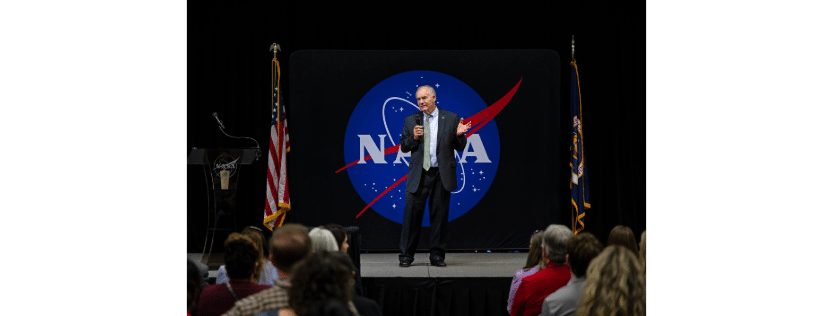
Just a couple of weeks ago, Stephen Cash was settling into retirement after a career at the Marshall Space Flight Center. Then, last Monday, everything shifted when he was named director of the NASA center, returning to lead the very facility where he started his professional journey more than four decades ago.
“Some of y’all may be as surprised as I am to be here,” Cash said Tuesday at the opening of the 26th Von Braun Space Exploration Symposium, hosted on the University of Alabama in Huntsville campus. “I am humbled to be here.”
The Marshall Space Flight Center faces a pivot as NASA prepares for returning to the moon and beyond, sustainable lunar infrastructure, and an evolving space workforce. For Cash, who stepped back into civil service after a brief retirement, the homecoming is deeply personal. “This is a job I’d do for free,” he told attendees. “I appreciate being back at Marshall and with you guys today. What I love about Marshall is we’re truly a family.”
Accelerating Exploration at the Von Braun Symposium
Organized by the American Astronautical Society in collaboration with Marshall, the annual gathering brings together leaders from government, industry, policy, and academia. This year’s theme, “Accelerating Exploration,” focuses on humanity’s return to the moon and sustainable lunar infrastructure.

The agenda features detailed panel discussions tackling Artemis II and III, space propulsion flash talks, moon base supply chain resilience, and the integration of space nuclear technology. Ron Birk, president of the American Astronautical Society, pointed to a clear roadmap for the space program.
“We are at a pivotal time in space exploration,” said Birk. “We need to continue to look forward.” Birk said there is a “slate of eight” priorities for the space program including commercial space, space traffic management, human space experience and space nuclear power and propulsion.
Hosting the event on the University of Alabama in Huntsville campus shows the deep ties between local academia and federal aerospace objectives. UAH President Donald Leo noted the institution’s role in the nation’s space ambitions.
“UAH was founded to move the nation’s space mission forward,” Leo said. “We’ve always been a bridge from government and academia to the space industry.”
Making NASA More Agile for the Next Era
In his first public remarks since taking the helm, Cash addressed the internal cultural shifts required to meet modern aerospace demands. Returning to the workforce after 46 years in the business gives him a unique vantage point on how institutional habits must evolve.

“We’re making NASA more agile,” Cash said. “We’ve been doing the same thing for a long time and we need to be doing it differently.”
That agility relies heavily on external collaboration. Cash emphasized that accelerating exploration depends on strong partnerships among government, academia and industry. Signaling an open-door policy for incoming collaborators, he added, “I want to be a part of this. That’s one of the reasons I came back. I’ve been in this business 46 years; it’s all about partnerships. If anyone wants to talk, my office is always open.”

Wauna Credit Union Experts Share Tips for Holiday Budgeting
On Tuesday morning, Charles Dennis and Willow Oelke from Wauna Credit Union joined ARC PDX to discuss practical...

AI-generated Wyoming map misrepresents Interstate 80 geography
An AI-generated map circulating on social media has triggered a wave of confusion by misrepresenting the geography of...

Wisconsin Technical Colleges Lose Federal Child Care Funding for Student Parents
For years, the bills Devvin Thomas Sr. received each semester for his son’s campus child care were a...

WVU Fraternity Houses Raided Amid Hazing Investigation
Police Raid Two WVU Fraternity Houses in Hazing Investigation Campus police and local law enforcement officers descended on...