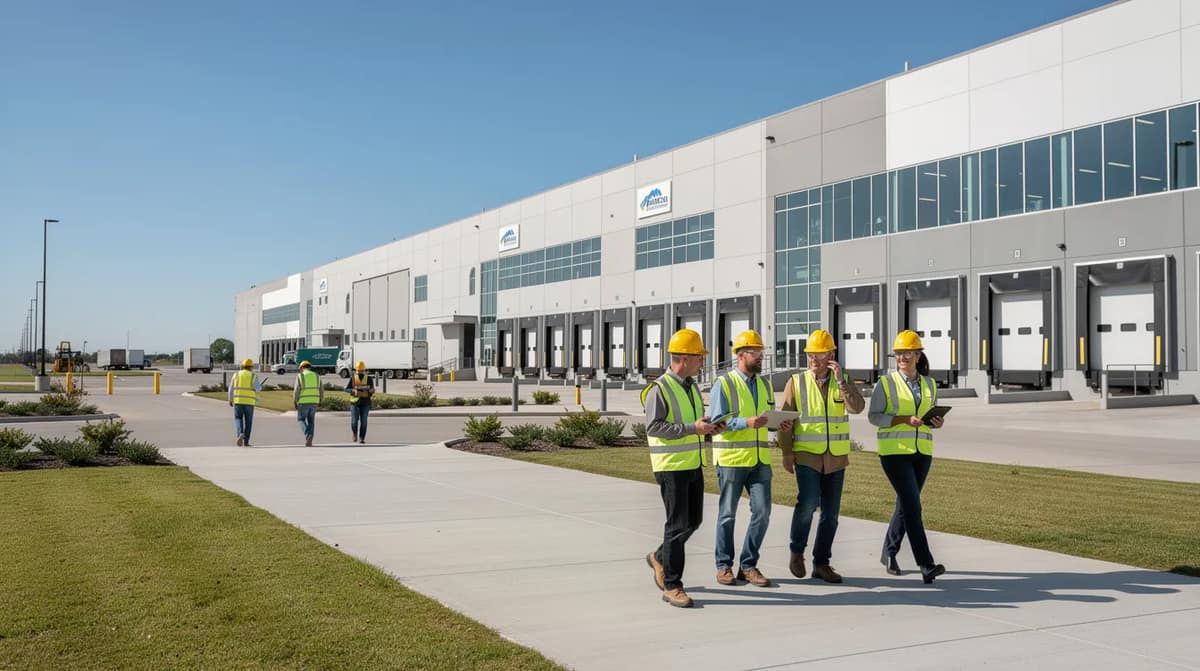
Tennessee’s construction backlog shrank to 8.1 months in October, down from 8.7 a month earlier, even as manufacturers pour billions into new plants across the state.
ABC Greater Tennessee reported that firms without data center work saw backlog drop further, to 7.6 months, a sign that the manufacturing wave is not automatically filling the pipeline for every builder.
Manufacturing employment sits at roughly 354,100 jobs, while construction employment trails at about 167,600, with unemployment at 3.4 percent as of September. Eighty-eight percent of Tennessee contractors report difficulty finding skilled labor, a figure that holds whether the question covers trades broadly or specific crafts like electricians and plumbers.
The pressure shows up first in the bid window. When a manufacturer commits capital and targets a production date, preconstruction timelines compress. Contractors with too much exposure to one owner are more vulnerable when those timelines shift.
Three corridors, different risk profiles
Middle Tennessee draws the most near-term demand. The Nashville region’s labor pool, utility capacity, and the I-65, I-24, and I-40 triangle have already absorbed large expansions in Lebanon, Spring Hill, and Maury County. East Tennessee runs along I-40 and I-75, where Knoxville-area parks attract food manufacturing, component production, and advanced materials. Permit timelines vary widely by jurisdiction, and environmental permits for stormwater can slow projects in less developed counties.

Chattanooga sits on I-24 near Georgia’s manufacturing clusters. Confirmed megaproject announcements have been less frequent there in the latest 12 months, but the corridor’s logistics advantages and available land position it as a potential beneficiary if supplier-network demand continues to rise. The Tri-Cities market — Kingsport, Johnson City, and Bristol — operates at a smaller scale.
Where the work actually sits
Primary demand sits in manufacturing facilities: chemical processing, nonferrous metals, medical devices, and EV battery electrolyte plants. These projects involve complex foundations, high structural loads, environmental controls, and heavy utility demand. Early procurement is critical to maintain schedules.
A secondary tier — supplier and component buildings, battery casings, die-casting, insulated panel production, and logistics centers — is smaller individually but more numerous across the state. Utility upgrades and enabling infrastructure (power interconnections, water and wastewater systems, site preparation at industrial parks) generate contract opportunities before the main facility breaks ground.

For some supporting structures, metal buildings are significantly more affordable than traditional construction. Prefab commercial storage facilities can be erected in weeks, which appeals to manufacturers on fast-track schedules. Many companies prioritize sustainability with recyclable steel buildings, adding another layer to procurement decisions.
Cost discipline or margin erosion
Construction input prices have risen over 8 percent year over year in Tennessee. Industrial construction cost pressures include rising insurance rates and permit fees.
ABC Greater Tennessee advises making escalation clauses a contract review priority on every industrial bid.
Labor is the binding constraint
Workforce pressure is a consequence of the manufacturing boom, not a separate issue. Tennessee faces a major shortage of electricians and plumbers, and demand for skilled trades exceeds the apprenticeship pipeline.
Electrical capacity may also be a constraint beyond labor. Before accepting new industrial work, contractors need to review project staffing requirements against confirmed backlog. A pursuit win that strips resources from an active project does not create net value.
A 90-day scoring framework
| Criteria | Pursue | Support | Pass |
|---|---|---|---|
| Trade capacity | Crews available or acquirable | Can partner or subcontract | No capacity, no path to fill |
| Site readiness | Utility and permits confirmed | In progress, timeline manageable | Unclear or years away |
| Margin potential | Competitive with escalation protection | Acceptable with discipline | Compressed, high risk |
| Fit with backlog | Complements current work mix | Manageable overlap | Conflicts with active commitments |
Score each opportunity against available workforce capacity and confirm preconstruction staffing before expanding the bid pipeline. Schedule a leadership review within the next 30 days to align pursuit strategy with the reality on the ground.
Until then, the backlog number — 8.1 months and falling — is the clearest measure of how fast the window is closing.
Worth a look

LPL Financial Closes Axial Deal at High-Teens EBITDA Multiple
LPL Financial closed its purchase of a $2.7 billion Commonwealth team on Friday as the platform conversion began,...

Wyoming Gallery Owner Pleads Guilty to Selling Counterfeit Native American Art
A Wyoming gallery owner pleaded guilty November 3 to a felony charge under the Indian Arts and Crafts...
Milwaukee Ranks 68th Among Most Sinful U.S. Cities, Madison Near Bottom at 181st
Milwaukee ranks 68th out of 182 U.S. cities on WalletHub's 2024 "Most Sinful Cities" index with a Vice...

West Virginia QB Michael Hawkins Jr. Questionable vs. No. 20 Houston
West Virginia needed a win to keep its bowl hopes alive; instead it got its worst loss of...