Environment Secretary Angela Eagle launched a public consultation on 17 September for a Norfolk pilot scheme requiring housing developers to pay a £2,675 per-house nature levy to unlock 15,780 stalled homes, drawing criticism from environmental groups who call the fee insufficient to tackle water pollution.
Government Tests Norfolk Nature Levy for Housing
The UK government has designated parts of Norfolk as the first test area for its Environmental Delivery Plan under the Nature Restoration Fund. Environment Secretary Angela Eagle termed the arrangement a win-win
for both construction and nature recovery after regulations previously blocked regeneration efforts at the former Colman’s Mustard Factory site at Carrow Works in Norwich.
Government officials argue the model creates a predictable financial route for developers while funding large-scale ecological repairs across the region.
Natural England Operates £42m Restoration Fund
Under the draft proposals, housebuilders would pay a fixed charge of £2,675 per house or flat rather than individually negotiating separate environmental mitigation measures for each construction project.
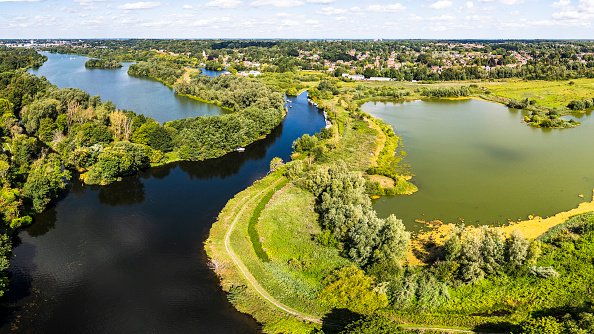
Natural England leads the project, pooling the collected capital to finance broad conservation interventions across key catchments including the River Wensum, the Bure broads and marshes, and the River Yare. Government estimates suggest the levy will generate approximately £42m if developers pay the proposed rate for all unlocked properties.
“Instead of tackling pollution piecemeal, site by site, we can now deliver conservation measures that make a real difference for rivers, wetlands and wildlife across Norfolk.”
Marian Spain, chief executive of Natural England
The pooled funds target a variety of environmental measures, ranging from wetland creation and river restoration to fen management and targeted deer culling. Booming deer populations inside The Broads cause considerable grazing damage to local habitats.
Conservationists Object to Housing Plan Fee
Conservation professionals argue that a flat financial contribution fails to stop nitrogen and phosphorus generated by new construction from entering delicate waterways.
“While [actions outlined in the plan] would improve ecological habitats in the area, they won’t necessarily address the pollution that will be going into the water.”
Sally Haines, chief executive of the Chartered Institute of Ecology and Environmental Management
Sally Haines also dismissed government claims that environmental rules represent the primary barrier to housebuilding, pointing instead to market issues like labour shortages, material availability, and land prices.
“We are concerned that it weakens existing protections for Norfolk’s nationally and globally important wildlife sites such as chalk streams, wetlands and valley fens.”
Eliot Lyne, chief executive of Norfolk Wildlife Trust
Eliot Lyne expressed wider fears regarding the stability of existing environmental regulations.
“Fundamentally, if you are polluting a chalk stream or a river and you’re putting more and more pollution into that river, and not seeking to address the underlying causes of that, then it’s only going to get worse.”
Mark Dye, chalk stream campaigner for the Gaywood River Revival group in west Norfolk
Steve Turner, executive director of the Home Builders Federation, contended that agricultural runoff poses a much greater threat than new housing developments, while also criticizing water companies for failing to upgrade infrastructure to prevent sewage discharges.
Public Consultation Runs Until 27 October 2026
As The English Chronicle notes, the initiative is still a draft proposal rather than an operational mechanism. The public consultation opened on 17 September and runs until 27 October 2026, giving residents, developers, and conservation groups an opportunity to submit feedback.
Natural England will review consultation responses before submitting final recommendations to Environment Secretary Angela Eagle and the Department for Environment, Food and Rural Affairs.
Wilkes Subglacial Basin Ice Could Raise Sea Levels by Four Meters
East Antarctica's Wilkes Subglacial Basin contains enough ice to raise global sea levels by up to four meters,...

Saturn Reaches Opposition on October 4 for Brightest Viewing of Year
Saturn reaches opposition on Sunday, October 4, 2026, sitting at its closest point to Earth for the year...

NASA Advances PRIMA Telescope to Phase B for Far-Infrared Research
NASA selected the PRobe far-Infrared Mission for Astrophysics, or PRIMA, to advance to Phase B development.

8-Hour SpaceX Flight Sets Speed Record for Crewed Spacecraft to ISS
Canadian Space Agency astronaut Joshua Kutryk and three crewmates reached the International Space Station on October 1, 2026,...