
A study of eight Rhododendron species finds mutational pressure alone cannot explain their codon usage bias, pointing to other factors such as natural selection that the data cannot yet confirm.
Researchers analyzed synonymous codon usage bias — the non-random preference for certain DNA triplets that encode the same amino acid — across eight species of the ecologically and economically important genus.
Total GC content varied narrowly, from 45.62% in R. griersonianum to 47.19% in R. vialii. That constrained range may reflect either a limited mutational landscape or stabilizing selection, though the present data cannot distinguish between them.
Neutrality plots indicated that mutational pressure weakly influences codon usage bias. An ENC-GC3s analysis showed most genes clustering below the expected curve, further supporting the contribution of factors beyond mutation, although the deviation is not diagnostic of any single mechanism and could also reflect other non-mutational factors such as mRNA stability.
A consistent bias toward A C at the third codon position appeared across all species in PR2 plot analysis.
Pairwise correlations of relative synonymous codon usage were extremely high across the eight species (Pearson’s r = 0.9991–0.9997).
The resulting RSCU-based dendrogram groups species solely by the similarity of their codon-usage profiles. It is a descriptive ordination of RSCU vectors, not a phylogenetic or taxonomic tree. Neither agreement with nor deviation from reported taxonomic groupings should be interpreted as evidence of evolutionary relationships.
The study concludes that a contribution of natural selection, including possible translational selection, remains plausible but is not established because tRNA-abundance, gene-expression, and translational-efficiency data were not examined.
The findings provide a genome-wide descriptive baseline for future functional, expression, and tRNA studies.

Study Ties Mantle Convection To Billion-Year Rock Gap; Coauthor Disputes Pattern
Imagine a book where a huge section in the middle has been ripped out.

University of Arkansas 3D-Prints Bricks From Simulated Moon Dust, Study Finds
University of Arkansas researchers have 3D-printed interlocking bricks from simulated lunar dust without any binder, a first step...
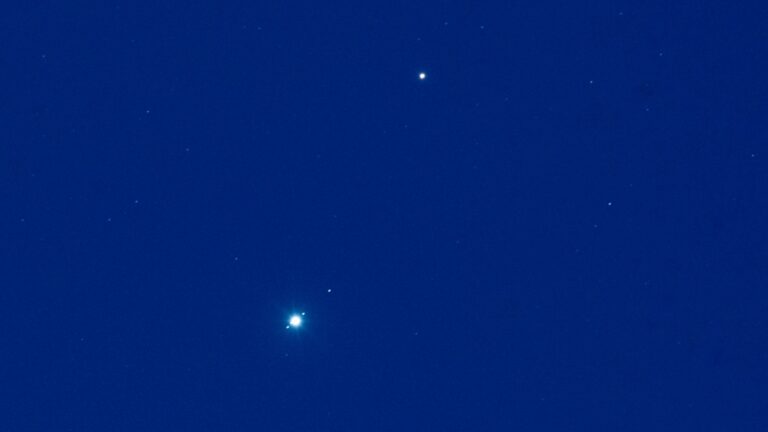
Mars and Jupiter Seen in Sky Over China’s Heilongjiang
Mars and Jupiter reached their closest apparent separation in the night sky on Sunday appearing as a spectacular,...

Scientists Discover Dragonball Organelles in Deep-Sea Mollusc
Deep inside an enigmatic ocean-floor animal, researchers have uncovered a tiny organelle that has no known counterpart anywhere...