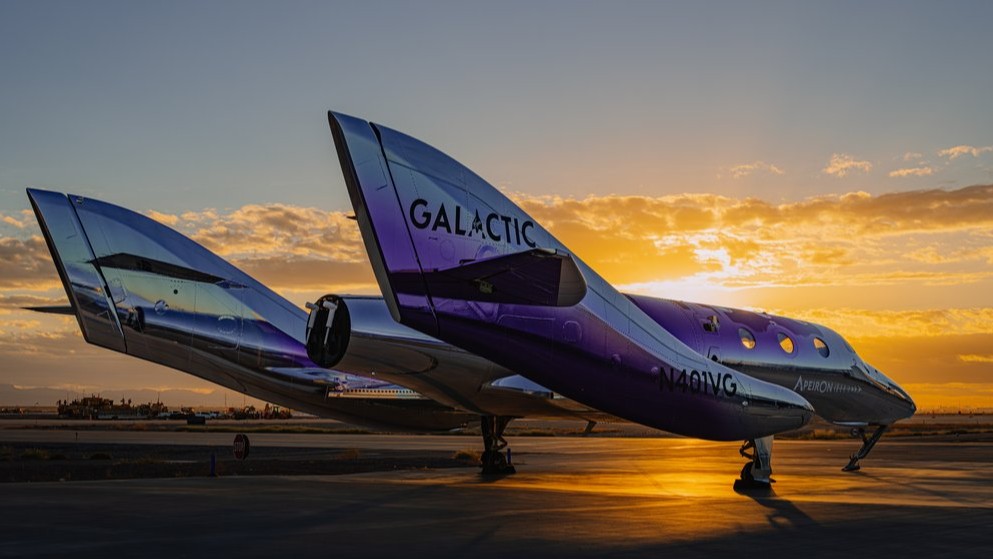
Virgin Galactic Transports Apeiron Spaceship to New Mexico
Virgin Galactic has completed assembly of its lead next-generation Spaceship, named Apeiron, and flown the aircraft from its factory in Mesa, Arizona, to its operational base at Spaceport America in New Mexico. The journey sets the stage for a flight test program ahead of planned commercial operations.
Welcome home, Spaceship Apeiron.Our newest spaceship completed its first flight today, from our factory in Mesa to Spaceport America in New Mexico. Details → https://t.co/f91NrhKECf pic.twitter.com/0KLw4tZLeW
The spaceship departed Phoenix-Mesa Gateway Airport at 10:29 a.m. MST on a captive-carry flight, mated to the company’s custom-built, dual-fuselage launch vehicle, Eve. According to Virgin Galactic, the aircraft landed at Spaceport America at 12:59 p.m. MDT. Pilot in Command Michael Masucci and Pilot Dan Alix flew Eve, with Flight Test Engineer Tori Crichton on board.
The name Apeiron—derived from ancient Greek for “boundless”—was chosen via a public vote from a shortlist developed by company teammates and members of the astronaut community, drawing participation from people across more than 80 countries. Earlier on the day of the transfer, the spacecraft was officially named and revealed in its completed livery at the Mesa facility.
“This morning, we gave Apeiron a name. This afternoon, Apeiron came home,” said Michael Colglazier, Chief Executive Officer of Virgin Galactic, in a press statement. “Seeing the ship fly beneath Eve to Spaceport America was a moment years in the making. To our team and our astronaut community: your Spaceship has arrived.”
Testing Plans and Production Timelines
With the vehicle now stationed in New Mexico, engineering teams plan to complete avionics software integration and validation alongside flight test preparations. Upon successful completion of that test program, the company aims to begin flying customers aboard the spacecraft, with commercial flights anticipated to start in early Q2 2027.
Apeiron is built in partnership with major aerospace suppliers as the first of Virgin Galactic’s next-generation fleet. The company states that the vehicle is designed to fly twice per week with a lifetime exceeding 500 missions, supporting the economics of a scaled commercial operation with increased flight cadence and a lower cost profile.
Meanwhile, manufacturing momentum continues at the Arizona factory. Assembly is underway on a static test article and a second spaceship, while teams prepare the rocket motor assembly line. That second vehicle is slated to enter commercial service in late Q2 or early Q3 2027.
Keep reading
Ron Hubbard trips Adam Schwegman to help stop Topeka attacks
Adam Schwegman faces 16 charges, including aggravated battery and rape, following a violent spree in Topeka on Wednesday,...

2026 Brian Keck Memorial Preseason Nationals 9th-10th Grade Results
West Des Moines Showdown Defines 2026 Preseason Nationals At the 2026 U.S. Marine Corps Brian Keck Memorial Preseason...

Minnesota Gophers Fall to Indiana in Overtime Heartbreaker
The Minnesota Gophers missed an opportunity to upset fourth-ranked Indiana in Bloomington, falling 23-16 in overtime after a...

Jeffery Simmons Arrival Fails to Fix Chicago Bears Secondary Flaws
The Chicago Bears are sitting at 5-2, and general manager Ryan Poles has just acquired Jeffery Simmons to...