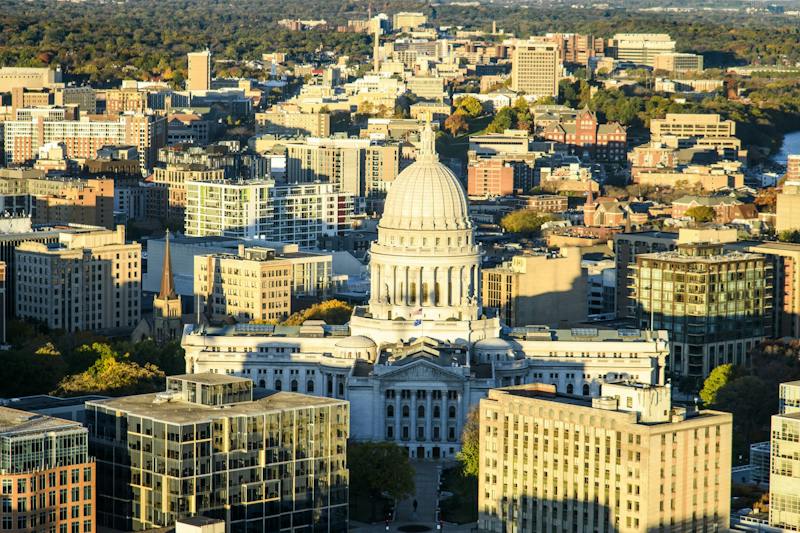
Young professionals moving to Madison for career prospects and abundant green spaces are increasingly confronting a major hurdle: a tight housing market with rapidly climbing rents. While the city’s appeal to younger generations remains strong, the financial reality of living there is drawing mixed reviews from its newest residents.
The Daily Cardinal reported that Madison’s growing allure for Generation Z professionals is bringing a steady wave of young workers into the local economy. Ranked as one of the best mid-sized U.S. cities for Gen Z in both 2024 and 2025, the generation now comprises 15.2% of Madison’s total population of 280,000. This demographic momentum is heavily supported by the University of Wisconsin-Madison, where 64.4% of students fall into Gen Z, while older adults aged 65 and older make up just 14.7% of the wider Dane County population.
Research Hubs and Professional Growth
Academic institutions, state politics, and a thriving biotech sector form the bedrock of Madison’s appeal for arrivals looking to build their careers. Yonathan Taye, a PhD candidate and teaching assistant at UW-Madison, pointed to the regular rotation of academic conferences and rapid access to hands-on teaching roles as vital draws for young researchers.
“There are often conferences here which are opportunities for me to present my research or network with people for professional development,” Taye said. “I got hands-on teaching experience relatively quickly as well.”
Taye also noted that the vast collections at the Wisconsin Historical Society, combined with the city’s proximity to collections in Chicago, strongly supported his academic ambitions. According to statements she shared with the Cardinal, Ellen Zhang is of the opinion that the concentration of state government, higher education, and biotech initiatives in Madison acts as a draw for youth relocating from neighboring communities. This dynamic receives significant backing from federal and state investment. The Wisconsin Biohealth Tech Hub secured $50 million for workforce development and biotech research in 2025, operating as part of a 15-member consortium featuring UW-Madison aimed at advancing the state’s biohealth sector and creating new employment avenues.

A Slower Pace and Urban Mobility
Beyond career opportunities, many newcomers highlight the city’s distinctive physical environment and pace of life as a primary reason for relocating. Tara Viswanath, a 26-year-old who moved from Washington D.C. to Madison for work, described Madison as slow-moving and more relaxed compared to the East Coast.
“People are burnt out. Madison is more in nature and has a more digestible lifestyle [which is] less overwhelming,” Viswanath said.
That access to the outdoors is backed by hard metrics. Madison ranks second nationally for park access, offering 10.3 parks per 10,000 residents. The city has also set a goal to reach zero carbon emissions in city services by 2030, a commitment that resonates with environmentally conscious arrivals.
“A lot of places like to say they encourage green living and encourage public transportation [when] they don’t in reality, but Madison does put their money where their mouth is,” Viswanath added.
Urban mobility adds to the appeal. Among mid-sized American cities, Madison secures the fifth spot for green commuting, with a 16.4% share of residents getting around by foot, bicycle, or public transit. Hamilton Williams, a UW-Madison graduate living in Madison, noted that the pedestrian and biker centered infrastructure makes commuting throughout the city easy for those who do not own a car.
The Rising Cost of Living
Despite the professional enrichment and cultural enrichment that Zhang credits the Gen Z population with bringing to the city, affordability remains a persistent friction point.
Housing costs have climbed alongside the population influx, forcing younger residents to weigh the city’s lifestyle benefits against stiff rental prices. While rates remain below those found in major metropolitan centers like Chicago, they still place a heavy strain on entry-level earners and graduate students.
“Housing is really expensive,” Williams said. “It is over a grand a month for a tiny studio apartment, but if I were to move to Chicago, I’d be paying twice as much.”
At the same time, the local job market presents a mixed picture. Viswanath pointed out that while job opportunities in Madison might feel uninspired, the situation is likely on par with the economic climate of any other municipality nationwide at present. Whether the city can successfully balance its growing reputation as a destination for young talent with long-term housing accessibility remains the central question for its future development.
Related reading

Jemila Momoh recounts Kulani Kinis Hawaii trip and L’Oréal internship
Jemila Momoh Reflects on L'Oréal Internship and Kulani Kinis Trip in LinkedIn Post In a post published on...

Atlanta United Eliminated From Playoff Contention After 2-1 Loss to NYCFC
Atlanta United Eliminated After Late New York City FC Wondergoals Atlanta United saw their 2026 Major League Soccer...

Icon of the Seas Miami Cruises Start at $1,203 per CruisesOnly.com
Seven-Night Caribbean Itineraries Aboard Icon of the Seas Start at $1,203 Travelers looking ahead to late autumn voyages...

LA28 Olympic Equestrian Events to be Hosted at Santa Anita
Stars Align for LA28 Olympic Equestrian Events at Santa Anita Los Angeles will host its third Olympics in...