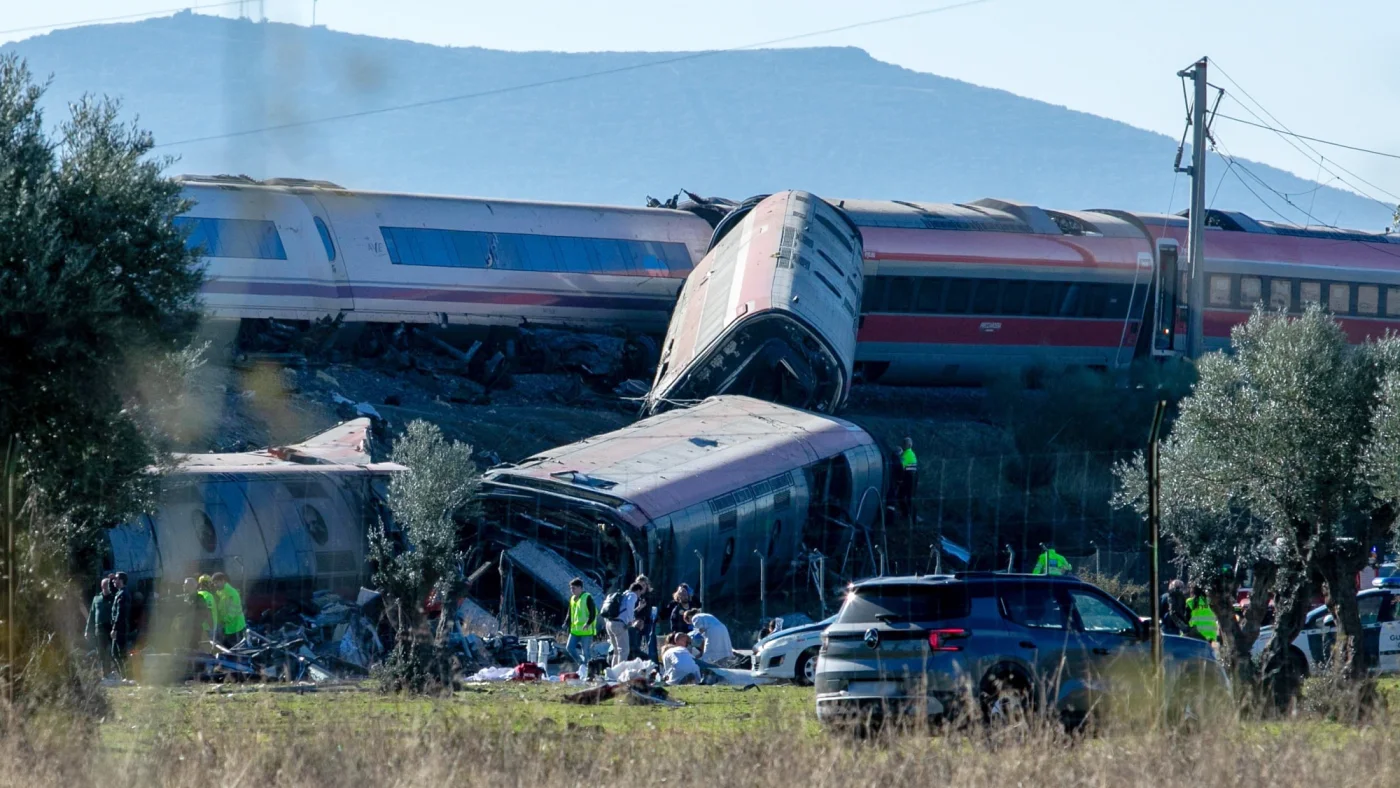
At least 68 people died on Wednesday, October 28, 2026, when a high-speed Renfe train slammed into the rear of a stationary Iryo train in Urda, Spain. The collision derailed two carriages and marks the second fatal accident on the Madrid-Seville line this year and the deadliest in Europe since 2013.
Rescue crews are still scouring the wreckage for survivors and additional bodies in the province of Toledo. The regional government of Castilla-La Mancha confirmed the death toll. They reported that 58 people required hospital treatment.
Other reports from the region indicate approximately 80 injuries. Fifteen are described as critical. Emiliano Garcia-Page, the government head for the Castilla-La Mancha region, warned that some of the most seriously injured might not survive. He specified that 24 of the victims killed were found on the Renfe train. The remainder were on the Iryo train.
The disaster involved two trains heading in the same direction from Madrid to Seville. According to Esther Padilla, a spokeswoman for the regional government, the Renfe train carried 397 passengers. The stationary Iryo train had 147 on board.
The impact knocked two of the Iryo cars off the tracks. They plummeted down a four-meter (13-foot) slope. More than 200 members of the Military Emergencies Unit deployed to the site to work alongside firefighters and police. Ambulances and medical helicopters transported victims. Unscathed survivors moved by bus.
Atocha Control Issues Inexplicable Order
Preliminary evidence points to human error following a failure in the line’s primary signaling system. Transport Minister Óscar Puente reported that the LZB control system suffered a computer malfunction at approximately 8:30 a.m. This occurred on a 63-kilometer (39-mile) stretch. The failure caused all trains in that area to stop.
🚨🇪🇸 TRAGIC NEW VIDEO: We’re getting more footage of this morning’s high-speed train crash near Toledo, Spain, that killed at least 46. It happened on the Madrid-Andalusia line between the Iryo Train with 147 passengers and a baby, and the Renfe train, with 397 passengers.…
Puente estimated the malfunction involved six trains. Control shifted to the Atocha control post in Madrid when the system failed. Transport Minister Óscar Puente described the subsequent decision to allow the Renfe train to resume its journey as inexplicable
.
The collision occurred at kilometer 118 of the line, between the towns of Mora, Orgaz, and Urda. This section is part of Spain’s oldest high-speed railway, which opened in April 1992 for the Universal Exposition in Seville.
Passenger Rafael Barcelo recounted that he and others were sent flying from their seats during breakfast when the impact hit. He noted at least eight victims in his carriage alone. A passenger speaking to Cadena Ser radio described seeing body parts and trapped people covered in blood. She added that the force of the braking broke the small table in front of her.
Maintenance Gaps Follow Safety Failures
This is the second major collision involving Renfe and Iryo on the same line in nine months. The current disaster is the deadliest in Spain since 2013. In that year, a train traveling between Madrid and Ferrol derailed near Santiago de Compostela, killing 80 people and injuring between 145 and 170.
The disaster has reignited a debate over whether the liberalization of rail services has outpaced infrastructure upkeep. Spain recently opened its rail network to private companies to compete against the state-owned Renfe. The International Union of Railways notes that only China, with 45,000 kilometers of track for 1.4 billion people, has a more extensive high-speed network than Spain.

| Metric | Verified Data |
|---|---|
| Avg. Annual High-Speed Spend (2018-2022) | €1.5 billion |
| Maintenance Allocation | ~16% of funding |
| Total High-Speed Network Length | ~4,000 km |
European Commission data suggests maintenance investment has lagged behind peers like Germany and Switzerland, though Spain spends more on its high-speed network than any other country. Most of Spain’s funding went toward new infrastructure rather than the renewal of existing lines.
The government claims it increased spending on network maintenance by 54% since 2018. Adif utilizes several systems to manage safety. These include ASFA for signal alerts and automatic braking. It also uses Automatic Block Control (BCA) for speed and distance monitoring and GSM-R mobile technology for communications between trains and the command center.
Political Fallout Follows National Mourning
Prime Minister Pedro Sánchez visited the site and declared three days of official mourning from October 29 to 31. The tragedy occurs as Sánchez prepares for a national election on November 29. He stated that it is unacceptable
for the country to suffer two such accidents in one year.
King Felipe VI also visited the crash site. The opposition People’s Party responded by canceling all campaign events. European Commission President Ursula von der Leyen and French President Emmanuel Macron expressed solidarity with the victims. Von der Leyen stated, Today, Europe mourns with you
.
The Military Emergency Unit mobilized to assist with rescue efforts. Spain’s soccer federation postponed all 24 Copa del Rey games scheduled for Wednesday.
The investigation now focuses on the specific sequence of events at the Atocha control center. Investigators are asking why the Renfe train was authorized to proceed. Iryo, an Italian-owned company, stated it has activated its security protocols and is closely working with authorities
. Renfe expressed its condolences and established a special line for the families of the victims.
Rail service remains suspended on the Madrid-Andalusia high-speed line.
Worth a look

US Defense Secretary Pete Hegseth Pledges Stronger Defense Ties to ASEAN
US Defense Secretary Pete Hegseth sought to reassure Southeast Asian counterparts in Cebu on October 28 of Washington’s...
Uganda Embassy Confirms 14 Nationals Killed in Russian Military Service
Uganda’s Embassy in Moscow has confirmed that 11 Ugandan nationals recruited into the Russian military have been killed...
Human Rights Watch Criticizes South Korea’s Restrictive Abortion Limits
South Korea plans to introduce medication abortion in 2027 following years of unregulated access since its abortion ban...

Mnangagwa Urges Zimbabwean Students to Return Home
President Mnangagwa urged Zimbabwean students studying in the Russian Federation to return home upon completing their degrees to...