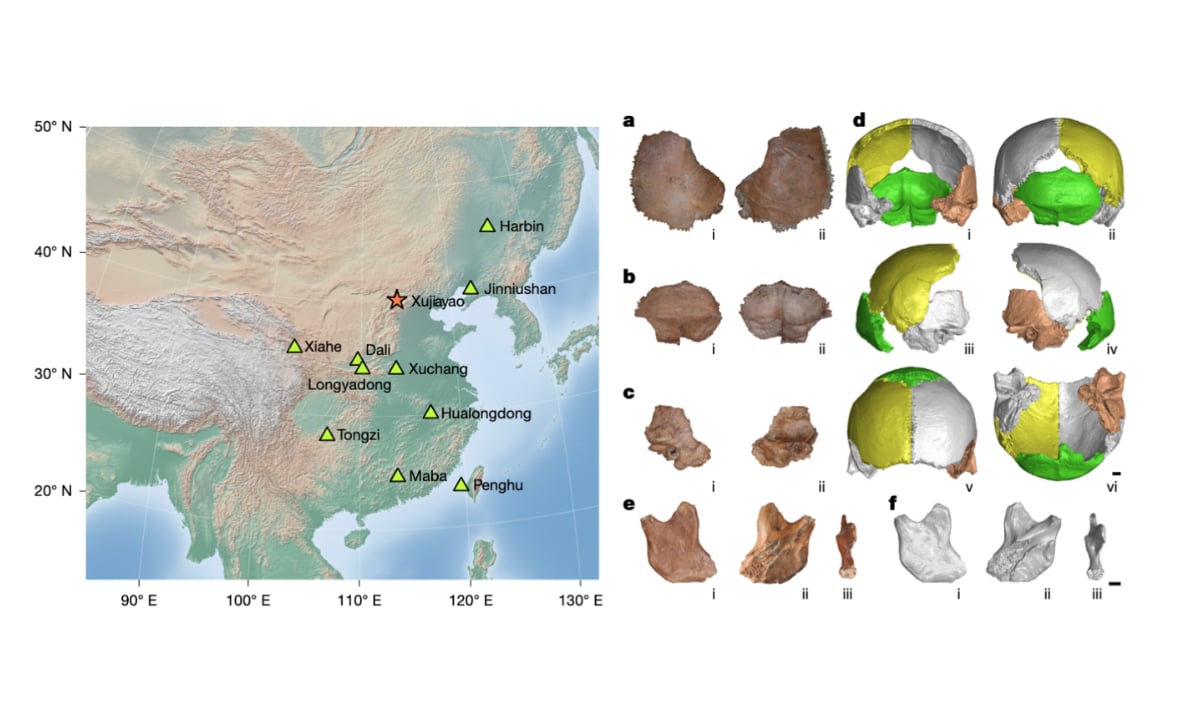
Researchers from the Chinese Academy of Sciences have identified the Xujiayao and Bianfu Cave hominins as Denisovans. Using ancient protein analysis, they established the first morphology-based identification framework for the extinct group. The findings, published in Nature on September 9, 2026, provide physical descriptions of Denisovan limbs, skulls, and teeth.
Denisovans were expected to remain a ghost lineage, known primarily through molecular evidence for 16 years. Analyses led by the Institute of Vertebrate Paleontology and Paleoanthropology (IVPP) changed this. They moved the group from a molecular mystery to a classifiable species with distinct physical traits.
Xujiayao Site Defines Denisovan Body
Excavations between 1976 and 1979 at the Xujiayao site in Hebei Province recovered 20 human fossils from at least 16 individuals. This site provided the ideal laboratory to link proteins to bone shape. It offered a clear stratigraphic record and reliable dating ranging from 199,000 to 138,000 years ago.
The team confirmed these hominins belonged to the Denisovan lineage by extracting endogenous proteins from bone powder. They systematically cataloged traits to create a blueprint for identifying other Denisovan remains.
- Primitive traits: A low braincase, thick cranial bones, and a low, broad cranial vault resembling Homo erectus.
- Derived traits: Simplified premolar chewing surfaces shared with later members of the genus Homo.
- Additional markers: Short mastoid processes and, based on comparable fossils, prominent brow ridges and flat faces.
Other Middle Pleistocene hominins in East Asia likely belonged to the Denisovan group. According to reporting from Xinhua, this identification suggests the group potentially extended its range across nearly the entire continent.
Bianfu Cave Yields Denisovan Radius
Bianfu Cave provided a rare anatomical find: a confirmed Denisovan radius. This forearm bone, cataloged as BFD771, reveals a mix of traits. Its large dimensions near the elbow and the orientation of its radial tuberosity mirror Neanderthals. However, its overall external shape is closer to modern humans.
The team used a morphological pre-screening + ZooMS identification
strategy to identify the radius, two parietal skull fragments, and two teeth. They first selected 22 potential hominin remains. Then they applied Zooarchaeology by Mass Spectrometry (ZooMS) to confirm their identity.
Fossils from Bianfu Cave date to different layers. One skull fragment was found in the older Layer 9, dated between 167,000 and 150,000 years ago.
Proteins Map Evolutionary History
The researchers detected the COL1A2 R996K protein variant to confirm these remains. This variant is specific to Denisovans.
Palaeoproteomic analyses identified the Xujiayao hominins as Denisovans. This group retained some primitive features similar to those of Homo erectus.
Ancient proteins identify various Denisovan remains from Southwest China.
Research finding, via SciTechDaily
Fossil Gaps Leave Taxonomies Unclear
Gaps persist in the East Asian fossil record despite progress in mapping Denisovan morphology. The research team compared Xujiayao hominins with previously confirmed Denisovans.
The taxonomic status of several other ancient hominins in the region remains unclear.
Worth a look

Antarctic Intermediate Water Becomes Saltier as Sea Ice Declines
A vast, freshwater-rich layer of the Southern Ocean known as the Antarctic Intermediate Water has abruptly reversed decades...

SpaceX launches 27 Starlink satellites on Falcon 9 from Vandenberg
SpaceX launched 27 Starlink satellites into low Earth orbit aboard a Falcon 9 rocket from Vandenberg Space Force...

Airbus to Build Two of Four More Galileo Satellites
The European Space Agency has awarded contracts to Airbus and Thales Alenia Space to build four additional Galileo...
Webb Study Compares Interstellar Comet 3I/ATLAS With Solar System Icy Bodies
Water ice with a deuterium-to-hydrogen ratio of 0.98 percent was detected by the James Webb Space Telescope in...