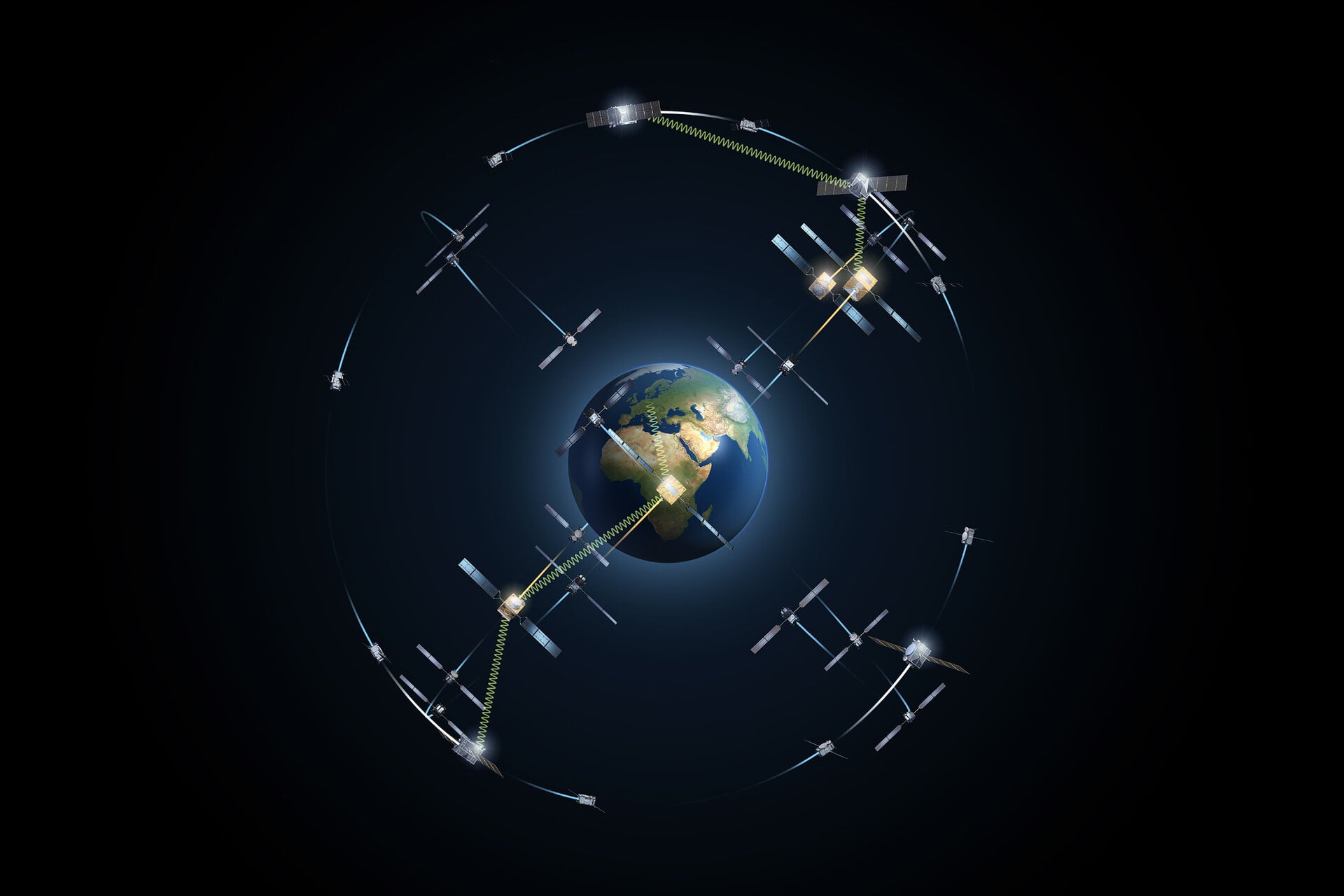
The European Space Agency has awarded contracts to Airbus and Thales Alenia Space to build four additional Galileo Second Generation satellites. The expansion grows the G2 fleet to 16 spacecraft, backed by full digital payloads and enhanced atomic clocks designed to strengthen Europe’s independent satellite navigation capabilities.
The European Space Agency has formally expanded its satellite procurement pipeline, extending ongoing manufacturing agreements to secure four additional second-generation spacecraft for the Galileo. Contracts were finalized in Rome on October 23 and in Ottobrunn on October 26, cementing commitments from prime industrial partners Airbus Defence and Space and Thales Alenia Space. The latest additions bring the total number of Second Generation (G2) satellites ordered to 16, reinforcing a constellation that has served billions of users since entering open service in 2016.
Airbus and Thales Alenia Space Secure Additional G2 Orders
The newly procured quartet of spacecraft builds directly upon existing production agreements signed in 2021, which originally tasked each prime contractor with building six G2 units. Thales Alenia Space in Italy and Airbus Defence and Space in Germany will utilize established manufacturing lines to build the four new additions.

Alain Fauré, Head of Space Systems at Airbus, highlighted the manufacturing footprint required across multiple European facilities.
This latest award for two additional sophisticated Galileo satellites underscores Airbus’ satellite manufacturing expertise. We are committed to delivering these next-generation satellites which are vital to augment navigation capabilities for European security and defence and wider societal benefits.
Alain Fauré, Head of Space Systems at Airbus
Production work spans several specialized European sites. Airbus is distributing manufacturing, integration, and testing tasks across facilities in Friedrichshafen, Ottobrunn, Backnang near Stuttgart, Toulouse, and Getafe near Madrid.
Airbus to build 2️⃣ additional Galileo G2 satellites 🧭🛰️Airbus Defence and Space has been contracted by the European Space Agency @esa on behalf of the EU agency for Space Programme @EU4Space to build two additional Galileo Second Generation (G2) satellites.Building on the… pic.twitter.com/NQDgvc5UCf
Upgraded Digital Payloads and Anti-Spoofing Architecture
Weighing more than two tonnes each, the second-generation satellites are engineered for a 15-year operational lifespan in orbit. Unlike their first-generation predecessors, the G2 craft incorporate fully digital payloads that can be reconfigured directly in orbit, enabling operators to deploy novel signals and adjust to evolving user requirements over time.
The technical specifications target significant performance gains across positioning, navigation, and timing services. Each satellite incorporates an enhanced atomic clock configuration alongside inter-satellite links that allow the spacecraft to communicate and cross-check data independently. Higher-strength navigation antennas and advanced anti-jamming and anti-spoofing capabilities are integrated to protect signal integrity against interference.
Contracts Strengthen Strategic Autonomy
Acting on behalf of the European Union—the system’s owner—and the European Union Agency for the Space Programme (EUSPA), which manages service operations and launch deployment, the European Space Agency oversees the initiative as system design and qualification authority.
With these contracts, ESA and European industry are safeguarding the continuity of Europe’s satellite navigation services, responding to the evolving needs of users, and strengthening Europe’s strategic autonomy. These contracts represent an investment in Europe’s ability to navigate its own future, independently and with confidence.
Laurent Jaffart, ESA Director of Resilience, Navigation and Connectivity
The four newly contracted G2 satellites are scheduled for delivery in 2031, with launches slated immediately afterward. Meanwhile, development of the initial 12 Second Generation satellites is nearing completion. System integration and compatibility testing are underway, setting up flight testing for the earliest spacecraft in 2027 ahead of a targeted inaugural G2 launch in 2028. Once in orbit, the G2 fleet will integrate with the 38 First Generation satellites already deployed.
Webb Study Compares Interstellar Comet 3I/ATLAS With Solar System Icy Bodies
Water ice with a deuterium-to-hydrogen ratio of 0.98 percent was detected by the James Webb Space Telescope in...

Brown engineers build brain-inspired camera for low-visibility environments
Drawing power measured in only tens of milliwatts, Engineers at Brown University have built a brain-inspired imaging system...
Sun’s Death Shreds Outer Solar System in Billion Years
New computer simulations published in The Astrophysical Journal Letters indicate the Sun's irregular mass loss as it dies...
Vera C. Rubin Observatory Captures Seagull Nebula in 2026 Test Image
The resulting test image, shared in October 2026, captures the head of the Seagull Nebula, officially cataloged as...