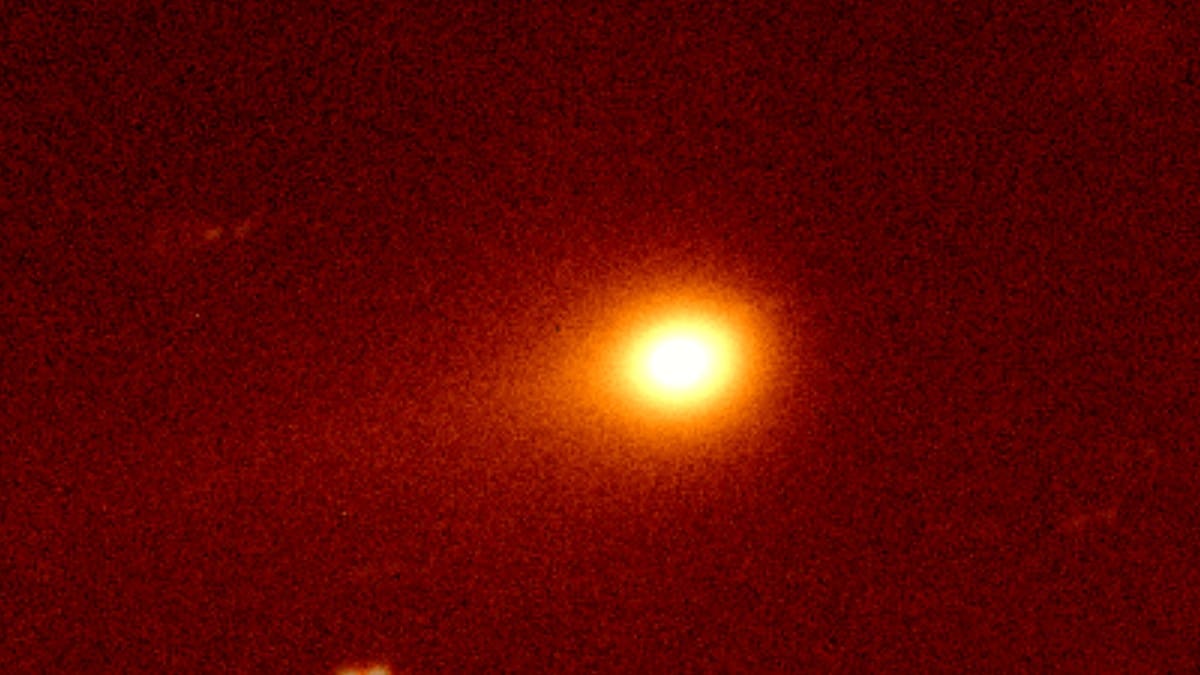
Water ice with a deuterium-to-hydrogen ratio of 0.98 percent was detected by the James Webb Space Telescope in grains streaming from interstellar comet 3I/ATLAS, matching the composition of icy bodies in the outer solar system.
When the interstellar visitor 3I/ATLAS journeyed through our solar system, it brought a pristine record of planet formation from a distant stellar neighborhood. Identified as only the third confirmed object from beyond our solar system, the comet drew a coordinated observation campaign involving multiple space agencies and ground-based telescopes.
Mars Orbiters Photograph Interstellar Comet
The interstellar intercept campaign kicked off when ESA’s ExoMars Trace Gas Orbiter photographed 3I/ATLAS from Mars orbit on October 3, 2025. That effort marked the first time a spacecraft orbiting another planet aimed its camera at an interstellar object. China’s Tianwen-1 Mars orbiter also photographed the comet between October 1 and October 4, according to the China National Space Administration.
Ground-based instruments quickly joined the tracking effort. Astronomers using the VIRUS instrument on the Hobby-Eberly Telescope in Texas recorded gas emissions spanning more than 85,000 kilometers from the nucleus. Integral-field-unit data showed that the gas coma expanded at roughly half the velocity observed in typical solar system comets at comparable distances. Spectroscopic observations also revealed prominent, unusually strong emission lines from neutral iron and nickel atoms in the coma.
🆕 Webb has found clues to the ancient origins of 3I/ATLAS!As the interstellar comet 3I/ATLAS began moving away from the Sun in December 2025 ☄️ astronomers took the opportunity to study its chemical makeup with the #NIRSpec instrument on Webb. This allowed them to understand… pic.twitter.com/apCg2UTiOT
Webb Space Telescope Reveals Deuterium-Rich Ice
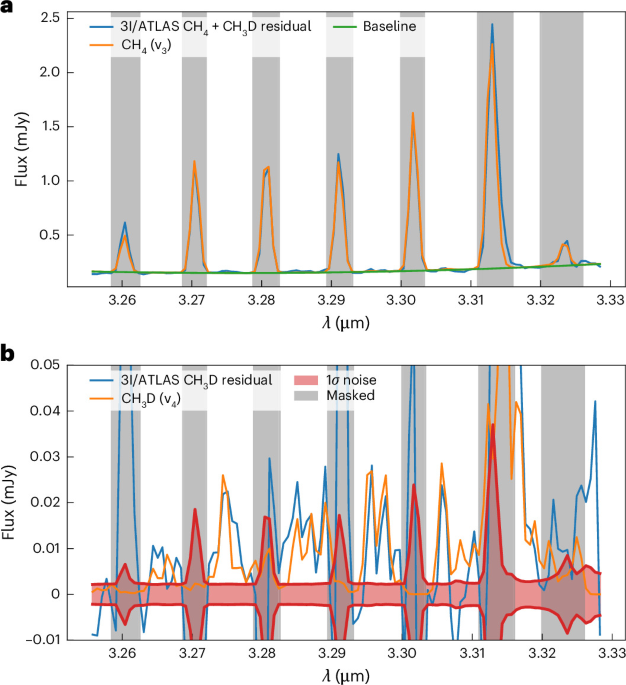
The campaign’s chemical insights emerged from observations with the James Webb Space Telescope’s NIRSpec instrument, managed by a team led by Martin Cordiner of NASA’s Goddard Space Flight Center. Researchers mapped water, carbon dioxide, and carbon monoxide across the comet’s coma, uncovering an extreme isotopic signature. The water ice exhibited a deuterium-to-hydrogen ratio of 0.98 percent, plus or minus 0.06 percent. That concentration sits more than 10 times higher than any known solar system comet and beyond values measured in nearby interstellar clouds and protoplanetary disks. Carbon isotope ratios were equally unusual, with carbon dioxide showing carbon-12-to-carbon-13 ratios ranging from 141 to 191, and carbon monoxide ranging from 123 to 172.
Building on these spectral mappings, a Southwest Research Institute-led study examined the physical state of the ice grains streaming from the nucleus. Dr. Silvia Protopapa and her collaborators analyzed data gathered by Webb’s Near-Infrared Spectrograph across three observations between August 2025 and April 2026.
Webb is looking at the chemical fingerprints of interstellar comet 3I/ATLAS in the mid-infrared 🔎 New data points to a very different formation environment and chemistry for this object compared to most comets that formed in our own solar system. https://t.co/6xJl3L6W9K pic.twitter.com/IyA14WwRqd
As 3I/ATLAS gains heat, interior gases vent outward, sweeping both ice and dust particles into the surrounding coma. Those grains hold clues to the conditions where the comet was born.
The Webb data pointed to tiny aggregates of water ice and dust about a micron or smaller in size. When researchers compared these spectra with trans-Neptunian objects orbiting beyond Neptune, they found a resemblance in the 3-micron water-ice absorption band, particularly with distant icy bodies whose spectra also highlight carbon dioxide ice and organic compounds.
Surface Erosion and Polarimetric Discoveries
Researchers Tessa T. Frincke and Darryl Z. Seligman of Michigan State University compiled production rates to estimate how much surface material vaporized during the solar system passage. Their framework calculated that gas-only solar heating removed approximately 1.71 to 5.24 meters of the comet’s surface, corresponding to roughly 1010 kg of material, or about 0.40 to 1.25 percent of its initial mass. When factoring in dust-to-gas ratios ranging from 1 to 4, total surface erosion likely exceeded 10 meters.
Researchers studying the light scattered by 3I/ATLAS dust discovered a polarization pattern differing from typical solar system comets. When the angle between the Sun and the observer was small, parallel-direction polarization—termed negative polarization—was stronger than in local comets, pointing toward a porous structural aggregation where small grains are bound together with numerous microscopic gaps.
Comet Heads Outbound Beyond Jupiter
After crossing closest approach to Earth on December 19, 2025, at roughly 1.8 astronomical units or 269 million kilometers, the interstellar wanderer resumed its high-speed outbound trip. Moving at tens of kilometers per second, 3I/ATLAS travels far beyond Jupiter’s orbit on a one-way trajectory back into interstellar space, remaining visible only to large professional installations like Hubble and JWST as astronomers continue tracking how its volatile activity shuts down.
Worth a look

Brown engineers build brain-inspired camera for low-visibility environments
Drawing power measured in only tens of milliwatts, Engineers at Brown University have built a brain-inspired imaging system...
Sun’s Death Shreds Outer Solar System in Billion Years
New computer simulations published in The Astrophysical Journal Letters indicate the Sun's irregular mass loss as it dies...

Vera C. Rubin Observatory Captures Seagull Nebula in 2026 Test Image
The resulting test image, shared in October 2026, captures the head of the Seagull Nebula, officially cataloged as...
ClearSpace UK to capture defunct British satellites
The UK Space Agency signed a £61.3 million contract with ClearSpace UK to build a robotic spacecraft featuring...