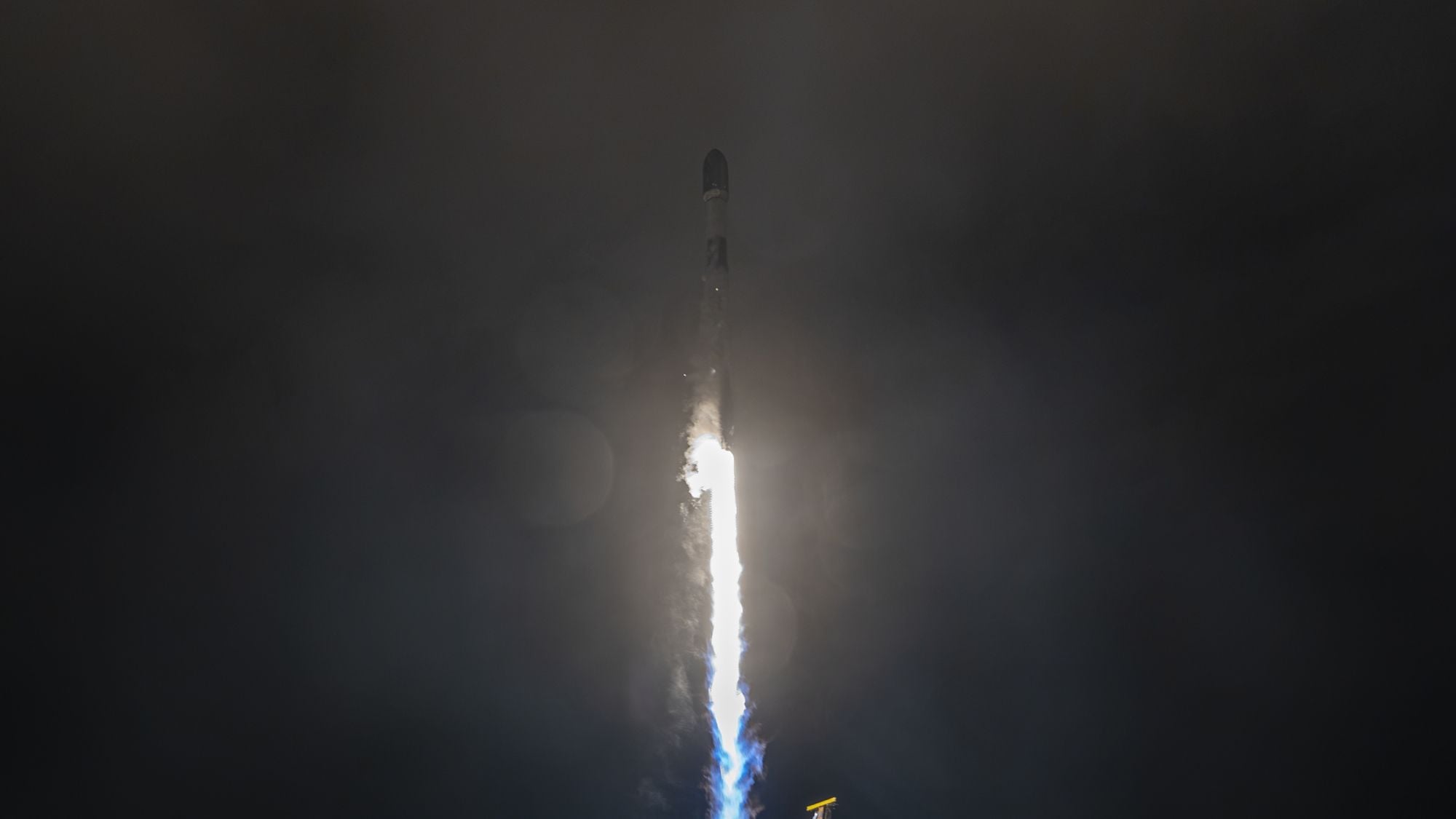
SpaceX launched 27 Starlink satellites into low Earth orbit aboard a Falcon 9 rocket from Vandenberg Space Force Base on Tuesday morning, marking the installation’s 71st or 72nd launch of 2026 while continuing a measured slowdown in the company’s West Coast operational cadence.
Early Tuesday morning at Space Launch Complex 4 East in California, a Falcon 9 rocket cleared the pad carrying 27 Starlink satellites into low Earth orbit. Liftoff occurred at 12:25 a.m. PDT (3:25 a.m. EDT / 0825 UTC), sending the payload on a southeast trajectory inclined 70 degrees to the equator. Space Launch Delta 30 personnel, consisting of Airmen and Guardians, backed the operation by supplying range services that help guarantee access to space from the principal West Coast test range and spaceport. DVIDS identified the flight as the 71st launch supported from Vandenberg in 2026, while local reporting indicated the mission pushed the base past the total number of launches recorded during all of 2025, when a record was set at 165 launches completed company-wide. KSBY News placed the count at the 72nd launch from the base since the start of the year, officially surpassing the total number of launches for all of 2025.
Because the returning booster plunges through the atmosphere at supersonic velocities and creates atmospheric shock waves that register on the ground as explosive noises as it decelerates, inhabitants throughout Santa Barbara County, San Luis Obispo County, and Ventura County encountered a fair chance of perceiving one or more sonic bangs, contingent upon prevailing local weather patterns and additional variables.
Booster B1082 Completes 26th Flight and Droneship Landing
Making its 26th flight overall, the booster previously flew missions including USSF-62, OneWeb Launch 20, NROL-145, Transporter-18, and 21 batches of Starlink V2 Mini satellites since entering service in January 2024.
Following separation, B1082 adjusted its trajectory for a touchdown on the company droneship Of Course I Still Love You,
stationed in the Pacific Ocean off the coast of Baja California, Mexico. At T+8:23, the booster touched down successfully on OCISLY, occurring just moments ahead of the Falcon 9 second stage wrapping up its initial engine firing. About an hour into flight, following a short circularization burn that lasted a very short 3 seconds, the stack of 27 Starlink V2 Mini optimized satellites was released from the rocket’s second stage.
Vandenberg Launch Cadence and Record Calculations
Despite heavy activity in California, overall Falcon 9 deployment frequency has slowed as SpaceX shifts focus to its larger, more powerful Starship rocket under development, which features a payload bay built to carry upgraded Version 3 Starlink satellites that are too big for the Falcon 9. Company plans already include phasing out Falcon 9 operations, having already ended Florida-based Starlink flights earlier in the year following the 100th Falcon 9 launch of 2026 from Cape Canaveral Space Force Station. Pointing to prospective plans to gain entry into upwards of 80,000 American cell sites in its pursuit to grow past satellite internet and construct a nationwide cellular network, financial analysts at Bank of America incorporated SpaceX into their ‘US 1 List’ of premier investment recommendations. Bernstein also raised its SpaceX price target to $268 from $248 with an ‘Outperform’ rating, expecting stronger growth from the company’s AI computing business and enterprise connectivity services, alongside a raised revenue forecast to $424 billion in 2028.

Frequently Asked Questions About the Vandenberg Starlink Mission
What was the exact payload for the flight?
The mission carried 27 Starlink V2 Mini optimized broadband internet satellites into low Earth orbit.
Where did the first-stage booster land?
Booster B1082 touched down on the droneship named Of Course I Still Love You,
positioned in the Pacific Ocean off Baja California, marking its 26th successful recovery.
When did liftoff actually occur?
Following a postponement from Monday night, the Falcon 9 rocket launched on Tuesday morning at 12:25 a.m. PDT (3:25 a.m. EDT / 0825 UTC) from Space Launch Complex 4 East at Vandenberg Space Force Base.
Related reading
Airbus to Build Two of Four More Galileo Satellites
The European Space Agency has awarded contracts to Airbus and Thales Alenia Space to build four additional Galileo...
Webb Study Compares Interstellar Comet 3I/ATLAS With Solar System Icy Bodies
Water ice with a deuterium-to-hydrogen ratio of 0.98 percent was detected by the James Webb Space Telescope in...

Brown engineers build brain-inspired camera for low-visibility environments
Drawing power measured in only tens of milliwatts, Engineers at Brown University have built a brain-inspired imaging system...
Sun’s Death Shreds Outer Solar System in Billion Years
New computer simulations published in The Astrophysical Journal Letters indicate the Sun's irregular mass loss as it dies...