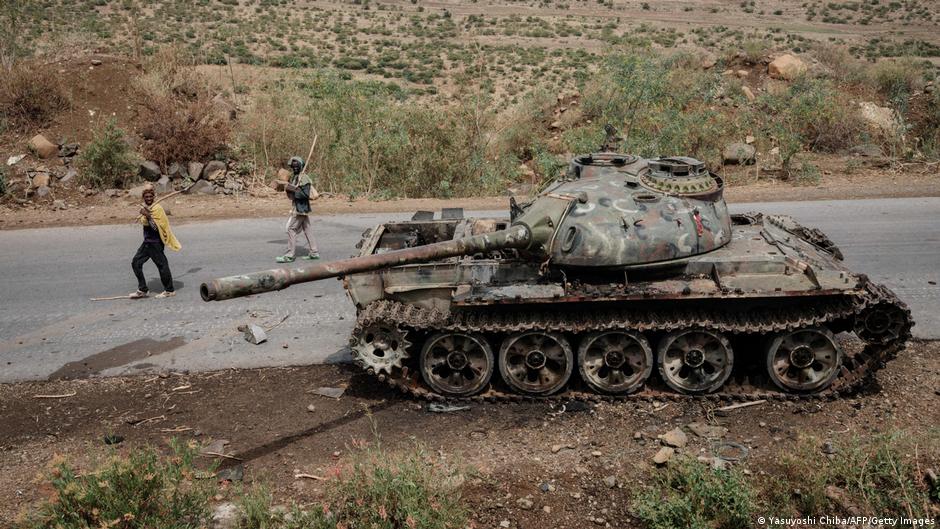
Ethiopian government forces launched drone strikes against Eritrean military positions near the northern town of Adigrat this week, marking a volatile escalation in the region. The strikes followed reports of Eritrean troops crossing the border into Ethiopia’s Tigray region, further fracturing diplomatic relations already severed by both nations earlier this month.
Drone Strikes and Troop Movements in Adigrat
Renewed conflict in northern Ethiopia has intensified as federal government drones targeted Eritrean forces positioned near Adigrat. Witnesses and conflict monitors reported multiple strikes overnight between Wednesday and Thursday, describing the destruction of military lorries and the subsequent retreat of personnel. According to the conflict monitoring group ACLED, the strikes targeted Eritrean troops and ammunition
in the area. A witness in Adigrat reported hearing a massive explosion during the night
and observing military vehicles that had been struck by a drone.
The presence of Eritrean troops inside Ethiopia was confirmed by multiple local accounts. Residents of Adigrat told the BBC they witnessed convoys of trucks—some bearing Eritrean registration plates—moving south toward Edaga Hamus. Ermiyas Ababu, a commander with the Tigray Peace Force, stated that Eritrean personnel had entered Adigrat on Tuesday and Idaga Hamus on Wednesday to conduct surveillance. Another resident, who requested anonymity, reported seeing approximately 40 trucks carrying soldiers moving south. While Eritrea’s information minister, Yemane Gebremeskel, dismissed the reports as wild allegations,
he did not explicitly confirm or deny the presence of his country’s troops on Ethiopian soil, instead accusing Ethiopia of creating a fallacious narrative of ‘self-defense’ to rationalise and camouflage its war of aggression.
Diplomatic Rupture Between Addis Ababa and Asmara
The military friction follows a rapid collapse of diplomatic ties. On October 1, the Ethiopian government ordered the closure of its embassy in Asmara and declared 10 Eritrean diplomats persona non grata, citing direct and indirect acts of hostility and belligerence.
Eritrea responded by severing all diplomatic relations with its neighbor, stating it had no option but to reciprocate in kind.
This fallout is deeply rooted in the shifting alliances of the Horn of Africa. During the 2020–2022 civil war, Eritrea fought alongside Ethiopian federal forces against the Tigray People’s Liberation Front (TPLF). Prime Minister Abiy Ahmed’s consistent push for Ethiopia to secure sovereign access to the Red Sea has become a primary point of contention; Asmara fears Ethiopia may attempt to seize the port of Assab by force. In his recent statements, Yemane Gebremeskel accused Ethiopia of openly working to bring about regime change in Eritrea by providing shelter and support to certain mercenaries who claim to be opposition.
TPLF Offensive Sparks Conflict Involving Regional Neighbors
The current fighting is concentrated in Tigray, where a seven-group armed alliance led by the TPLF launched an offensive on September 23. While federal forces captured the regional capital of Mekelle on October 4, the government continues to face pockets of resistance. The conflict has drawn in regional players beyond Ethiopia and Eritrea, with Addis Ababa accusing Egypt and Sudan of providing support to the opposition coalition—an allegation all three nations deny. Cairo responded to the expulsion of its own diplomats by declaring an Ethiopian embassy counselor in Egypt persona non grata.
The African Union Commission has issued an appeal for maximum restraint,
urging all parties to resolve their disputes through established diplomatic channels. Despite this, the humanitarian toll of the resumed fighting remains high. Civilians in Tigray, Amhara, and Afar, who were just beginning to recover from the two-year civil war that ended in 2022, now face renewed displacement and violence. As Jalale Getachew Birru, an analyst at ACLED, noted, the population didn’t get healed from the first round of violence
before the latest hostilities broke out.

Historical Context and Wider Implications
The current volatility evokes the long-standing enmity between the two nations, who previously fought a border war from 1998 to 2000. That conflict, which transformed a border dispute into one of Africa’s most destructive interstate wars, left deep military and political ruptures. While Prime Minister Abiy Ahmed earned the 2019 Nobel Peace Prize for his historic rapprochement with President Isaias Afwerki just eight years ago, the recent escalation marks a dramatic collapse of that peace. Ethiopia now faces a complex military environment, with reports of fighting occurring as far as the Tekeze River, where federal forces recently gained control of Adi Gebru.
Beyond the immediate border conflict, the situation is further complicated by Ethiopia’s broader security doctrine. Senior government official Abraham Belay recently accused the Eritrean army of participating with its full capacity and logistics,
warning that there is no doubt that the retaliation will be double.
As the conflict continues, the region remains caught between the promise of connectivity and the persistent pull of historical grievances and security-driven mobilization.
More on Yemane Gebremeskel
Worth a look

Oxford and Mastercard Foundation Offer Fully Funded MBA Scholarships for Africans
Oxford University and the Mastercard Foundation have established up to three fully funded graduate scholarships for African nationals...

Donald Trump Demands Lower Interest Rates as Mortgage Costs Climb
US President Donald Trump demanded lower interest rates on Wednesday, criticizing Federal Reserve policymakers as average 30-year mortgage...

FlyDubai Co-Pilot Attacks Captain on Flight to Israel, Lands in Saudi Arabia
Out of 172 passengers and crew aboard a Boeing 737 MAX plunging from 33,000 feet to 17,000 feet...

Can Xue and Anne Carson Lead Nobel Literature Betting Markets
The 2026 Nobel Prize in Literature will be announced on October 8, with Can Xue and Anne Carson...