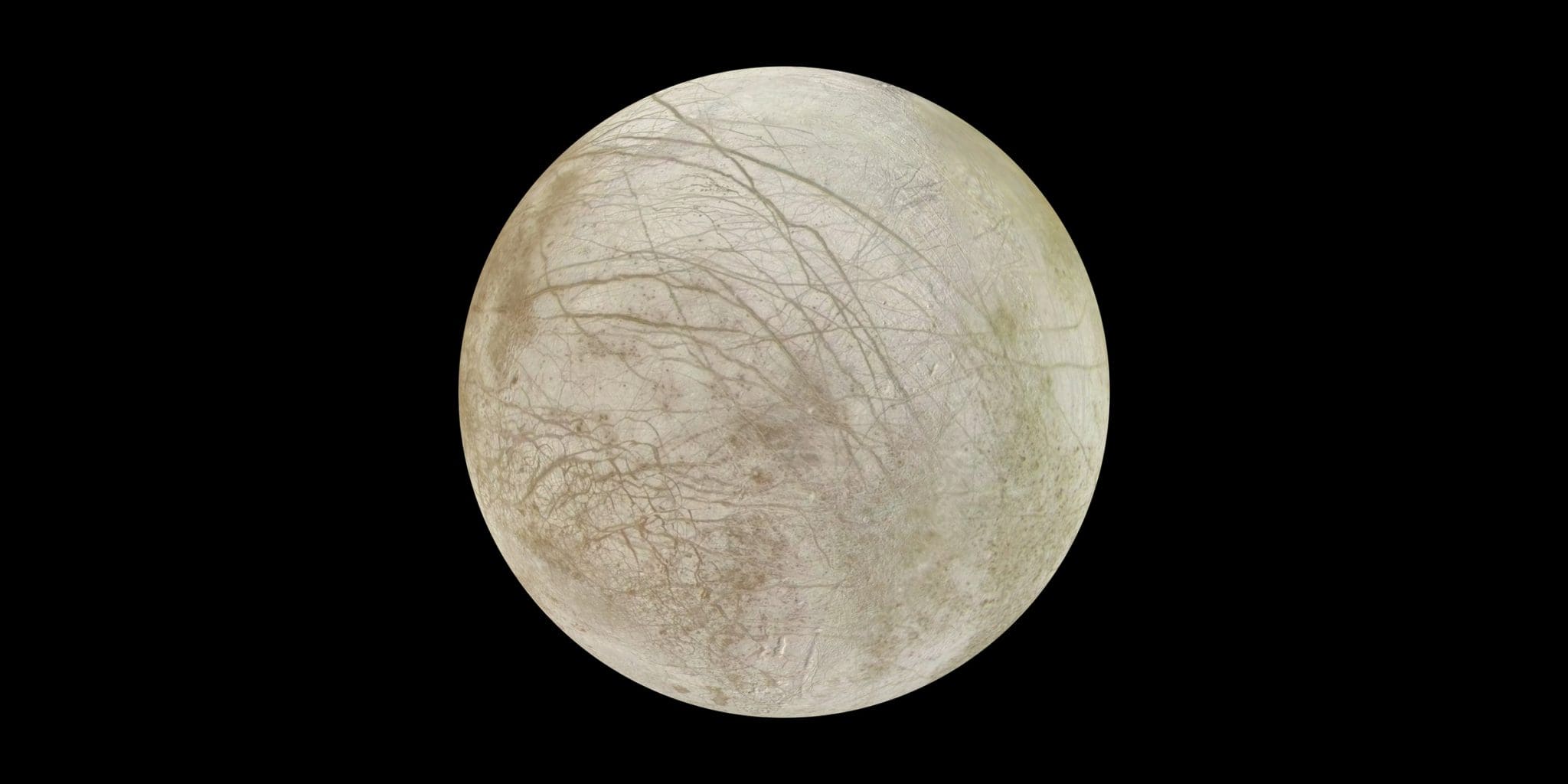
New computational modeling reveals that liquid water from Europa’s global subsurface ocean is far less likely to reach the moon’s upper ice layer than previously assumed. Published in Nature Astronomy, the research demonstrates that the icy shell acts as a rigid barrier, complicating future space exploration missions targeting Jupiter’s moon.
The search for extraterrestrial life has long pinned its hopes on Jupiter’s moon Europa. Beneath a thick, fractured shell of ice, the moon is widely believed to hold a vast global saltwater ocean in contact with a rocky interior. For astrobiologists, that combination of liquid water, chemistry, and potential energy sources makes it a premier destination in our solar system. Reaching that deep ocean directly, however, has always presented a daunting engineering challenge.
Scientists had hoped that narrow fractures known as dikes might serve as natural conduits, allowing deep ocean water to rise via cryovolcanism and pool in shallow reservoirs near the surface. Such pockets would offer a much easier target for incoming space probes to analyze without drilling tens of kilometers through solid ice. A new study published in Nature Astronomy challenges that optimistic assumption, suggesting that getting to Europa’s secrets is significantly more complicated than expected.
Why Deep Ocean Pathways Freeze Shut
Earlier theoretical models often treated water rising through Europa’s ice as if it moved in a relatively orderly, laminar flow. To test whether deep water can truly complete the journey to the upper ice shell without freezing along the way, a research team led by planetary scientist Lujendra Ojha at Rutgers University ran advanced simulations accounting for fluid dynamics and heat exchange.

The computational modeling arrived at a discouraging conclusion: fluid movement through these deep cracks would actually be highly turbulent. This constant churning forces rising water to rapidly dissipate its internal heat into the surrounding ice shell. As the water cools below its freezing point, it becomes supercooled and forms microscopic ice crystals known as frazil ice. These crystals quickly accumulate, blocking the pathway and freezing narrow fractures completely shut within hours.
“There’s all this speculation about how that water can come from deep underground and make its way all the way up without freezing en route. That’s really what we think we disproved.”
Lujendra Ojha, earth scientist at Rutgers University
Reassessing Surface Water and Seafloor Energy
If deep ocean water cannot reliably force its way to the surface, how do we explain the small pools of water and localized features observed by astronomers? The findings suggest that shallow pockets of liquid water discovered within Europa’s crust are likely created by localized internal friction and melting within the ice shell itself, rather than direct replenishment from the ocean below.
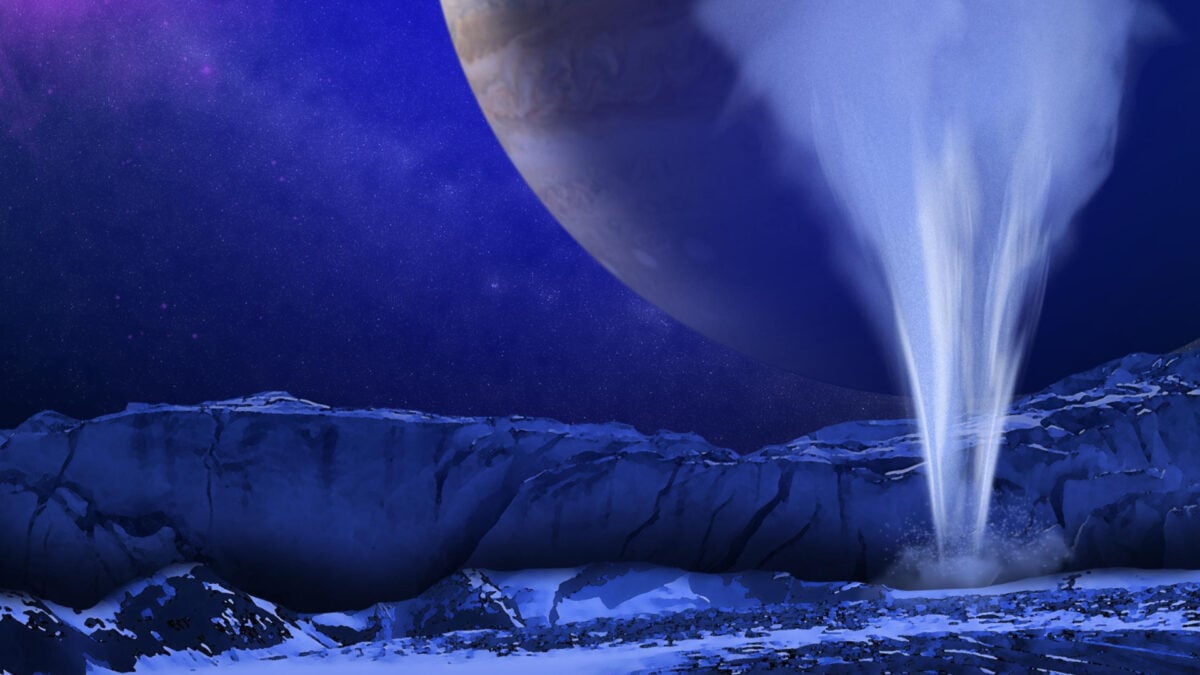
This distinction carries major consequences for future sampling. As Lujendra Ojha noted to Gizmodo, chemical, physical, and biological constraints derived from studying shallow liquid water layers may not reflect the actual chemistry of the underlying ocean. Beyond the ice shell, researchers have also questioned the energy available at the bottom of that hidden ocean. A separate study examined whether Europa’s rocky seafloor experiences active faulting akin to Earth’s hydrothermal systems. That mechanical modeling calculated that present tidal stress at Europa’s seafloor is only about 54 kilopascals—roughly 3 percent of what would be required for extensional faulting 100 meters below the seafloor.
Incoming Spacecraft and What to Watch Next
Despite these physical hurdles, the scientific community’s focus on Jupiter’s moon remains intense, bolstered by upcoming planetary missions designed to probe its frozen exterior. NASA’s Europa Clipper launched in October 2024 and is scheduled to arrive at the Jovian system in April 2030 to execute 49 close flybys. Equipped with ice-penetrating radar, the spacecraft will actively search for shallow water pockets and map the internal structure of the shell.
It will be followed by the European Space Agency’s JUICE mission, which launched in April 2023 and will arrive in July 2031 to study Europa alongside Ganymede and Callisto. Mission scientists will use the new hydrodynamic models as critical theoretical context to interpret the compositional data and radar measurements collected during these high-stakes flybys.
Webb Telescope Finds Chariklo’s Rings Are Changing Over Years
Astronomers using the James Webb Space Telescope (JWST) have discovered that the two narrow rings surrounding the distant...

SpaceX Launches Final Three O3b mPOWER Satellites for SES
SpaceX successfully launched the final three O3b mPOWER satellites for SES on September 13, 2026, from Cape Canaveral...
Japan Launches Kaguya Spacecraft to Map Moon in 2007
On September 13, 2007, Japan launched its advanced Kaguya spacecraft from the Tanegashima Space Centre aboard an H-IIA...

Astronomers Identify Eos, a Massive Molecular-Hydrogen Cloud Near the Sun
Astronomers have identified Eos, a massive molecular-hydrogen cloud located roughly 300 light-years away and spanning 40 full-Moon widths...