Astronomers using NASA’s Hubble Space Telescope have uncovered evidence of an ancient dwarf galaxy merger, extending our understanding of the Milky Way’s assembly timeline. The findings, published in the journal Nature Astronomy, show that the infant Milky Way absorbed an ancient dwarf galaxy shortly after the Big Bang.
Unlocking the Milky Way’s Earliest History With Hubble
Our home galaxy grew to its massive modern size by consuming smaller neighbors, but peering into its earliest years remains a profound challenge. As NASA’s Hubble Space Telescope reveals, researchers have successfully peered past 10 billion years ago to spot signs of an ancient collision. The findings, published in the journal Nature Astronomy, show that the infant Milky Way absorbed an ancient dwarf galaxy shortly after the Big Bang.

While recent galactic history includes the Sagittarius dwarf galaxy—a massive merger that began over 6 billion years ago and continues today—and the Gaia-Sausage-Enceladus collision 10 billion years ago, theorists have long debated whether an even earlier event occurred. Hubble’s high-resolution imaging and depth have finally settled that debate, extending humanity’s knowledge of the galaxy’s evolutionary timeline.
Using Globular Clusters as Cosmic Archaeological Sites
Because the early Milky Way was smaller, much closer in size to the galaxies it encountered, and far more chaotic, the physical signs of ancient clashes risk being entirely erased over billions of years. To find them, researchers turned to globular clusters—immense, roughly spherical collections containing tens of thousands to a few million stars. These clusters host some of the oldest stars in the galaxy, serving as cosmic archaeological sites that preserve stellar populations gathered from absorbed galaxies.
A team analyzed Hubble observations of 39 globular clusters positioned within the inner 20,000 light-years of the Milky Way, the exact zone where the most ancient merger remnants are preserved. By combining Hubble’s data with measurements from the European Space Agency’s Gaia mission, the researchers calculated each cluster’s precise age and metallicity—the abundance of elements heavier than helium.
“Thanks to the high resolution and depth of Hubble imaging, we could measure the age and the metal content of these clusters with unprecedented precision.”
Chiara Zerbinati, University of Bologna in Italy
Discovering the Dwarf Galaxy
The precision age and metallicity measurements revealed a distinct third population of globular clusters nestled in the inner galaxy. These clusters proved older than the group collected during the Gaia-Sausage-Enceladus merger, yet younger than those born natively inside the Milky Way, regardless of their metal content.
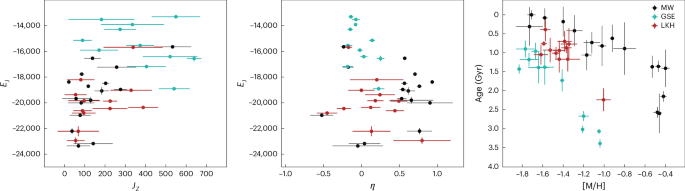
That distinct grouping proved they originated from a separate and much earlier galactic collision. According to the study, the absorbed dwarf galaxy contained a significant fraction of the Milky Way’s mass at that epoch. Researchers named this newly identified building block, honoring three preceding research papers that championed the theory of an early galactic merger.
“In this paper we discover where the first significant batch of bricks came from: a dwarf galaxy that we call LKH.”
Davide Massari, Astrophysics and Space Science Observatory of Bologna in Italy
Rewriting the Evolutionary Models of Spiral Galaxies
Confirming a massive merger so early in the Milky Way’s formation forces astrophysicists to rethink how spiral galaxies assemble. Past models often assumed that the earliest phases of stellar evolution were defined strictly by stars born locally within the host galaxy itself.
By demonstrating that external galaxies played a foundational role even 11.8 billion years ago, the findings require models of galactic evolution to account for imported stars from the very beginning. The discovery bridges a vital gap in cosmological archives, validating decades of theoretical simulations with sharp, observational proof from space-based instruments.
Worth a look
SpaceX Falcon 9 Upper Stage Strikes Moon, Renewing Lunar Waste Debate
An 8,800-pound, four-tonne SpaceX Falcon 9 upper stage struck the Moon on August 5, 2026, according to Space....
Lawrence Livermore Researchers Shock-Compress Diamond to Resolve 20-Year Debate
Researchers at Lawrence Livermore National Laboratory used the Omega Laser Facility to shock-compress diamond samples to extreme temperatures...
Antarctica’s Blood Falls Hosts Marine Microbes Sealed for Millions of Years
Sealed beneath Antarctica's Taylor Glacier for more than a million years, Blood Falls discharges a rust-red brine fed...
Exoplanet Spin Measurements Risk Capturing Atmospheric Winds
Astronomers warn that measuring the rotation of distant exoplanets often captures atmospheric winds rather than a planet's true...