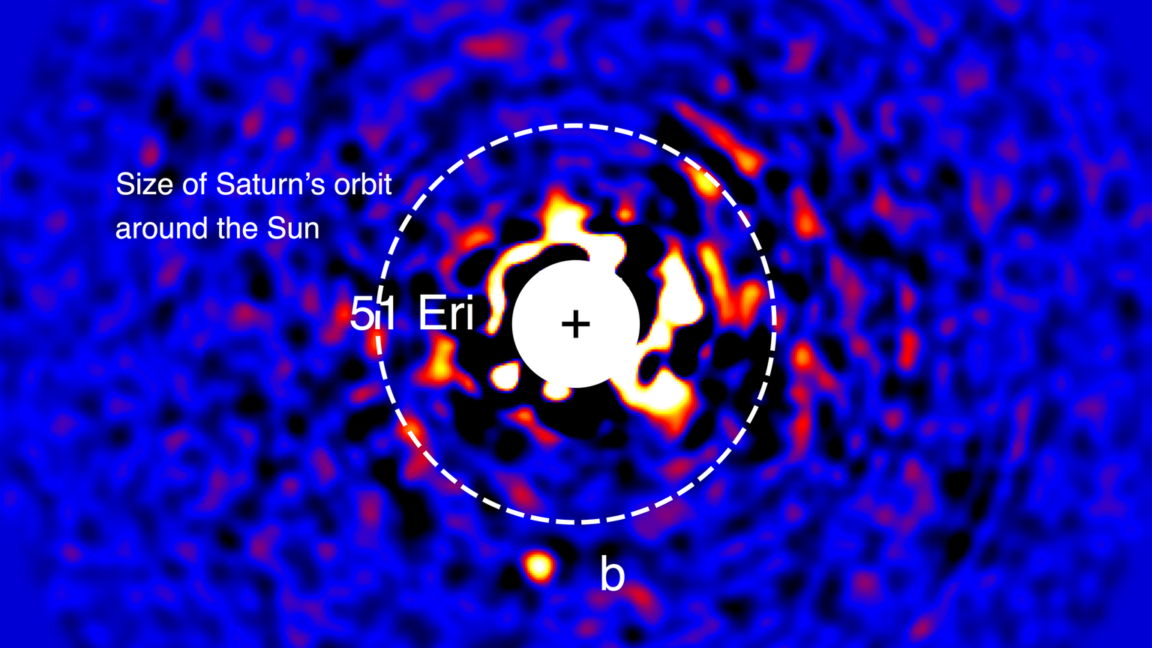
Astronomers have developed a new software technique that makes the James Webb Space Telescope two to 15 times more sensitive for directly imaging planets around other stars, revealing a planet previously hidden in its data.
The Challenge of Stellar Glare
Directly imaging exoplanets is notoriously difficult because these worlds can be up to 10 billion times fainter than the stars they orbit. Even the most powerful telescopes struggle to separate the faint planet light from the overwhelming glare of its host star. The James Webb Space Telescope, while optically stable to the nanometer level, still has physical imperfections and instabilities that limit its ability to detect smaller, closer-in planets.
Traditional methods to remove this stellar glare, such as using a coronagraph—a device that blocks starlight, likened to an artificial eclipse
—are not perfect. Tiny mismatches between observations, caused by slight shifts in the telescope’s mirrors or temperature changes, leave smudges of starlight that can conceal a planet’s signal.
A New Computational Approach
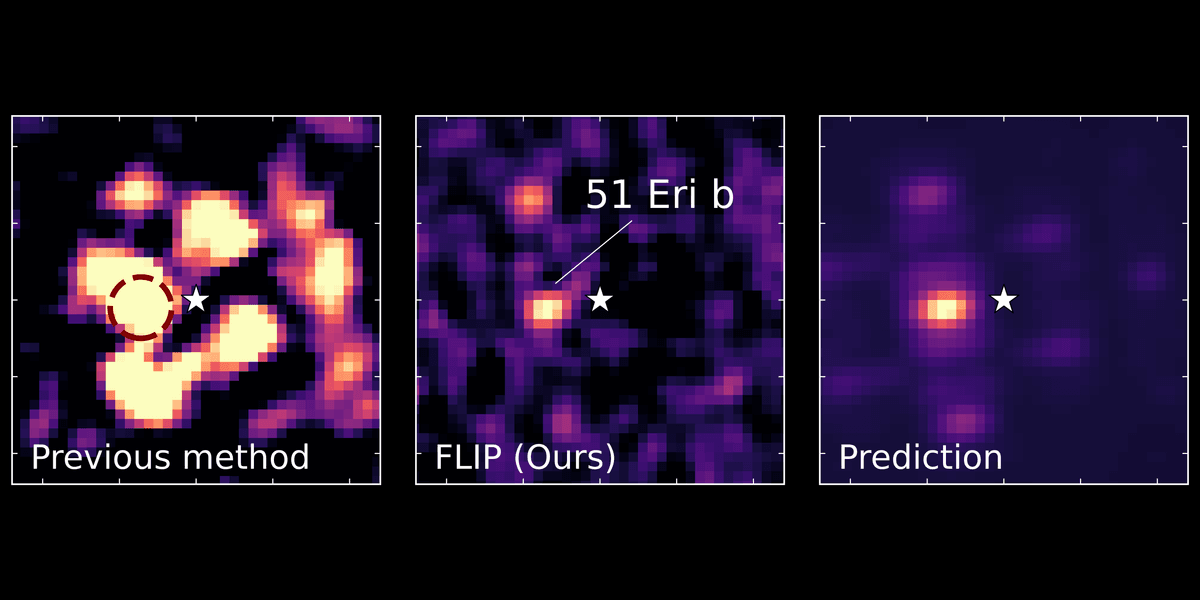
To overcome this, a team of researchers developed a method called Physics-based Learning for Imaging Planets (FLIP). Instead of relying on physical measurements of other stars, FLIP builds a detailed digital twin of the JWST’s Near Infrared Camera (NIRCam). This model incorporates millions of possible physical parameters and imperfections, allowing it to simulate exactly how the telescope observes a specific star.
👀 Sneak a peek at the deepest & sharpest infrared image of the early universe ever taken — all in a day’s work for the Webb telescope. (Literally, capturing it took less than a day!) This is Webb’s first image released as we begin to #UnfoldTheUniverse: https://t.co/tlougFWg8B pic.twitter.com/Y7ebmQwT7j
— https://x.com/NASAWebb/status/1546621080298835970
By running this simulation on a GPU, the software optimizes its parameters to match real-world observations. This process, which takes about half an hour, allows researchers to create a perfect model of a star’s glare. They can then subtract this simulated glare from actual JWST images, revealing any hidden planets.
As the lead author, Rodrigo Ferrer-Chavez, explained, As you go through this iterative process of trying to find what the telescope actually is doing during observations, you basically see the glare of the star disappearing in very bizarre ways. It gets dimmer and very deformed until at the end you get a pretty clean image and, if you’re lucky, there’s a blob there, which is a glowing planet.
Detecting the Previously Hidden
The team tested FLIP on JWST observations of three young star systems. In one system, 51 Eridani, the software successfully detected the giant planet 51 Eri b—a world that was not visible in the original analysis using standard techniques. For another star, TYC 5899, the new method boosted the sensitivity of observations by a factor of 15.
This result was noted by outside experts as significant. Dimitri Mawet, a senior research scientist at NASA’s Jet Propulsion Laboratory who was not involved in the study, said, This is a significant result.
He added that while model-based methods for removing starlight have been discussed for over a decade, Ferrer-Chavez and colleagues have shown it can outperform methods based on physical measurements. Ferrer-Chavez and colleagues show that it can,
Mawet stated.
A Technique for Any Telescope
The researchers emphasize that FLIP is not limited to the James Webb Space Telescope. Its design means it could be applied to any telescope, including upcoming missions like NASA’s Nancy Grace Roman Space Telescope and the planned Habitable Worlds Observatory (HWO).
According to Caltech’s Katie Bouman, a co-author on the paper, We’re excited because this technique is not limited specifically to JWST. Because of some very specific design, this technique could be used on any telescope.
The team believes that computational advancements like FLIP could help future missions like HWO, which aims to find Earth-like planets and signs of life, by easing some of the extreme hardware stability requirements.
Ferrer-Chavez notes that the ultimate goal is to image Earth-like planets. We’ve now gone beyond the telescope stability limit for the first time with this new technique, and this new paradigm, I think, can be applied to every instrument that’s trying to image exoplanets.
As Bouman puts it, Sometimes, the key to seeing something new isn’t just building a better instrument but finding a better way to make sense of the light it collects.
Worth a look
KM3NeT Telescope Finds No Violation of Einstein’s Relativity
Only the neutrinos can get through, says Lukas Hennig, a doctoral student at Erlangen-Nürnberg.

McGill University Researchers Build Biocomputer Using Bacteria
Researchers at McGill University have built a biocomputer that runs on living bacteria, using their ability to multiply...

HOXA10 Gene Preserves Lifelong Supply of Bone Stem Cells, Study Finds
A study published online November 4 in Science Advances identifies the gene HOXA10 as the brake that keeps...
NASA Swift Observatory Faces Uncontrolled Reentry After Failed Rescue
The Neil Gehrels Swift Observatory is on a collision course with Earth after two decades in orbit, following...