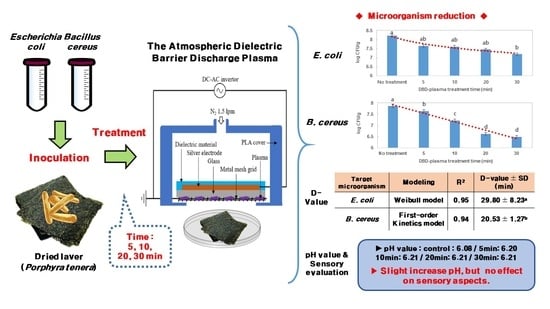
Researchers exploring non-thermal atmospheric dielectric barrier discharge plasma report that operating devices at 1.1 kV and 43 kHz for up to 30 minutes significantly reduces bacterial contamination on dried seaweed, offering a chemical-free preservation method that protects food safety without altering essential properties or sensory attributes.
Laver occupies a foundational place in culinary traditions across Korea and Japan, where it serves as both a daily meal staple and a popular snack accompaniment. Yet the path from coastal harvest to packaged market shelf introduces distinct hygiene challenges. Because edible seaweeds thrive in seawater teeming with native microbial populations, harvested algae naturally harbor diverse microorganisms that multiply rapidly if exposed to ambient air during extended drying and distribution cycles.
According to research data examining commercial market samples, dried seaweed products frequently carry substantial microbial loads, including detectable counts of total cells alongside specific foodborne pathogens. Previous investigations have identified coliform bacteria and opportunistic pathogens distributed on commercial dried laver such as Escherichia coli and Bacillus cereus, highlighting the persistent vulnerability of marine-derived foods to secondary contamination from handling, air exposure, and processing equipment.
Atmospheric Plasma Technology as a Non-Thermal Sterilization Tool
Cold atmospheric plasma has emerged as a promising technology for food sterilization and surface modification. Operating at near-room temperature, the partially ionized gas contains charged particles, reactive neutral species, electrons, and ultraviolet radiation that act simultaneously on microbial cell structures.
Among various plasma configurations, atmospheric dielectric barrier discharge systems utilize insulating barriers over metal electrodes to generate stable, low-temperature discharges at ambient pressure. This operational simplicity allows continuous treatment streams suitable for agricultural and food processing industries at a lower cost than complex sterilization infrastructure. While early applications focused primarily on general disinfection, researchers have increasingly targeted specific commodity items, including dried seaweed and fishery products, where thermal treatments would ruin texture and taste.
Experimental Parameters and Microbial Inactivation on Dried Laver
To evaluate the efficacy of this technology on real food matrices, scientific studies tested specific treatment regimes on dried laver inoculated with bacterial strains including Escherichia coli (utilizing repository stocks such as ATCC 11,229, KCCM 11,234, and KCCM 12,181) and Bacillus cereus (including strains NCCP 10,623, NCCP 14,579, and ATCC 1178).
The experimental setup deployed an atmospheric dielectric barrier discharge device operating at 1.1 kV and 43 kHz with a nitrogen flow rate of 1.5 L/m. Exposure times ranged from 5 to 30 minutes. Results demonstrate that increasing the duration of plasma exposure yields a proportional reduction in viable pathogen counts on the seaweed surface. Crucially, analytical tests evaluating the treated seaweed confirmed that the plasma intervention achieved significant microbial inactivation without causing adverse shifts in chemical pH or sensory attributes like color, flavor, and texture.
Broad Agricultural Applications Across Seeds and Fillets
The versatility of atmospheric plasma extends well beyond seaweed products. Similar dielectric barrier discharge methods are being evaluated across diverse agricultural and biomedical sectors to sanitize delicate biological surfaces without thermal damage.
For instance, investigations into wheat seed treatments reveal that exposure to diffuse coplanar surface barrier discharge plasma in ambient air significantly enhances seedling vigor, wettability, and germination speed. When agricultural researchers tested seeds artificially contaminated with filamentous fungi, the inactivation efficiency varied by fungal species, demonstrating pronounced growth inhibition as treatment times increased.
| Treated Agricultural Product | Target Pathogens or Fungi | Observed Treatment Effect |
|---|---|---|
| Dried Laver (Porphyra tenera) | Escherichia coli and Bacillus cereus | Significant microbial reduction without altering pH or sensory qualities |
| Wheat Seeds (Triticum aestivum L.) | Filamentous fungi (Fusarium, Aspergillus species) | Enhanced seed wettability, faster germination, and surface microflora inhibition |
| Fresh Mackerel Fillets (Scomber scombrus) | General microbial populations | Improved microbiological shelf-life stability under in-package plasma treatments |
Commercial Viability and Future Processing Challenges
Industrial seaweed processors handle vast tonnage—exemplified by domestic production exceeding 210,000 tons annually in Korea alone, where seaweed and kelp account for roughly 27 percent of total regional algae output.
Keep reading

Very Early-Onset Prosthetic Valve Endocarditis Following TAVI with Aorto-Left Atrial Fistula and Aortic Root Pseudoaneurysm
Very early-onset prosthetic valve endocarditis occurring within 48 hours of transcatheter aortic valve implantation represents an extreme diagnostic...
NanoMAP Uses Alpaca Antibodies to Modernize Nanobody Discovery
Tufts University researchers have introduced NanoMAP, a custom computational tool that uses alpaca antibodies to help scientists identify...

Sleeve gastrectomy improves cardiac and kidney MRI markers in youth-onset T2D
Vertical sleeve gastrectomy significantly improves cardiac and kidney MRI markers in youth-onset type 2 diabetes.

Treatment Action Group Launches Architects of Trust Program
As late-stage clinical trials advance toward potential approvals by 2029, the Treatment Action Group and Wellcome have launched...