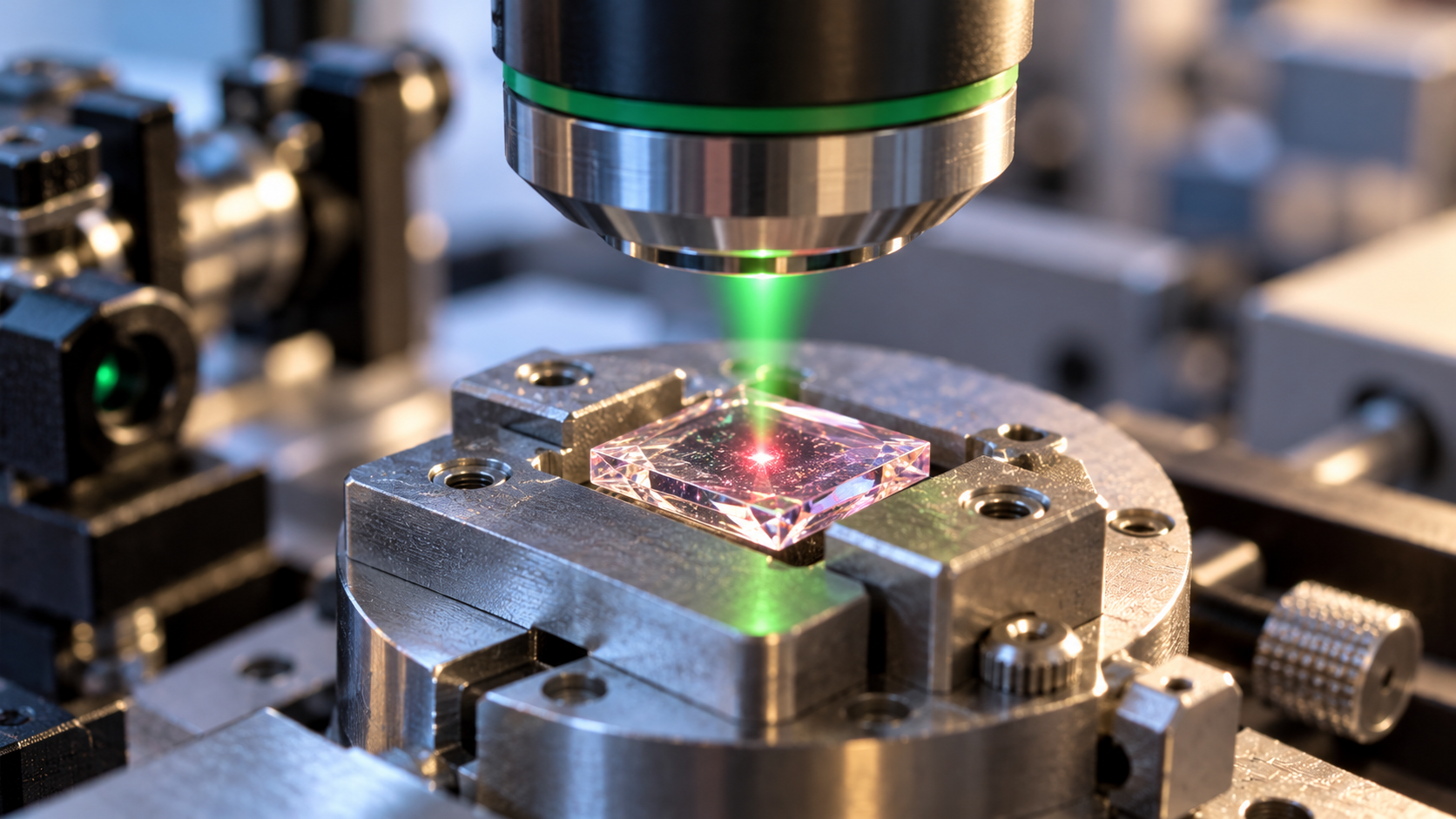
Researchers have built a computational framework that captures the complete optical cycle of spin defects in crystals, resolving a long-term physics discrepancy and identifying promising boron- and oxygen-containing defect candidates for quantum technologies.
Tiny imperfections inside crystals can act as stable qubits. When lasers excite electrons at these microscopic flaws, the energy does not always bounce back as light. Instead, defects relax into their ground states by emitting photons, shifting between electron spin states, or releasing energy through atomic vibrations known as internal conversion.
Physicists have long understood the fundamental equations governing light emission and spin state transitions. Modeling energy loss through atomic vibrations proved difficult. Researchers at the University of Chicago Pritzker School of Molecular Engineering (UChicago PME) developed a new computational framework to capture that missing link, publishing their findings on 14 October 2026 in Physical Review Letters according to SciTechDaily.
Solving Silicon Carbide Divacancy Discrepancies
The newly built framework addresses a persistent mismatch between theoretical predictions and experimental results concerning a divacancy in silicon carbide, a defect formed by two neighboring missing atoms. Team calculations revealed that internal conversion makes a substantial, previously overlooked contribution to the lifetime of the triplet excited state. Factoring in that contribution brought theoretical models into line with actual experiments.
We were expecting to see an effect, but of a smaller magnitude.
Giulia Galli, the Liew Family Professor of Electronic Structure and Simulations in UChicago PME and the Department of Chemistry
For a nitrogen-vacancy center in diamond, where a nitrogen atom sits beside a missing carbon atom, the framework predictions aligned with recent spectroscopy measurements. Internal conversion contributed little to energy loss for triplet states but dominated energy loss from singlet states.
Combining Molecular Models with Crystalline Environments
Calculating internal conversion requires handling complex interactions between electrons and surrounding atoms in models featuring hundreds or thousands of atoms. Stefano Villani, a UChicago PME postdoctoral researcher, explained the situation.
Although the equations are known, it’s hard to describe the process accurately because of computational difficulties.
Stefano Villani, UChicago PME postdoctoral researcher
Researchers combined several methods previously developed within their group. They utilized many-body wavefunctions to describe excited states and exact mathematical derivations to determine how strongly each excited state couples to atomic motion.
Yu Jin worked alongside Galli and Villani on the formulation.
Jin is a former graduate student now at the Flatiron Institute in New York.
The formulation accounts for coupling across hundreds of nearby atoms rather than calculating configurations individually.
In the past, a clear mathematical derivation and efficient algorithms were not available.
Yu Jin, postdoctoral scholar at the Flatiron Institute in New York
The team implemented the framework inside WEST, an open-source simulation code optimized for graphics processing units. The Midwest Integrated Center for Computational Materials (MICCoM) has supported WEST development with funding from the U.S. Department of Energy’s Office of Basic Energy Sciences since 2015.
Screening Boron and Oxygen Defects in Diamond
Because we’re treating the qubits as molecules, the cost of calculating these defects is equivalent to the cost of just modeling a simple molecule.
Mark Martirez
One could imagine, then, combining different qubits of different responses, so you can basically probe one qubit but not the other.
Mark Martirez
Worth a look

Researchers Study Link Between Early Brain Development and Conditions Like Autism
Researchers using non-invasive tools like EEG and fMRI are probing infant brain development to pinpoint when consciousness emerges.

Artemis II Commander Recalls Moment He Feared Being Lost in Space
Artemis II Commander Reid Wiseman recalled a terrifying moment during his ten days in space earlier this year...
Researchers Recreate Planetary Turbulence in Laboratory Experiment
Scientists have successfully recreated an extreme, long-theorized form of planetary and stellar turbulence in a desktop-sized laboratory setting...

Iapetus Moon Visible Near Saturn on Thursday, October 22
Shining at 11th magnitude on October 22, Saturn’s two-toned moon Iapetus is currently passing south of the ringed...