Russian forces suffered their highest monthly battle casualties of the full-scale invasion in October 2026, losing 54,400 troops killed or seriously wounded as territorial control moved away from Moscow across multiple frontline sectors. According to the Institute for the Study of War (ISW), Russian troops captured or consolidated 53 square miles during the month while yielding ground across the rest of the theater.
Territorial Losses and Operation Vivaldi in Donetsk
The Washington think tank reported that Moscow’s forces lost more territory in October than they managed to consolidate, marking the second consecutive month of net territorial losses for the Russian military. The only gains occurred in the Sumy and Zaporizhia regions, while sectors in Donetsk and elsewhere saw steady retreats. Ukrainian forces cleared Russian troops from 11 settlements spanning 1.25 square miles, outpacing the 10 settlements totaling 2.26 square miles that Russian forces captured. According to ISW, Ukraine regained 252.7 km2 during the period, encompassing gains in Donetsk, Dnipropetrovsk, Sumy, Kharkov, Zaporizhia, and Lugansk.
Although Russian units made marginal advances in the Donetsk town of Dobropillya, those gains fell short of enabling sweeping breakthroughs needed to encircle Ukraine’s heavily defended Fortress Belt. In the Lyman direction, Ukraine’s completed Operation Vivaldi successfully thwarted Russian attempts to envelop those critical eastern cities. Brigadier General Andrii Biletskyi noted that the 3rd Army Corps’ offensive operation cleared Russian infiltrators from northern Donetsk Oblast.
Along the Kostiantynivka axis, Ukrainian Defense Forces repelled 24 enemy assaults near Kostiantynivka, Rozkishne, Vilne, and toward Raiske, Novopavlivka, Kucheriv Yar, and Zolotyi Kolodiaz.
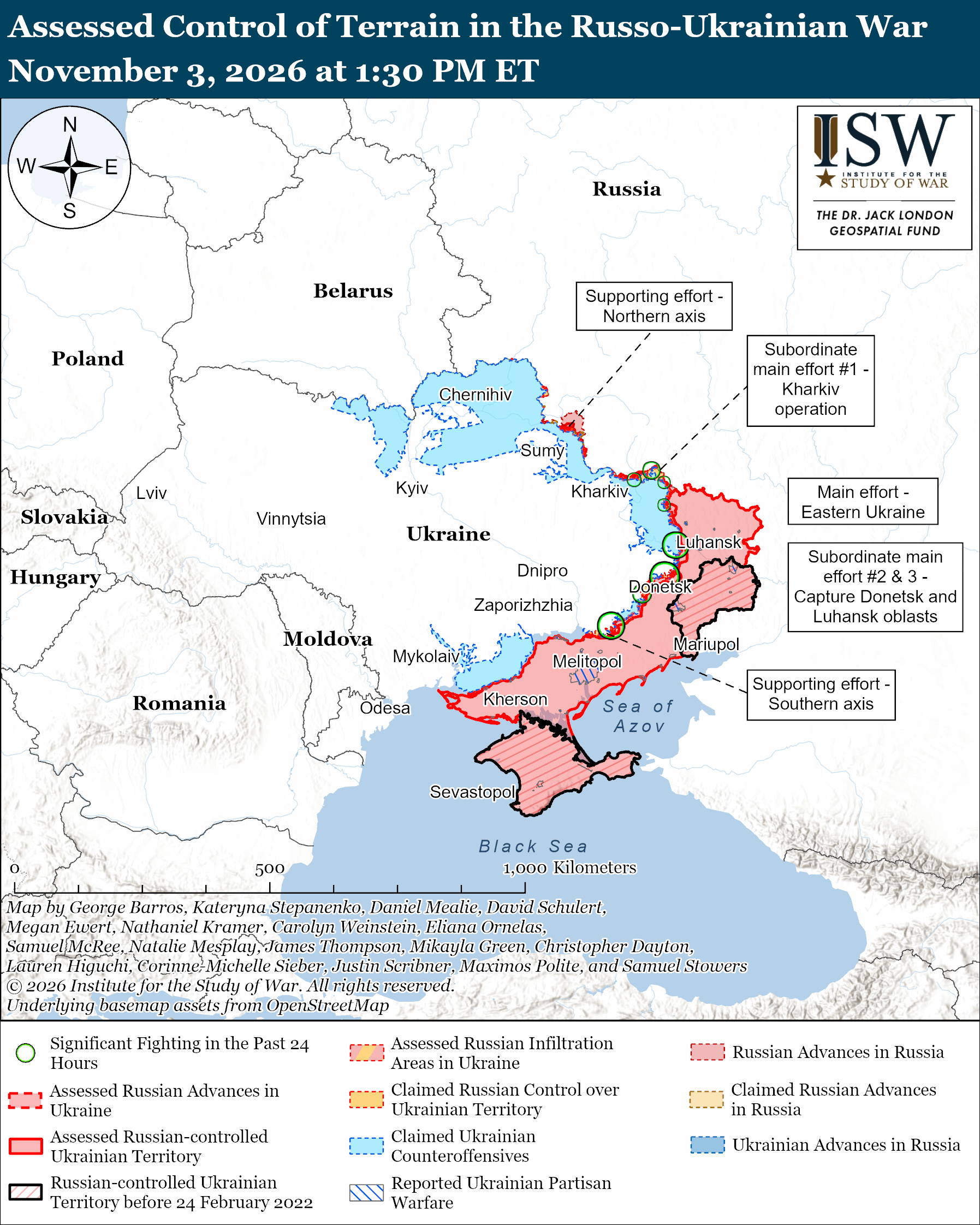
Russian forces also conducted assaults in the Orikhiv direction in the Zaporizhzhya region near Mala Tokmachka, Stepnohirs’k, and towards Novoandriyivka.
Ukrainian Estimates Cite Mounting Daily Losses Reaching Nearly 2,000
The staggering casualty toll of 54,400 killed or wounded in October surpassed 40,000 for the fourth consecutive month, pushing daily losses to nearly 2,000 according to Ukrainian estimates cited by the National Security Journal. Unmanned Systems Forces Commander Major Robert Brovdi reported on Telegram that the heaviest losses occurred in the Dobropillya, Oleksandrivka, and Hulyaipole directions. Total Russian casualties since February 2022 were estimated by The Economist at 1.4 million to 2.1 million, including 374,000 to 770,000 dead.
Total combat losses of the enemy since the start of the full-scale invasion as of 5 November 2026 Personnel: ˙ approximately 1 599 390 (+2 380) Weapons and military equipment: ˙ Tanks: 12 454 (+1) ˙ Armored combat vehicles: 25 643 (+3) ˙ Artillery systems: 51 902 (+23) ˙… pic.twitter.com/iEkO96vqyf
Russian regional authorities have reduced or eliminated death benefits for deceased servicemembers across at least a dozen federal subjects throughout 2026, with compensation cuts ranging from 50 to 100 percent. Regional recruitment bonuses in St. Petersburg were slashed to 400,000 rubles (roughly $4,940), down from one million rubles in mid-October 2026 and 3.5 million rubles before October 2026, though these do not include federal payments of 400,000 rubles from the Russian Ministry of Defense.
Moscow Intensifies Missile and Drone Strikes Targeting Energy Infrastructure
Stalled ground offensives have prompted Moscow to intensify long-range missile and drone strikes aimed at crippling Ukrainian infrastructure before winter. Scott Edwards, director of Amnesty International’s Crisis Response Program, stated that Moscow is deliberately targeting energy and heating infrastructure intended to cause civilian suffering, resulting in immense harm. On the night of November 2 to 3, Russian forces launched a massive combined strike involving 250 Geran UAVs and strategic bombers firing cruise missiles like the Kh-101, alongside ballistic and cruise missiles, targeting major facilities and leaving households across 10 provinces without electricity.
First Deputy Energy Minister Artem Nekrasov reported that systemic attacks forced nuclear plants to reduce generation. On November 3, three drones struck a substation vital to the Khmelnytskyi nuclear plant. While First Deputy Prime Minister Denys Shmyhal noted that 235 second-level shelters now protect key energy elements, air defenses face severe interceptor shortages, with SOFREP reporting that Kyiv’s requests for domestic Patriot production remain under Pentagon review.

DTEK CEO Maxim Timchenko reported that their infrastructure suffered one of the most serious attacks ever.
Three thermal power plants were forced to shut down and the power grid was damaged in Odessa province, while a pro-Kremlin channel urged Moscow to cut off Odesa and the northeast.
Trilateral Talks and Diplomatic Maneuvering in Abu Dhabi
Russian Presidential Aide Yuri Ushakov indicated that Moscow agreed in principle to resume U.S.-mediated talks, though Kremlin statements have conditioned participation on battlefield developments and a cessation of Ukrainian long-range strikes. Kremlin spokesperson Dmitry Peskov stated that Vladimir Medinsky will head the Russian delegation, having previously led talks in Geneva in February 2026.
Ukrainian Foreign Minister Andrii Sybiha expressed skepticism regarding Moscow’s seriousness, stating that Kyiv sees no readiness for genuine negotiations on the ground. Meanwhile, analysts warn that the Kremlin is systematically laying groundwork to blame Ukraine if the upcoming talks collapse, demanding NATO’s return to its 1997 borders while attempting to exclude European representatives.
Separate strikes hit Kharkiv City, injuring 73 people and damaging the cardiology department.

Ukrainian forces continued their long-range strike campaign against Russian oil infrastructure, hitting the Yaroslavl Oil Refinery in Yaroslavl Oblast roughly 770 kilometers from the frontline, as acknowledged by Yaroslavl Oblast Governor Mikhail Yeraev.
Alain Homsy, IRC country director in Ukraine, noted that people are increasingly exhausted and unable to cope with daily life under missile and drone strikes. International Rescue Committee data indicated that in some regions, 90 percent of people are in urgent need of financial aid, up to 60 percent need health services and medicines, and 70 percent of internally displaced families wish to return home but cannot due to the security situation.
On October 29, a Russian drone strike on Dnipro’s main railway station killed at least 14 people, according to Al Jazeera, and on October 30, a jet-powered Shahed hit Kharkiv, injuring three and damaging ten homes.
Related reading

Haze Disrupts Southeast Asian Marathons During Peak Race Season
Southeast Asia's record-breaking marathon season is being rewritten by haze, with at least nine half-marathons and marathons in...

Timi Frank has accused President Bola Tinubu’s administration of allegedly using the judiciary and
Timi Frank has accused President Bola Tinubu’s administration of allegedly using the judiciary and intimidation tactics to undermine...

France Braces for Nationwide General Strike and Mass Protests
France is bracing for a nationwide general strike and mass protests on Thursday, November 5, 2026, with unions...

Democrats Win Historic Midterm Sweep, Flip House and Senate
Democrats won a sweeping victory in the 2026 midterm elections, flipping control of both the House and Senate...