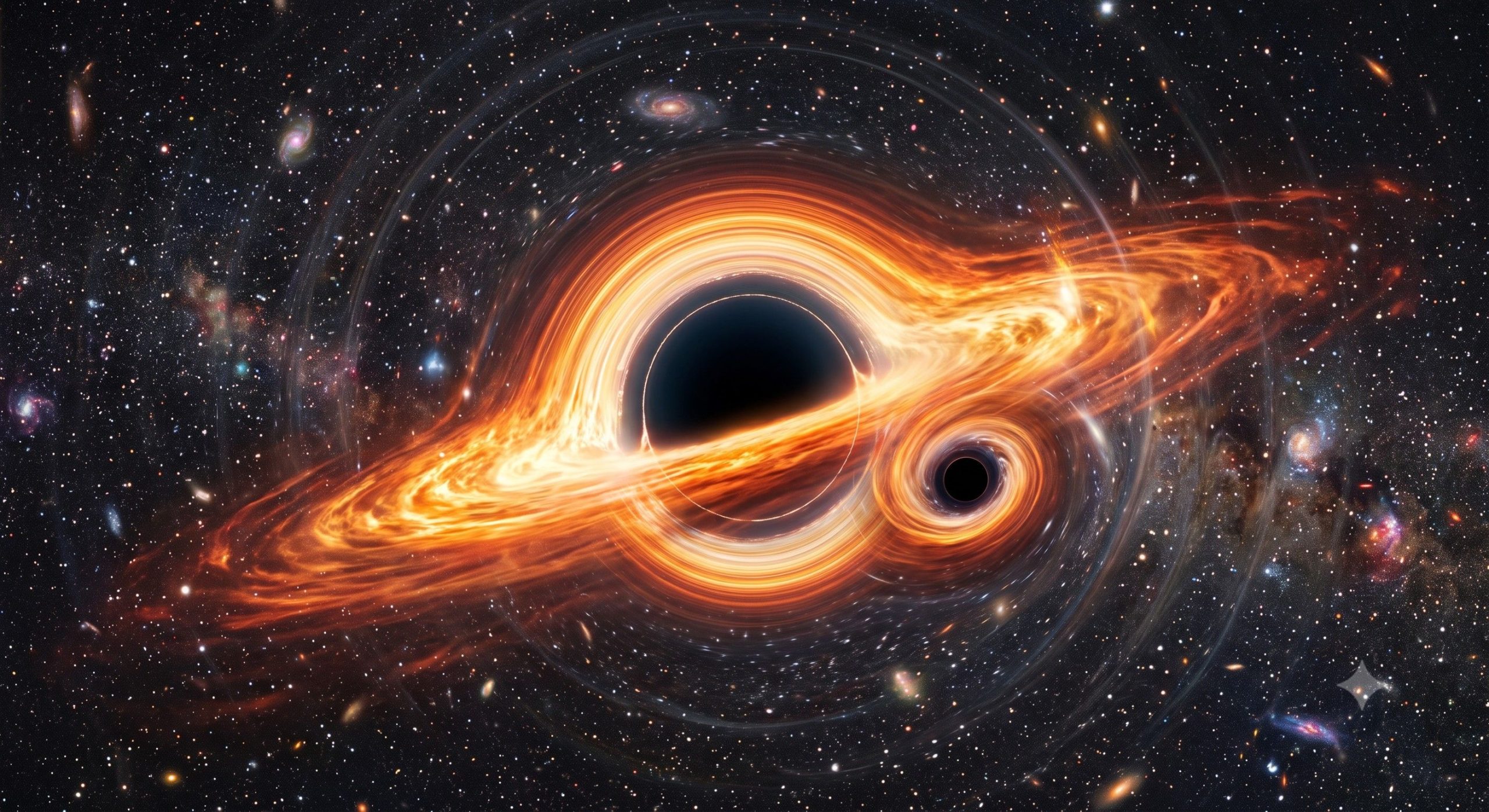
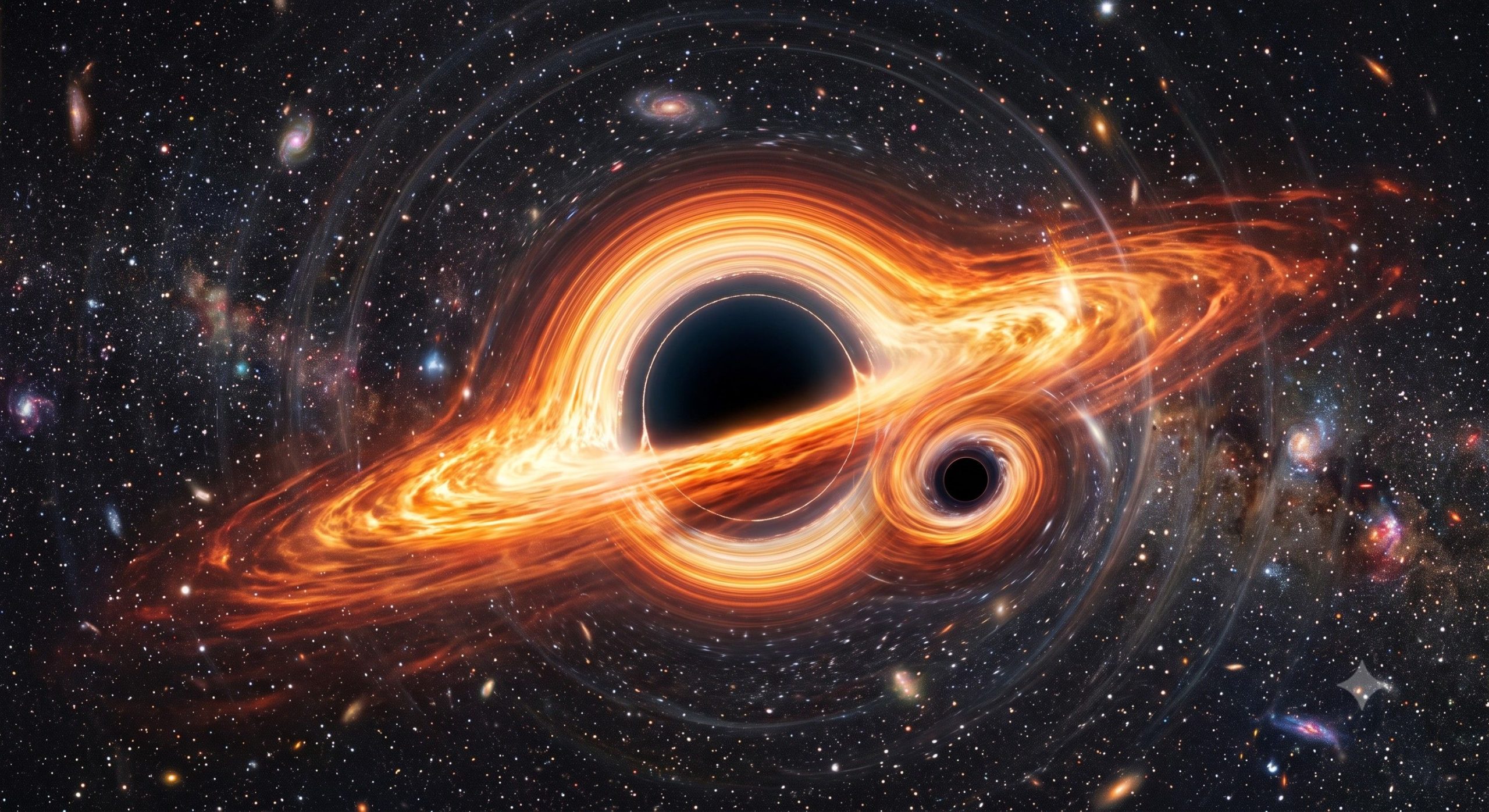
Researchers have discovered that approximately 14% of black holes observed by gravitational-wave detectors are “second-generation” objects formed from the mergers of previous black holes. This “hierarchical” process, confirmed through analysis of 155 binary pairs, challenges traditional models of stellar evolution and explains the existence of unexpectedly massive celestial bodies.
Beyond the Death of Stars: The Hierarchical Merger Pathway
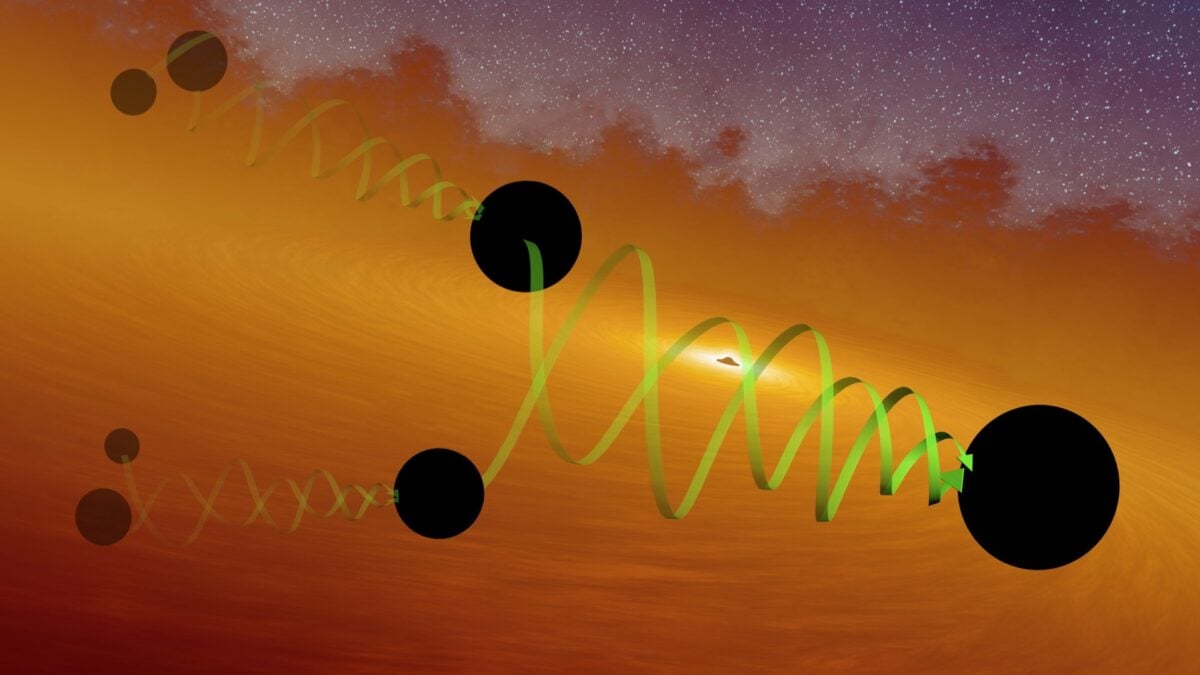
For years, the textbook definition of a black hole’s birth was straightforward: a massive star reaches the end of its life, its core collapses, and a black hole is born. However, data from modern gravitational-wave observatories has forced astrophysicists to reconsider this singular origin story. Instead of forming only from the remains of individual stars, a significant fraction of black holes are the products of “hierarchical mergers”—the collisions of black holes that were themselves born from earlier events.
This discovery stems from a recent study published in Physical Review Letters. By analyzing 155 binary black hole pairs identified by the LIGO, Virgo, and KAGRA observatories, researchers determined that roughly 14% of these objects are second-generation black holes. Now we’re seeing a relatively consistent picture where there’s a decent percentage of black holes that are coming from this repeated pathway.
Identifying Cosmic Billiards via Orbital Wobble
Distinguishing a second-generation black hole from its first-generation counterparts requires looking for the “wobble” in their final moments. When black holes spiral toward each other, they orbit in a common plane. If the spin axes of these black holes are tilted, the orbital plane precesses, or wobbles.
The research team, which included collaborators from Williams College and Northwestern University, utilized this wobble to confirm the hierarchical nature of these mergers.
- Asymmetry: If one black hole in a pair is significantly heavier and spins much faster than its companion, it is a strong indicator that the “heavyweight” is the product of a previous collision.
- High Spin: While black holes born from supernova explosions typically have minimal spin due to energy loss, objects born from mergers can reach speeds up to 70% of the maximum possible limit.
- Mass Gaps: These second-generation objects often weigh in at 20, 40, or more solar masses, placing them in ranges that standard stellar collapse theory struggles to explain.
Solving the Impossible-Mass Mystery
The study provides a potential solution to a long-standing astrophysical paradox: the existence of black holes that are simply too heavy to have formed from a single star. Traditional stellar evolution theory suggests that a supernova should not leave behind a black hole weighing more than approximately 45 solar masses, as the explosion disperses too much material. Yet, detectors have repeatedly captured signals from events involving black holes that exceed this limit.
It is increasingly clear, both from individual events and population analyses, that massive black holes exist in [this] range,
the researchers noted in their paper. By confirming that these massive bodies are the result of hierarchical mergers, scientists can now account for their existence without violating the laws of stellar collapse. These mergers likely occur in dense stellar environments where black holes are packed closely enough to interact repeatedly, a process that could repeat potentially ad infinitum, by virtue of the fact that you have a ton of stars and black holes in this really dense environment,
Plunkett explained.
Find more reporting in our Science section.

University of Queensland Researchers Propose Omic Technologies to Develop Heat-Adapted Chickpeas
Researchers at the University of Queensland have proposed a staged approach using new omic technologies to accelerate the...

President Daniel Chapo Urges Global Action on Climate Justice
Mozambican President Daniel Chapo called for strengthened international climate justice measures at a Maputo conference on October 14.

CHIME Telescope Detects Early Universe Hydrogen Signal Independently
Using only its own data, the Canadian Hydrogen Intensity Mapping Experiment (CHIME) telescope in British Columbia detected a...
NASA’s Perseverance Rover Breaks Opportunity’s Mars Mileage Record
NASA’s Perseverance rover has set a new off-world driving record on Mars, surpassing the mileage of its predecessor...