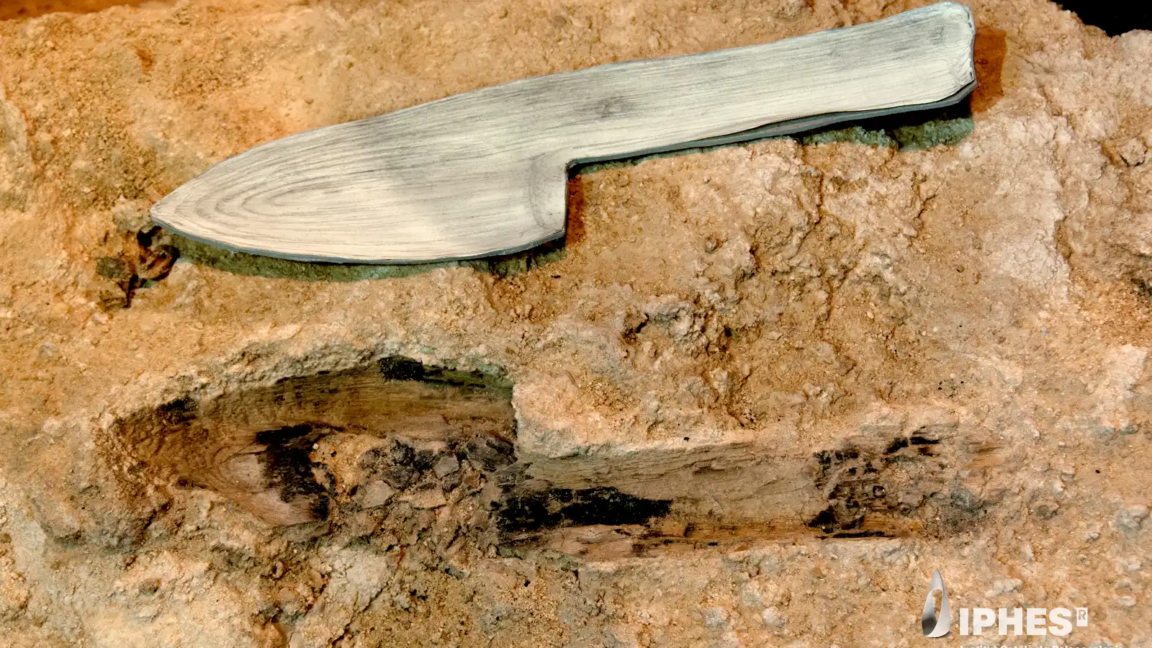
Spanish archaeologists have cataloged 597 wooden remains and imprints from Neanderthal living areas at Abric Romaní, dating between 62,000 and 40,000 years ago. The collection, preserved in mineral deposits at the Catalan site, reveals diverse tools including spears, bark trays, structural elements, and a distinctive club.
Early humans worked far more frequently with wood because it is so much easier to process. The Stone Age owes its conventional name to the durability of stone artifacts that withstand decay over millennia. Because organic matter rots rapidly, researchers know little about Paleolithic woodwork. That dynamic changed at Abric Romaní, a rock shelter in Capellades west of Barcelona, where mineral-rich water coated ancient wooden objects in a limestone-like crust. As the timber decomposed, it left behind hollow molds that preserve precise shapes down to the cellular level.
A team of researchers from the Catalan Institute of Human Paleoecology and Social Evolution published an analysis of the site’s collection in Science Advances. The study brings together 597 wooden specimens recovered across 16 archaeological layers spanning roughly 20,000 years of Neanderthal occupation.
Catalan Rock Shelter Yields Spears, Containers, and a Unique Club
Excavations at the site revealed where Neanderthals slept, cooked, managed fire, and organized their living spaces, while previous discoveries of prehistoric woodwork largely consisted of isolated hunting weapons recovered from waterlogged bogs or lakebeds—such as famous finds in Germany and England.
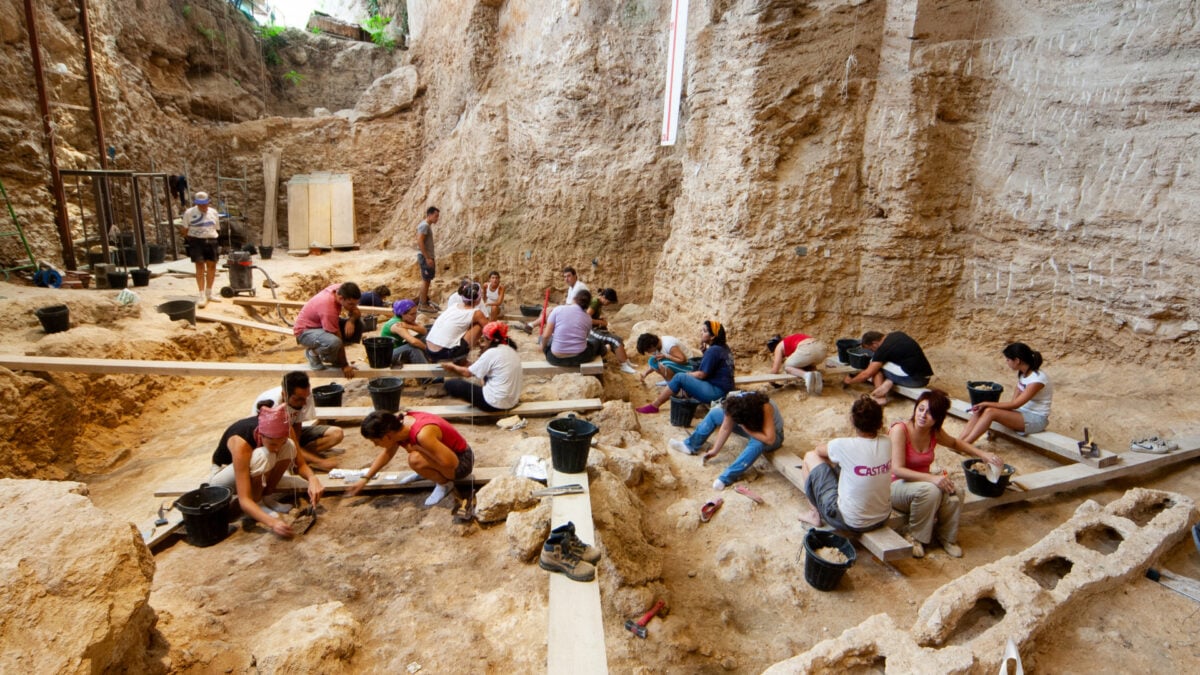
Among the 597 specimens, researchers identified 13 definite wooden artifacts. These include two Scots pine hunting spears measuring 1.99 meters and 2.45 meters—equivalent to roughly 6.5 and 8 feet long—alongside pointed digging sticks, four bark trays, and structural poles that may have formed parts of huts or windbreaks. Investigators also documented crossed wooden poles that could have functioned as a tripod for cooking over hearths.
The collection also features an item unlike anything previously recorded in the prehistoric catalog: a wooden artifact with a narrow handle and an enlarged, bumpy head. Recovered from a separate archaeological layer, the object displays deliberate scraping marks showing it was carefully shaped. Researchers note its exact purpose remains open to interpretation.
It could have been used as a hammer or striking tool, as a secondary weapon for hunting, or in interpersonal violence. We could even consider a symbolic role, perhaps as an object indicating someone’s status within the group.
Dr Palmira Saladié, study author at the Catalan Institute of Human Paleoecology and Social Evolution
3D Technology Reveals Details of Fragile Molds
Combining the complete set into a unified analysis had proved difficult due to the fragile nature of the mineral casts, though archaeologists had intermittently studied individual finds at the location for years.
Recent advances in 3D recording technology allowed the team to rapidly reconstruct damaged and delicate samples without destroying them.

Because the wooden imprints appear repeatedly in level after level over millennia, the authors argue that carpentry was an everyday, routine practice rather than an occasional exception. Small wood chips recovered across several layers provide additional physical evidence of tool manufacturing on site. The practical versatility and adaptability demonstrated by the artifacts paint a fuller picture of an extinct hominin species thoroughly comfortable with complex material processing.
Fieldwork Continues at Abric Romaní
The research team continues active fieldwork at Abric Romaní.
Excavators emphasize that stone implements represent only a fraction of prehistoric material culture.
Wood usually disappears.
Josep Vallverdú, study co-author and archaeologist at IPHES-CERCA
Wood usually disappears, but these rare impressions provide a vital window into the complex tool-making behaviors of Neanderthals that would otherwise remain hidden from the archaeological record.
Related reading

Curiosity Rover Captures Detailed Martian Dawn Panorama
NASA’s Curiosity rover has captured its most detailed panorama of distant Martian cliffs yet, photographing wind-carved yardangs under...
£15m Spent to Clean Hoads Wood Illegal Waste Site
Roughly 39,500 tonnes of illegally dumped waste have been removed from Hoads Wood in Kent following a 15-month,...
Abric Romaní Finds Reveal Advanced Neanderthal Woodworking Skills
Archaeologists at the Abric Romaní rock shelter near Barcelona, Spain, have recovered nearly 600 wooden artifacts dating from...

North American Stargazers to See Saturn, Meteor Showers, and Moon in October 2026
October 2026 brings North American stargazers an unusually favorable combination of clear skies, comfortable autumn temperatures, and a...