
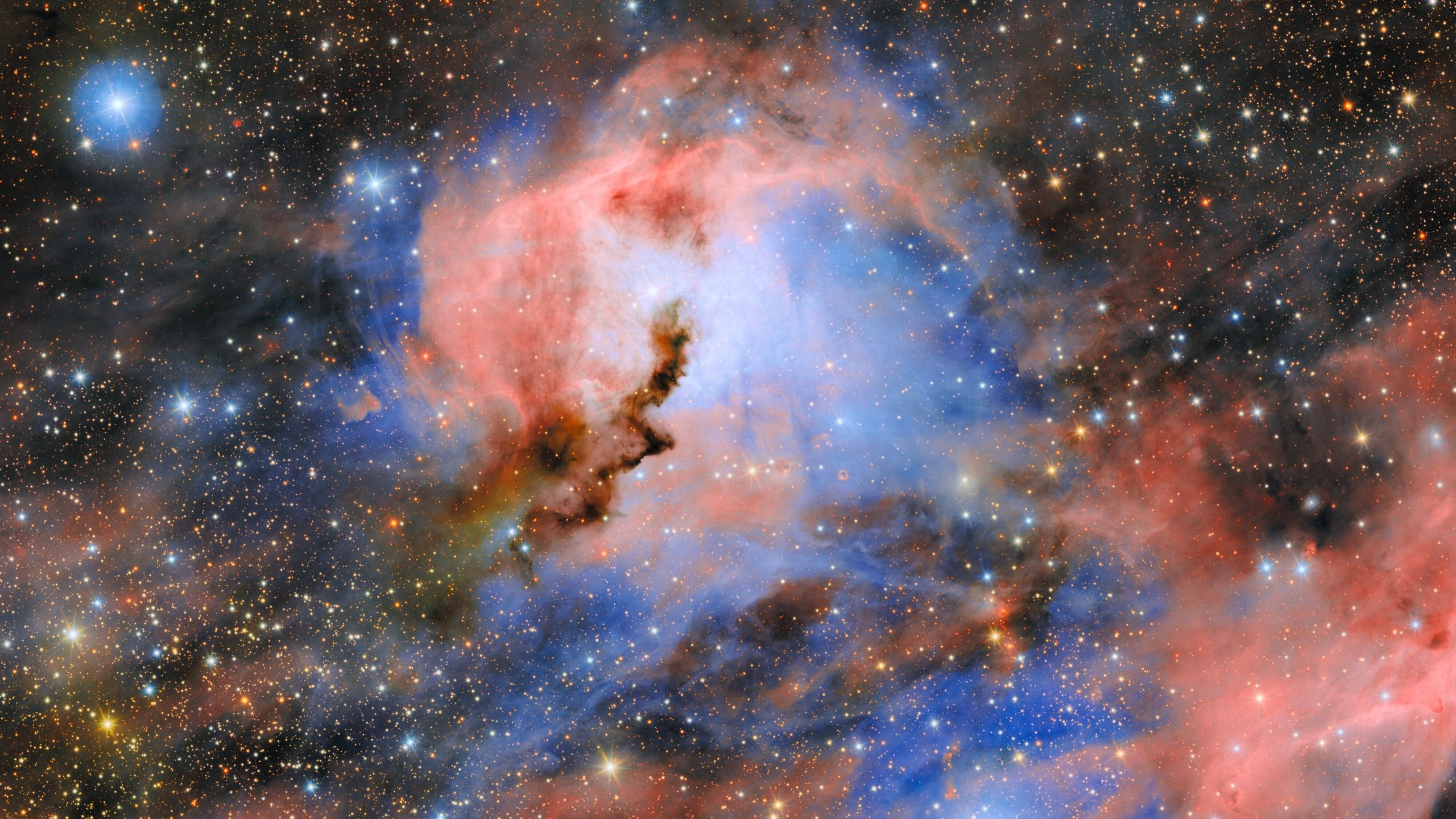
The resulting test image, shared in October 2026, captures the head of the Seagull Nebula, officially cataloged as IC 2177, situated approximately 3,700 light-years away from Earth between the constellations Canis Major and Monoceros. The nebula itself consists of three massive, billowing clouds of irradiated gas. Specifically, the bird’s head is formed by a cloud known as Sharpless 2-292, where glowing hydrogen gas creates pink plumage energized by ionizing radiation from newborn stars at the center. Meanwhile, the blue feathers are composed of dust reflecting light from young blue stars nestled nearby.
Testing Hardware and Software Systems
The detailed image served as an early technical evaluation for the observatory. Captured using the LSST Commissioning Camera, known as ComCam, the photograph was just one of approximately 16,000 exposures gathered during a seven-week test campaign running from October 24 to December 11, 2024, as noted by the National Science Foundation. ComCam features a mosaic of nine CCD sensors totaling 144 megapixels, covering an area of the sky roughly twice the size of the full moon. This testing phase allowed engineers and scientists to examine hardware, software, and image-processing pipelines before deploying the much larger primary instrument.
The observatory is jointly funded by the U.S. National Science Foundation and the Department of Energy’s Office of Science, and it is operated jointly by NSF NOIRLab and the SLAC National Accelerator Laboratory. Planning for the facility began in the 1990s under the original working title of the Dark Matter Telescope. Following its top-ranked priority status in the National Academies’ 2010 Decadal Survey in Astronomy and Astrophysics, construction officially commenced in 2015 on Cerro Pachón in Chile. Following extensive troubleshooting and technological development, the facility observed its formal first light on April 15, 2025, with celebrations held in Chile, California, and Arizona.
Transition to the Legacy Survey of Space and Time
While the ComCam image provided a remarkably crisp and deep view of the region—highlighting complex star-forming structures and the triple-star system HD 53367 acting as the nebula’s flickering blue eye—the observatory has since advanced its capabilities. The facility has transitioned to using the Legacy Survey of Space and Time Camera mounted on the Simonyi Survey Telescope. According to Rubin chief scientist Tony Tyson, the currently mounted camera boasts a field of view more than 20 times larger than ComCam, capturing 3,200-megapixel images every 30 seconds to complete a full scan of the southern sky every few nights.
With the Legacy Survey of Space and Time now officially underway following earlier engineering milestones like the Rubin First Look releases in June 2025, the facility will spend the next decade capturing nightly images of the sky. This continuous observation aims to construct a comprehensive time-lapse movie of the universe, expected to uncover millions of cosmic phenomena ranging from exoplanets and newfound comets to exploding supernovas.
More on Seagull Nebula
Explore this new image of the Seagull Nebula at https://t.co/QsjADSLuKv 🎥: NSF–DOE Rubin Observatory/NOIRLab/SLAC/AURA
🗣️ This is your flight captain speaking 🪶✈️Keep your seatbelts fastened as we glide across NSF–DOE Rubin Observatory's view of the Seagull Nebula!On your screen, you’ve got a front-row seat to young stars reshaping their stellar neighborhoods.Sit back, relax, and enjoy!🪽 pic.twitter.com/MgctedLiSp
This image featuring the head of the Seagull Nebula, just released today, was captured by the @VRubinObs Commissioning Camera in 2024. https://t.co/TuZ3ZlPyWo pic.twitter.com/4XdmQs4fHH
Related reading
ClearSpace UK to capture defunct British satellites
The UK Space Agency signed a £61.3 million contract with ClearSpace UK to build a robotic spacecraft featuring...
Griffith University Researchers Map Growth Curves for Eastern Australian Humpback Whales
Eastern Australian humpback whales reach an average length of 10.9 meters by age five, according to new research...

NASA to Land Astronauts on Moon by 2028
NASA is adopting an urgent, streamlined approach to spaceflight, targeting the launch of Artemis III next summer for...

Laurentide Ice Sheet Expansion Began 2,000 Years Ago, But Stopped In The 1960s
Radiocarbon dating of dead moss preserved beneath the Barnes Ice Cap reveals that glacier expansion began around 2,000...