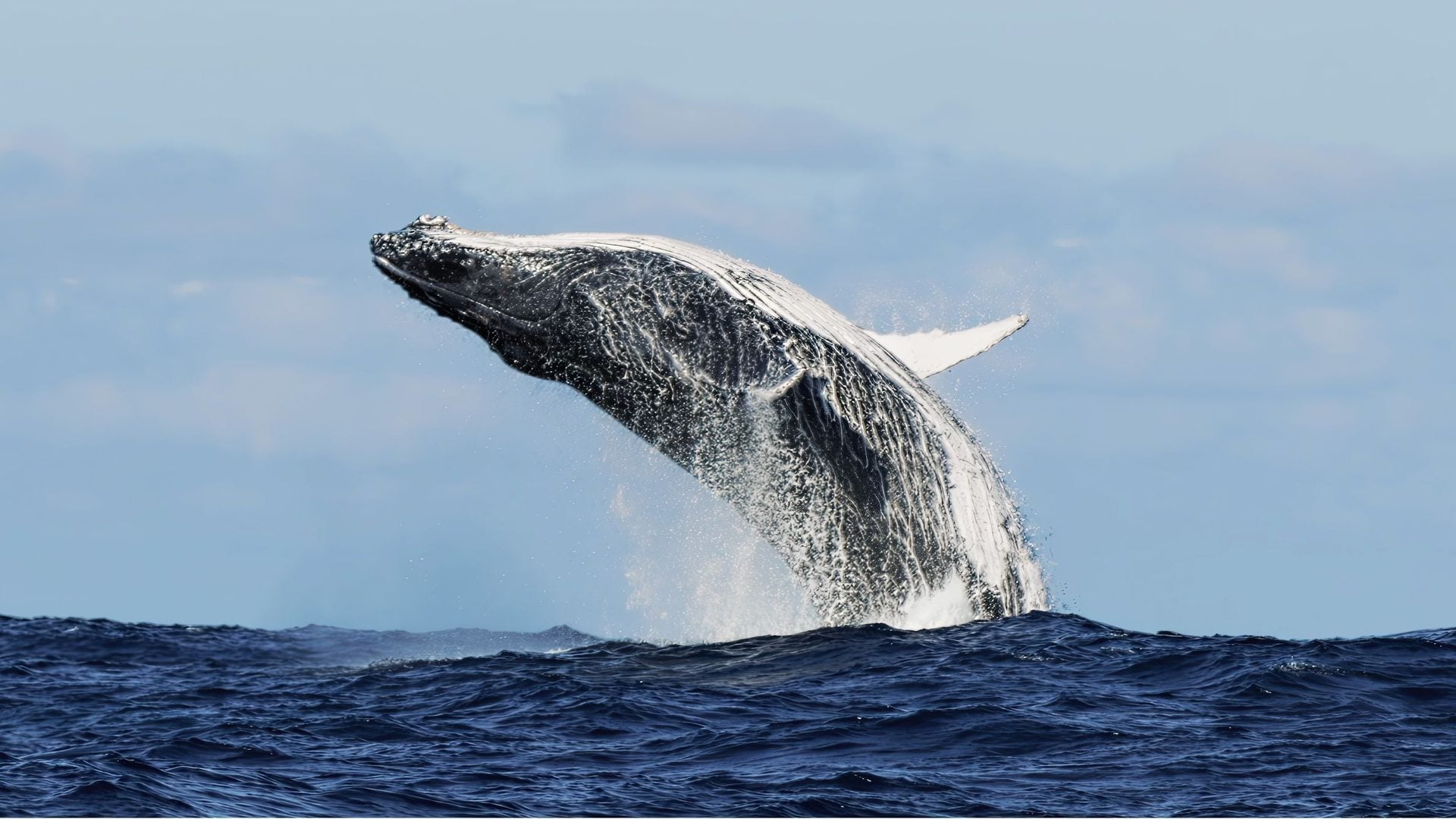
Eastern Australian humpback whales reach an average length of 10.9 meters by age five, according to new research published in Marine Mammal Science. Scientists used non-invasive drone photogrammetry and long-term photo-identification records between 2021 and 2024 to map contemporary growth curves for the recovering population.
Wild humpback whales off Australia’s east coast grow faster than populations measured anywhere else in the world. A Griffith University-led study tracked hundreds of animals from newborn calves to adults over forty years old, establishing that these migratory whales attain roughly ninety percent of their adult body length by six or seven years of age.
Scientists Track 865 Whales Using Drone Photogrammetry and Photo-Identification
To map how humpbacks develop throughout their lives, researchers analyzed data from 865 individually identified whales between 2021 and 2024.
The Pacific Whale Foundation has collected photographs along Australia’s east coast since 1984, building a catalog of more than 8,000 whales. To calculate each whale’s lowest possible age, the researchers relied on its initial observation date, treating fully grown whales as at least five years old upon first detection, assigning a developmental minimum to single-sighting whales based on visual traits, and setting calves at zero to designate ages under twelve months.

Stephanie Stack Details Contemporary Growth Benchmarks
Lead researcher Stephanie Stack noted that the project provides the first contemporary growth curves for the region derived from living animals. Previous benchmarks relied heavily on data gathered during commercial whaling operations in the mid-twentieth century, an era when legal restrictions prevented the capture of calves or whales shorter than 35 feet (10.7 meters).
These are also the first contemporary growth curves developed for eastern Australian humpback whales using measurements from living animals, updating knowledge that has relied heavily on measurements collected during the commercial whaling era in the mid-20th century.
The study established that growth is most rapid during early life before gradually tapering off as the animals approach their maximum adult size. Newborn calves measured an average of 6.2 meters, while five-year-olds reached approximately 10.9 meters. Because the dataset encompassed calves alongside juveniles and fully grown specimens, researchers could track developmental changes during critical early years directly instead of extrapolating them from mature subjects.
Researchers Compare Growth Rates Across Global Humpback Populations
When set against other well-studied groups, eastern Australian humpbacks show a distinct developmental advantage. By comparison, those alternative models estimate that five-year-old specimens achieve shorter measurements, averaging roughly 34.7 feet (10.6 meters) in the North Pacific alongside 31.5 feet (9.6 meters) within the Northeast Atlantic.
Despite this rapid juvenile development, the final adult size aligns closely with historical Australian estimates. Australia’s main historical growth records came from R. G. Chittleborough, who studied whales killed off both coasts from the late 1940s to the early 1960s. Out of 12,276 whales taken off Western Australia between 1949 and 1962, only 118 were recorded below that length, requiring Chittleborough to build growth charts for whales roughly five to 19 years old and estimate early growth from those older animals.
Implications for Whale Conservation in Changing Ocean Conditions
Researchers emphasize that having biological benchmarks like these will be essential for understanding how whale populations are responding to changing environmental conditions. H. Stack, T. Fettermann, B. McGovern, and S. M.
Keep reading

NASA to Land Astronauts on Moon by 2028
NASA is adopting an urgent, streamlined approach to spaceflight, targeting the launch of Artemis III next summer for...
Laurentide Ice Sheet Expansion Began 2,000 Years Ago, But Stopped In The 1960s
Radiocarbon dating of dead moss preserved beneath the Barnes Ice Cap reveals that glacier expansion began around 2,000...
Egypt Uncovers Fossils of Five Extinct Shark Species in Western Desert
Fourteen shark teeth from at least five extinct species have been discovered in Egypt’s Western Desert.
Korean Artists Hyewon Kwon, Boo Jihyun, Eunhae Jung, Eco Orot Explore Water’s Ecological Role
Aqua Paradiso continues as a 2026 touring exhibition at Korean Cultural Centres in India and Australia.