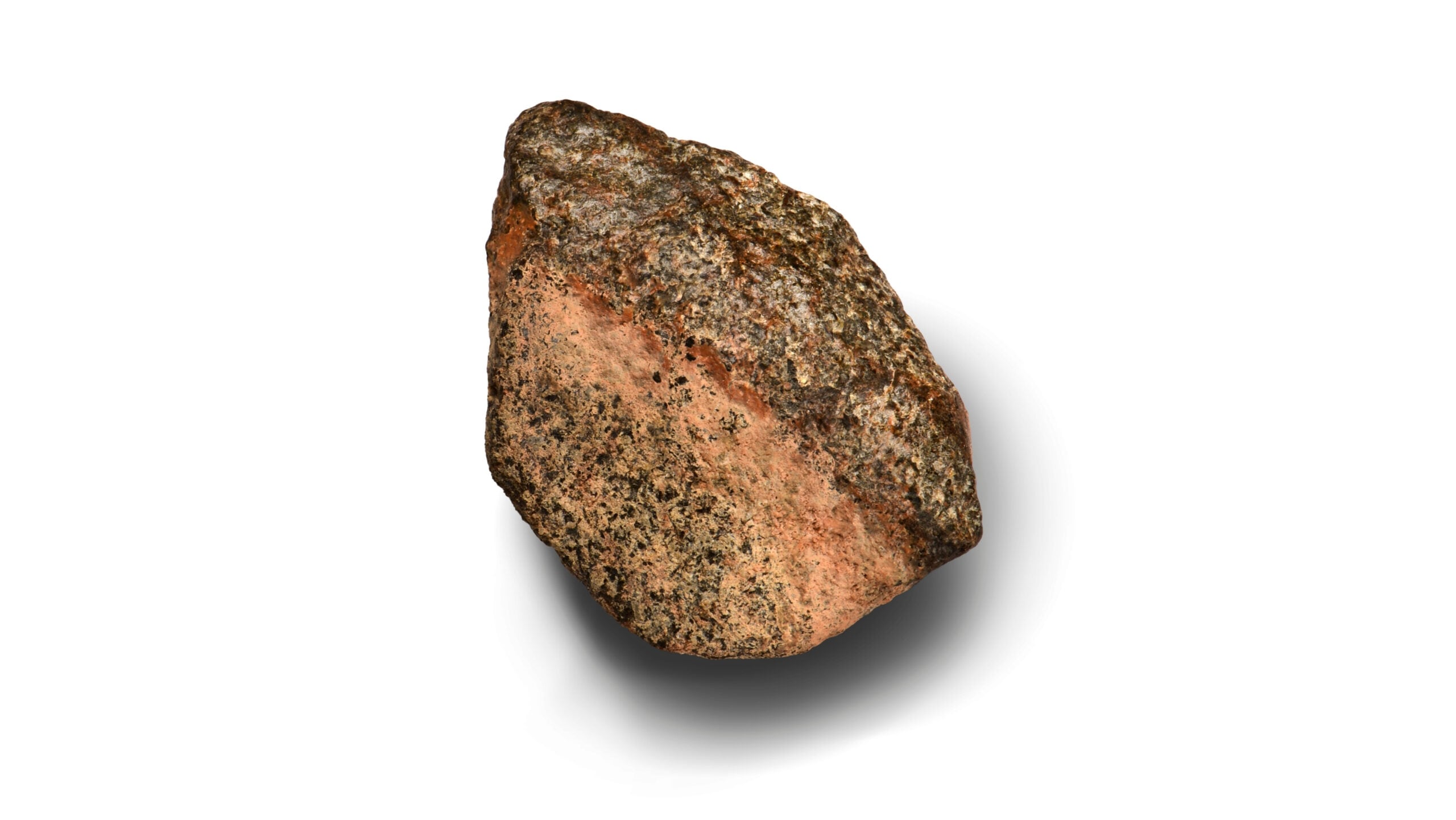
Discovered in the Sahara Desert in 2022, a nearly two-pound rose-colored rock found in Mali has been identified as a 4.1-billion-year-old fragment of Mars. Researchers age-dated its minerals using a high-precision technique, revealing a rare snapshot of ancient Martian crust and an early dynamic water cycle.
Teghaza 001 Mineral Makeup and Ancient Sahara Discovery
The roughly 800-gram rose-colored meteorite surfaced in Mali’s salt plain region known as Teghaza in 2022. Initially, researchers recognized the object stood out against the barren desert terrain, but its true planetary origins remained unconfirmed until recent laboratory analysis. Scientists matched its oxygen isotopes—which function as geochemical fingerprints—to known Martian meteorites, determining the specimen belonged to the Red Planet. This brought the verified catalog of Martian meteorites to approximately 435 worldwide.
A 4.1 billion year old piece of Mars discovered in the Sahara DesertFound in Mali in 2022, the 800 gram meteorite, named Teghaza 001, contains minerals showing that water once interacted with Mars' crust, providing evidence of the planet's ancient watery past pic.twitter.com/reF0N1CvXE
As NASA-funded scientists age-dated its minerals, they established that the rock formed more than 4.1 billion years ago, positioning it among the three oldest Martian meteorites ever recovered on Earth. While other ancient samples like ALH84001 consist almost entirely of a single mineral, and younger specimens like “Black Beauty” formed about 2.1 billion years ago as collections of volcanic fragments, Teghaza 001 displays a complex assortment of igneous minerals. Its distinctive mineralogy closely mirrors data collected by orbiters examining the cratered southern highlands of Mars.
Caltech Rubidium-Strontium Age-Dating Method
Pinpointing the exact age of Teghaza 001 required a novel analytical approach rather than traditional bulk-dissolution techniques. Caltech coauthor Francois Tissot helped researchers implement an in-situ rubidium-strontium age-dating method capable of analyzing single mineral grains on a sliver of the meteorite smaller than a fingernail. This high-precision technique preserves rare planetary samples for future laboratory work while delivering rapid results.

Right now, we are one of very few labs in the world able to perform this kind of age-dating, and the first to date such an ancient Martian meteorite.
Francois Tissot, Caltech coauthor
When the laboratory results returned, lead author Yang Liu of the Jet Propulsion Laboratory admitted she nearly passed on examining the specimen initially, expecting another routine shergottite. Instead, microscopic examination uncovered zircon crystals that allowed the team to establish the rock’s timeline with extreme precision.
It was only after we started looking closely that we realized this meteorite is really unique.
Yang Liu, Jet Propulsion Laboratory lead author
Implications for Martian Water and Crust Formation
The significance of Teghaza 001 extends beyond its age. Data analyzed by researchers show that subsurface water altered the rock approximately 4.1 billion years ago, implying that the parent material formed even earlier in Martian history. A separate study published in Science Advances in June examined the rock’s water content to understand how early surface fluids shaped planetary topography.

This is really our first piece of Martian crust from a part of Mars we’ve never had a sample of before.
Lee Saper, NASA Ames Research Center scientist
Saper noted that the meteorite records interactions of water and rock and preserves an imprint of the Martian atmosphere as the planet gradually lost its water supply. Reviewers studying the findings have dubbed the rock a Rosetta Stone for Mars
because it opens a window into a volcanic and aqueous chapter of planetary history.
Related reading

You start painting pictures of squirrels twirling their mustaches’: A biologist on whether animals can lie
Biologist James O'Hanlon tackles tactical deception and whether animals can truly lie in his 2026 book Liars, Cheats...

GSI Study Reveals Ancient Redox Shifts in Bijawar Basin
Geochemical analyses of Paleoproterozoic sedimentary rocks in Madhya Pradesh's Barwah-Harda inlier reveal shifting oceanic redox gradients and atmospheric...
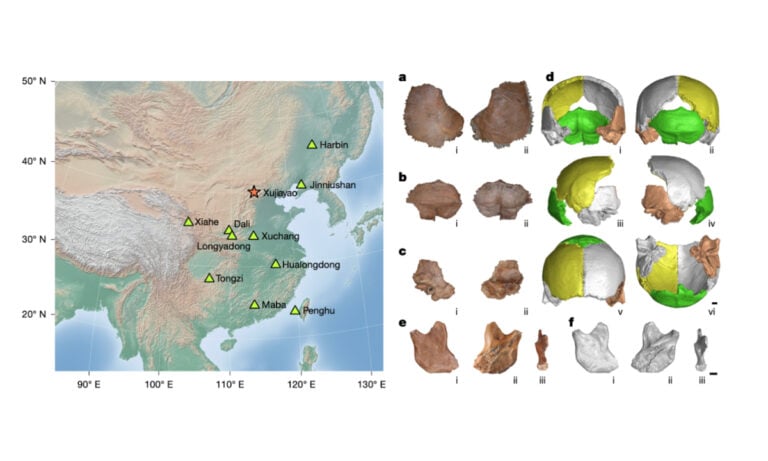
Chinese Academy of Sciences Identifies Denisovans via Protein Analysis
Researchers from the Chinese Academy of Sciences have identified the Xujiayao and Bianfu Cave hominins as Denisovans.
Antarctic Intermediate Water Becomes Saltier as Sea Ice Declines
A vast, freshwater-rich layer of the Southern Ocean known as the Antarctic Intermediate Water has abruptly reversed decades...