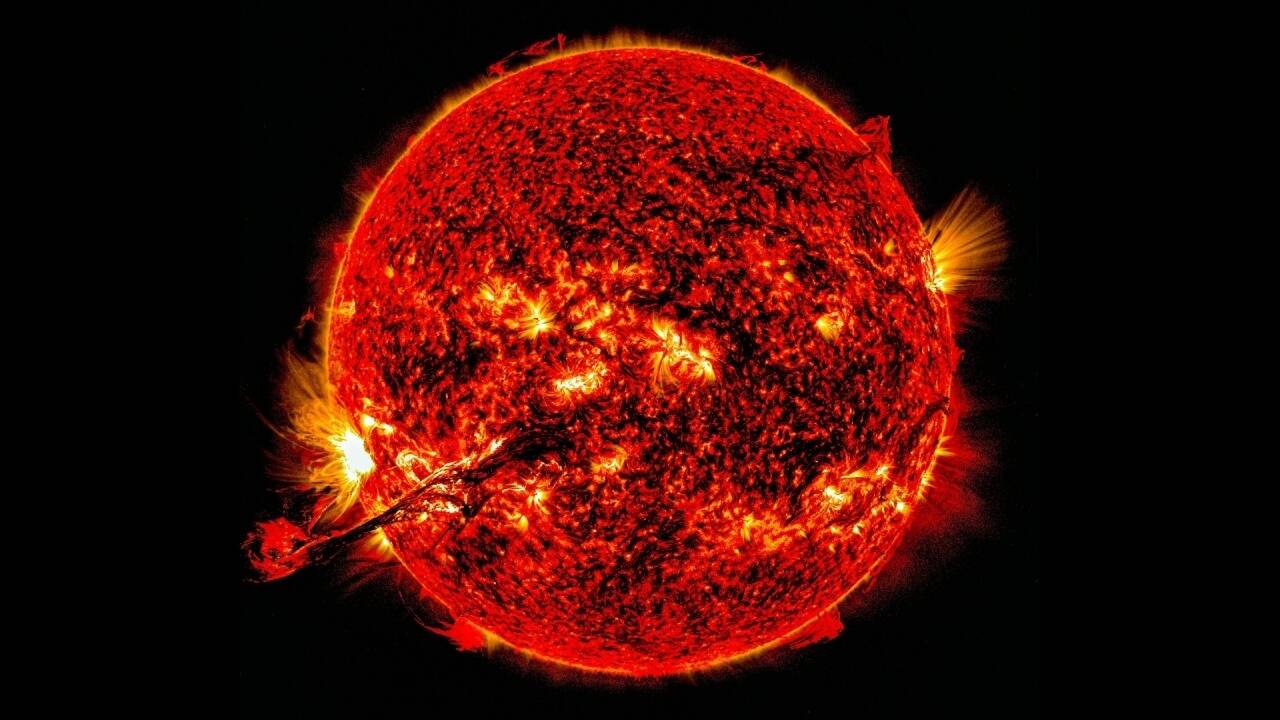
New computer simulations published in The Astrophysical Journal Letters indicate the Sun’s irregular mass loss as it dies will destabilize Jupiter, Saturn, Uranus, and Neptune within about a billion years of forming a white dwarf, cutting previous survival estimates by a factor of 100.
Our Sun has sustained the solar system for approximately 4.6 billion years, maintaining an orderly planetary dance that astronomers once assumed would persist in cosmic slow motion for tens or hundreds of billions of years after the star’s death. Traditional models operated on the premise that the Sun would shed roughly half its mass smoothly and gently as it evolved into a white dwarf, allowing planetary orbits to widen without violent disruption. A 2020 study factoring in the gravitational tug of passing stars estimated the solar system would hold together for about 100 billion years. Older projections running on purely gravitational calculations stretched that timeline to a quintillion years—a figure exceeding the current age of the universe.
Konstantin Batygin, Jim Fuller, and Fred C. Adams Model Stochastic Mass Loss
Those long-term horizons dissolve once researchers account for the messy reality of stellar death. A team led by California Institute of Technology planetary astrophysicist Konstantin Batygin, alongside Jim Fuller of Caltech and Fred C. Adams of the University of Michigan, published a study on September 21, 2026, in The Astrophysical Journal Letters that radically shortens the expected lifespan of the outer planets. Instead of a steady, calm stellar wind, the team modeled the dying Sun ejecting matter in thousands of separate, randomly directed bursts.
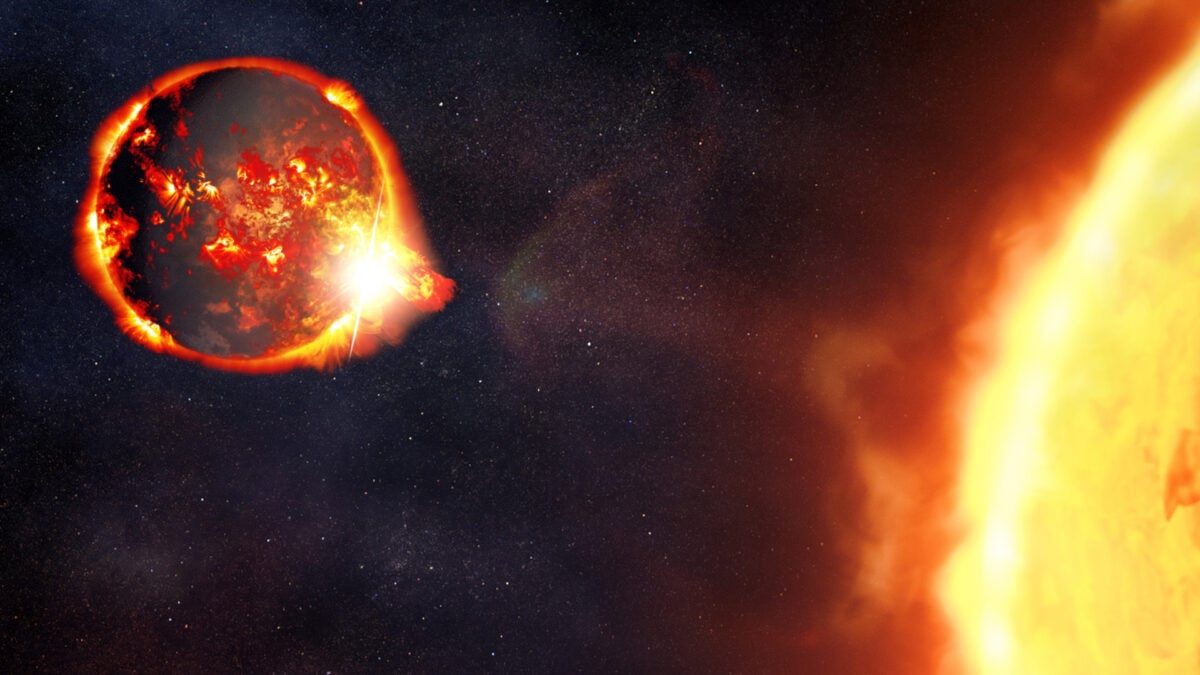
Each discrete ejection acts like a tiny rocket boost, giving the shrinking star a slight nudge and altering its gravitational grip on the surrounding neighborhood. This stochastic shaking introduces chaos into planetary dynamics.
Because planetary dynamics is chaotic—exhibiting sensitive dependence on initial conditions—no single simulation tells you what will happen, only what could happen.
Konstantin Batygin, planetary astrophysicist at the California Institute of Technology, via Gizmodo
Computer Simulations Reveal Outer Solar System Instability Within a Billion Years
To test how these irregular ejections alter long-term fate, Batgyn and colleagues ran 672 different probabilistic scenarios, tracking how and when mass loss occurs as the Sun transitions toward white-dwarf status. Even in test runs where the Sun shed its mass smoothly, roughly 96 percent of the hypothetical planetary systems spiraled into chaos within 3 billion years of white-dwarf formation. Across the set of turbulent mass-loss simulations, the dynamical lifetime of the outer planets collapses to approximately 1 billion years.
The simulations demonstrate that orbital resonances do not protect the giant planets once stochastic perturbations begin. Intermediate ejections nudged about one in five simulations into mean-motion resonances where orbital periods form small-integer ratios. Rather than acting as a stabilizing shield, those resonant simulations proved slightly more likely to disassemble than non-resonant ones.
In short: as the Sun dies, it will take the outer solar system down with it. The Sun’s death is not an event the planets will quietly survive—it is the trigger for their orbital undoing.
Konstantin Batygin, astrophysicist at the California Institute of Technology, via Gizmodo
Planetary Ejections, Orbit Crossings, and Interstellar Wanderers
As the Sun’s gravitational anchor destabilizes, the giant planets experience dramatic rearrangements. In many of the runs analyzed by Natureworldnews, Uranus and Neptune swapped positions, plunged inside Jupiter’s orbit, or crossed paths before the star even finished its white-dwarf transformation. Close gravitational encounters frequently accelerated planets onto hyperbolic trajectories.
In roughly 90 percent of the simulation runs, at least one giant planet was hurled completely out of the solar system to become a rogue wanderer traversing interstellar space. The researchers note that this mechanism aligns with astronomical surveys from missions like ESA’s Gaia and the Sloan Digital Sky Survey, which have catalogued thousands of polluted white dwarf
stars bearing the signature spectral debris of infalling rocky material. Continuous giant planet instability provides a natural mechanism for scattering asteroids and comets onto star-grazing orbits where tidal forces shred them.
Timeline of Stellar Evolution and Earth’s More Immediate Fate
None of this celestial mechanics demands immediate concern. The Sun remains stable in its current hydrogen-burning phase and will not begin swelling into a red giant for approximately 5 billion years. White-dwarf formation follows roughly 1 to 2 billion years after that red-giant phase concludes. Earth faces an even more direct peril long before the outer planets unravel: as the aging Sun grows hotter and brighter, our planet’s surface will scorch, stripping away its water and atmosphere.
The study notes that while it remains physically possible that our specific solar system occupies the rare minority of simulations that survive the full integration window intact, the probabilistic modeling fundamentally inverts traditional astronomy’s view of how planetary systems end. White-dwarf formation follows roughly 1 to 2 billion years after that red-giant phase concludes.
Worth a look
Vera C. Rubin Observatory Captures Seagull Nebula in 2026 Test Image
The resulting test image, shared in October 2026, captures the head of the Seagull Nebula, officially cataloged as...
ClearSpace UK to capture defunct British satellites
The UK Space Agency signed a £61.3 million contract with ClearSpace UK to build a robotic spacecraft featuring...
Griffith University Researchers Map Growth Curves for Eastern Australian Humpback Whales
Eastern Australian humpback whales reach an average length of 10.9 meters by age five, according to new research...
NASA to Land Astronauts on Moon by 2028
NASA is adopting an urgent, streamlined approach to spaceflight, targeting the launch of Artemis III next summer for...