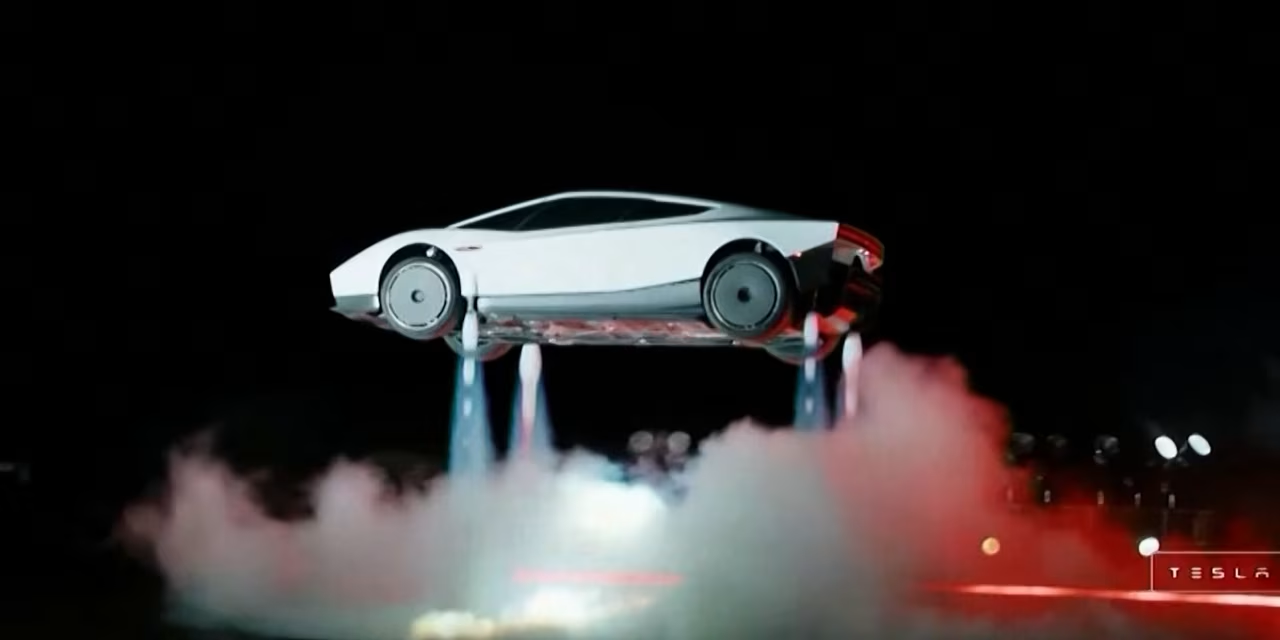
Tesla unveiled a radically redesigned Roadster at its McGregor, Texas facility, featuring SpaceX cold-gas thrusters and an underbody suction system that enable brief aerial stunts. CEO Elon Musk set production for 2028, with deposits opening immediately at $50,000 for the Performance trim and $250,000 for the thruster-equipped Thrust model.
Nearly nine years after the initial 2017 concept debut, Tesla finally pulled the covers off its second-generation sports car during a high-profile livestreamed demonstration at SpaceX’s rocket testing site near Waco, Texas. The vehicle that took the stage bore little resemblance to the original concept.
Instead, it emerged as a low-poly, angular machine drawing visual cues from the Cybertruck. In a series of remote-controlled stunts directed by autonomy, the prototype drove up a 90-degree vertical ramp, hung suspended upside down using an underbody fan suction system, dropped and barrel-rolled midair using compressed air, and later leaped over a standing lineup of vehicles that included a Cybertruck and a Tesla Semi.
Tesla Structures New Roadster Trims
Tesla has structured the new Roadster lineup into three distinct versions, each carrying a heavy upfront payment requirement while final retail pricing remains unannounced. The base Performance trim features active aerodynamics and a fan-driven downforce system designed to achieve a zero-to-60 mph sprint in under 1.6 seconds. Securing a spot for the Performance model requires a $50,000 deposit due within 10 days.
Stepping up to the Thrust variant introduces rear-mounted cold-gas thrusters that slash the zero-to-60 time to 0.85 seconds, according to company engineers Lars Moravy and Franz von Holzhausen, while Tesla’s order page lists it as under 0.9 seconds. That mid-tier version demands an eye-watering $250,000 reservation payment. Finally, the single-seat Rocket variant adds front and side thrusters for a claimed zero-to-60 time under 0.59 seconds, a setup available strictly by invitation only with no publicly disclosed fee.
What if the Tesla Roadster’s body were made of stainless steel? pic.twitter.com/Eu8RDOPQo5
Regulatory Hurdles and the Public Road Ban
Federal and state regulators are already fielding questions about where such a vehicle fits. The Federal Aviation Administration confirmed to Politico that the vehicle does not meet its definition of an aircraft, while a Department of Transportation official noted it might not fall under that agency’s purview either. State traffic laws add further ambiguity, leaving it unclear whether any state will permit rocket-boosted propulsion on public asphalt even if restricted to track use.
Engineering Realities of Compressed Air and Battery Range
The physics behind the Roadster’s performance figures require substantial hardware compromises. The rocket thruster system relies on two carbon-overwrapped 600-liter air tanks holding roughly 250 kilograms of compressed air. That supply stores enough energy for roughly a single five-second thruster burst.
Once deployed, the onboard high-pressure compressor takes between two and six hours to fully recharge the vessels, limiting track drivers to a single high-acceleration launch per afternoon. The marquee specifications published on Tesla’s order page reflect significant cutbacks from the 620-mile range promised when the concept debuted in 2017. Official specifications now point to an expected range of more than 300 miles.
Manual Driving Survives in Autonomous Fleet
The Roadster occupies an unusual philosophical space within Tesla’s corporate strategy. As the automaker ramps up production of the driverless Cybercab—a vehicle lacking a steering wheel, pedals, or side mirrors—Musk envisions a future where manually driving a car resembles operating a vintage elevator. Yet the Roadster is engineered to swim against that current.
From Roadster in a rocketTo rocket in a Roadster
This will actually be, long-term, the only manually driven car that Tesla makes.
With production officially scheduled to begin in 2028, industry observers note that the project functions primarily as a technology showcase and a loyalty test for investors rather than a high-volume financial driver.
Roadster is a true pilot's car: active aerodynamics, a multi-mode suction system & cold-gas thrustersExterior– Concealed headlights, full-length taillight & flush-mounted surfaces for a minimalist, highly technical form– Super light wheels w/ thin spokes that reinforce… pic.twitter.com/3fT1dlUPX7
More on Thrust
The Tesla Roadster’s rear lightbar and rear wing create an afterburner effect, just like the Model Y and Cybercab! pic.twitter.com/Nsg0EBCrgc
Related reading

Banque du Caire to Raise Up to $454 Million in Egyptian IPO
Banque du Caire is preparing to raise up to 24.25 billion Egyptian pounds, equivalent to $454 million, through...
Tanzania’s finance minister thanked the World Bank on October 12, 2026, for supporting 33 strategic
Tanzania’s finance minister thanked the World Bank on October 12, 2026, for supporting 33 strategic projects valued at...

Kenya Overtakes Ethiopia to Become East Africa’s Largest Economy
Kenya has overtaken Ethiopia to become East Africa's largest economy, ending a five-year period of regional dominance.
Jaguar Unveils All-Electric Type 01 Grand Tourer
Jaguar has unveiled its new all-electric Type 01 grand tourer in New York, setting a starting price of...