Artemis II Commander Reid Wiseman recalled a terrifying moment during his ten days in space earlier this year when his spacecraft overshot its turn-back point.
The Odometer That Kept Climbing Past Deep Space Limits
Commander Reid Wiseman and his three crewmates launched from NASA’s Kennedy Space Center in Florida on April 1. During the sixth day of the 10-day lunar journey, the crew was scheduled to reach a maximum distance of 219,667 nautical miles, equivalent to 252,788 standard miles or 406,823 kilometers, before turning back toward Earth. Mission control in Houston had set this strict boundary as the furthest point the spacecraft should travel.
As Wiseman monitored the digital display on the Integrity spacecraft, the odometer ticked past the assigned limit. Expecting the next number to decrease as the capsule headed home, he watched in disbelief when the counter climbed upward.
While Wiseman experienced this quiet panic, his fellow crewmates remained busy with their assigned duties. NASA astronauts Victor Glover and Christina Koch were positioned at the window conducting scientific observations of the moon, while Canadian Space Agency astronaut Jeremy Hansen handled reports back to mission control, leaving Wiseman’s moment of terror entirely unnoticed by the team.
Relief finally arrived when the odometer counter dropped back down to 219,668 nautical miles. Witnessing the reversal, Wiseman announced We’re going home
to the crew, prompting a shared cheer as the uncertainty lifted.

Wiseman Described the Moon’s Far Side and a Thumbnail Earth
The mission marked the first crewed flight of the Orion space capsule and the initial crewed journey to the moon since Apollo 17 in 1972. During the flight, the crew spent 45 minutes cut off from all communication while passing behind the far side of the moon, sharing their unprecedented perspective with no one else.
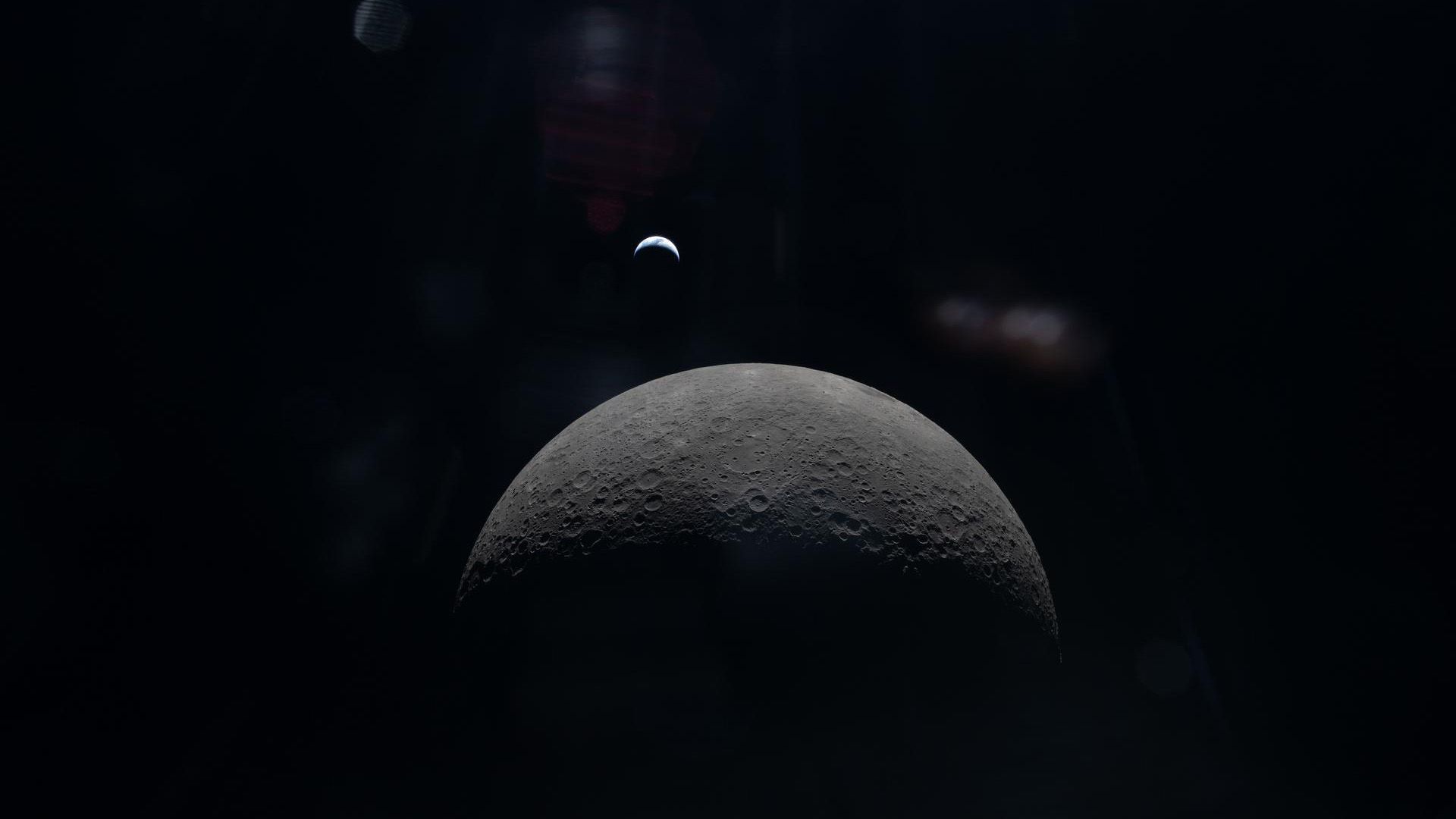
Wiseman discussed the profound isolation and visual impact of that passage during a visit to the Johns Hopkins University Bloomberg Center last month for a conversation with Bobby Braun, head of the Space Exploration Sector at the Johns Hopkins Applied Physics Laboratory. He described seeing the moon’s craters and mountains silhouetted as the Earth set behind the lunar horizon.
Tiny Earth was as big as your thumbnail. The gray of the moon just made the Earth so beautiful, so vivid. And then the thing that caught us off-guard was you could see the craters and the mountains silhouetted … as the Earth was setting behind the moon. … Everything that keeps us alive down here, good and bad, it’s just right there, and you can see it, just so tiny.
Reflecting on the emotional weight of the journey, Wiseman noted that the limited vocabulary available to humanity felt inadequate for the experience. He contrasted his crew’s reactions with those of the Apollo astronauts who preceded them decades earlier.
In Apollo, those astronauts, they said things like, ‘Peace, love, hope, joy, all mankind.’ And I thought they just had really good speechwriters. And then they put the four of us out there, and the only thing that we could say was, ‘Peace, hope, joy, all of humanity, unity, lucky.’ I think if we had different words, we could use them, but those are the words that we have in this language to describe what it feels like. And there’s nothing else that we felt other than we wanted to get home to our families and our friends on this planet.
Wiseman Accepted Honors at Starmus VIII and Visited Johns Hopkins
Following their return, the Artemis II crewmembers—Wiseman, Jeremy Hansen, Victor Glover, and Christina Koch—traveled to Tenerife, Spain, where they received the Stephen Hawking Medal for Science Communication at the semi-annual Starmus VIII festival on Oct. 17.
Wiseman credited the success of the voyage to the ground teams in Florida and Houston, emphasizing the rigorous engineering and flight control operations that managed the capsule’s trajectory.
During his appearance at the Johns Hopkins Bloomberg Center—part of an event series celebrating the university’s 150th year—Wiseman reconnected with his home state roots. A Johns Hopkins alum who earned a master’s degree in engineering in 2006, Wiseman invited university President Ron Daniels on stage to present a little gift from the crew of the mission
: a framed Maryland flag that accompanied the spacecraft around the moon.
Daniels accepted the flag on behalf of the institution, confirming plans to place it permanently in the university’s new Bloomberg Student Center to inspire future students.
In Apollo, those astronauts, they said things like, ‘Peace, love, hope, joy, all mankind.’ And I thought they just had really good speechwriters. And then they put the four of us out there, and the only thing that we could say was, ‘Peace, hope, joy, all of humanity, unity, lucky.’ I think if we had different words, we could use them, but those are the words that we have in this language to describe what it feels like. And there’s nothing else that we felt other than we wanted to get home to our families and our friends on this planet.