
Shining at 11th magnitude on October 22, Saturn’s two-toned moon Iapetus is currently passing south of the ringed planet following superior conjunction, offering observers a view with a telescope, according to Astronomy magazine senior editor Alison Klesman.
On October 22, Iapetus sits just past superior conjunction, positioned south of Saturn. Saturn’s unusual moon Iapetus orbits the planet on a wide path that takes nearly 80 days to complete, as reported by Astronomy. During its orbit, the satellite slowly rotates in synchrony, causing it to brighten and fade by up to two magnitudes depending on which hemisphere faces Earth.
Telescopic Tracking of Iapetus
Iapetus lies 1.7’ south-southeast of Saturn, shining at 11th magnitude and appearing fainter than the other four moons. Because its orbit takes it far from the planet and leaves it relatively faint, Iapetus is easiest to locate during superior and inferior conjunctions, making tonight an ideal time to track it down.
Saturn is well-positioned for viewing soon after darkness falls, reaching a height of roughly 30° above the eastern horizon by 8 P.M. local daylight time. Through a telescope, observers can easily view the southern side of the planet’s rings. Bright Titan, Saturn’s largest moon, shines at mid-8th magnitude just 1.6’ east of the planet. Meanwhile, Tethys, Rhea, and Dione glow around 10th magnitude closer to the ringed world. Around 8 P.M. CDT, Dione is located east of Saturn, while Tethys and Rhea sit to the west.
Observational Timeline and Lunar Phase
The Moon appears as a waxing gibbous at an illumination of 89 percent, measured at 10 P.M. local time from the same location. Times for sunrise, sunset, moonrise, and moonset are recorded from 40° N 90° W. Sunrise occurs at 7:18 A.M., while sunset takes place at 6:10 P.M. Moonrise is set for 4:18 P.M., with moonset following at 3:20 A.M.
Related reading

Researchers Find Rock from Papua New Guinea Reveals Unexpected Temperature Reversal
An international research team analyzing a rare metamorphic rock from Papua New Guinea has discovered that tectonic plates...

Researchers Propose Light-Based Method to Detect Hypothetical ‘Mirror Life
Researchers at the University of Strathclyde and Durham University have proposed the first light-based method to detect hypothetical...
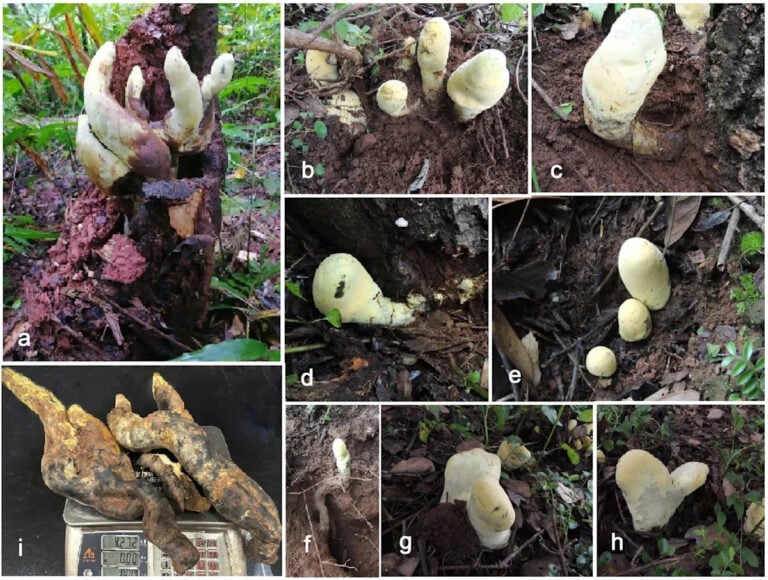
Researchers in southwestern China discovered a nearly 5-pound fungus so unique it required a new family
Researchers in southwestern China have discovered a towering new fungus species, Dianjunus rex, that grows up to 50...
Microraptor was a very small, feathered dinosaur with wings on its legs as well as its arms
Discovered in northeastern China, Microraptor is a diminutive, feathered dinosaur renowned for its four wings and shimmering plumage,...