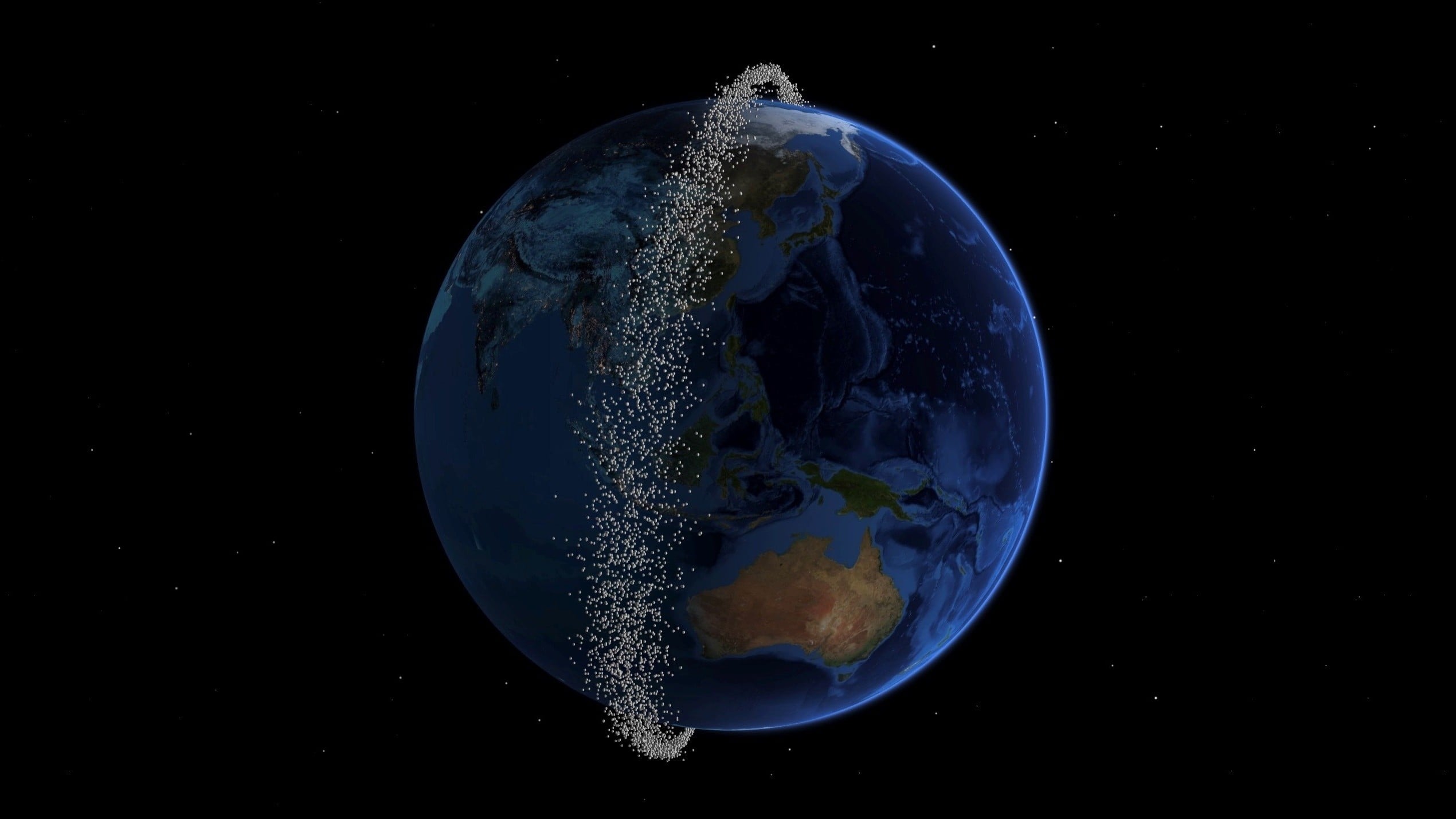
Google confirmed on October 30 that its Project Suncatcher prototype has run an artificial intelligence model in orbit for the first time, transmitting a short poem back to Earth generated by the satellite’s onboard chips. The test marks an early milestone in Google’s effort to one day build AI data centers in space.
The prototype launched on October 1 aboard SpaceX’s Transporter-18 rideshare mission, built with orbital imaging company Planet, and carries four of Google’s Tensor Processing Units. After roughly three weeks of commissioning checks, engineers sent a prompt to the onboard Gemma 4 model asking for a haiku about being in space — and got one back.
Blue marble below / data flows in silent grace / starlight feeds my core.
Gemma 4 model aboard Project Suncatcher prototype, transmitted from orbit
Google is calling the result its “Hello World” milestone for a data-center-class chip in orbit. Engineers also ran space-themed limericks and prompts that pulled telemetry on the spacecraft’s operating conditions, and the company said the satellite was functioning normally.
Dr. Travis Beals, Google senior director and Project Suncatcher lead, put the achievement plainly:
our chips have officially earned their space wings.
Dr. Travis Beals, senior director, Google
Dr. Travis Beals, Google senior director and Project Suncatcher lead, said that everyone responds to this idea with ‘that’s crazy’, and there has to be some reason it won’t work. The first thing he tried to do is to find that reason – and it turns out that it is possible.
One TPU, 20 minutes, 1 kilowatt
The poetry is real, but the power budget is not. The satellite carries four TPUs and generates up to roughly 1 kilowatt of electricity, which means engineers can run only one processor at a time, for about 20 minutes per session. The response was transmitted as the craft passed Svalbard, Norway.
That constraint is why the milestone announcement matters more as proof of concept than as capacity. Google’s engineers are now watching how the chips hold up under continuous orbital exposure — temperature swings and radiation included — before committing to anything larger.
The 118-terawatt-hour problem on the ground
The push skyward is rooted in an energy squeeze. A study published in Nature put electricity consumption by AI-dedicated data centers at 118 terawatt hours in 2024, with estimates of 239 to 295 terawatt hours by 2030. Goldman Sachs has projected 170% growth in data-center power demand globally between 2025 and 2030, and JLL notes that connecting new facilities to power grids can take anywhere from 2 to 10 years.
Orbit sidesteps the wait: solar panels in space can harvest large amounts of solar energy 24/7. BCG puts today’s orbital cost premium at 2.5 to 3 times higher than terrestrial computing, but estimates space could eventually claim 10 to 15 percent of the AI data-center market by 2040.

Space hardware faces physics challenges
The physics is not cooperative. High-energy particles can trigger memory “bit flips” that corrupt calculations without tripping standard monitoring, and ionizing radiation can cause silent data corruption. Thermal management is its own fight: cooling relies on a combination of heat pipes and radiators rather than airflow, as there is no air to carry heat away.
Google is not alone in the race. Starcloud was the first company to put AI into space, launching a conventional NVIDIA H100 ‘AI factory’ GPU last year, and Elon Musk has previously rhapsodised about the promise of orbiting data centers. Cowboy Space is pursuing single-satellite inference.
A ‘hello world’ milestone for Project Suncatcher 🚀 After launching our prototype satellite a few weeks ago, we’ve now successfully sent a command up to orbit, booted up the TPU, ran the prompt, and received our first complete response back on earth – a haiku! pic.twitter.com/kOFmETUskm
Planet’s director of systems engineering, Eric Stevens, framed the moment with characteristic understatement:
Everything seems too hard until someone tries it, and my first reaction was ‘wow, that seems big even for us’ – but it’s an experimental moonshot, and an important first step towards moving data centres off planet and into Earth’s orbit.
Eric Stevens, director of systems engineering, Planet
Two linked satellites in 2027
The next test is coordination, not poetry. If current checks go well, Google plans to launch two interconnected satellites in 2027 with higher power generation and optical links that let the spacecraft share workloads — the architecture behind its vision of solar-powered compute constellations. Eric Stevens, Planet director of systems engineering, explained that Planet can take advantage of commercial industry advances and deploy them to orbit right away, rather than waiting for extended design cycles to make them ‘space rated’.
The project remains experimental, and Google has announced no commercial service or customer rollout. Whether a haiku from orbit can scale into an economically viable data center is the question the 2027 test is designed to start answering.
More on Google
Keep reading

Sonic Racing: CrossWorlds datamine hints at potential Year 2 characters, unconfirmed by SEGA
A datamine of Sonic Racing: CrossWorlds' Version 2.0.0 files has turned up potential Year Two characters: Cloud Strife...
Study Finds One in Three Babies With Suspected Peanut Allergy Are Actually Safe to Eat Nuts
For years, a hive-filled reaction in infancy meant a peanut allergy diagnosis that stuck for life. The stakes...

DataReportal report shows Latvia’s mobile connections at 148% of population
In late 2026, Latvia crossed a threshold that sounds like a mistake: 2.71 million active cellular mobile connections...

US-funded newborn vaccine trial in Guinea-Bissau cancelled after WHO objections
A US-funded vaccine trial on newborns in Guinea-Bissau has been cancelled after the World Health Organization raised alarms...