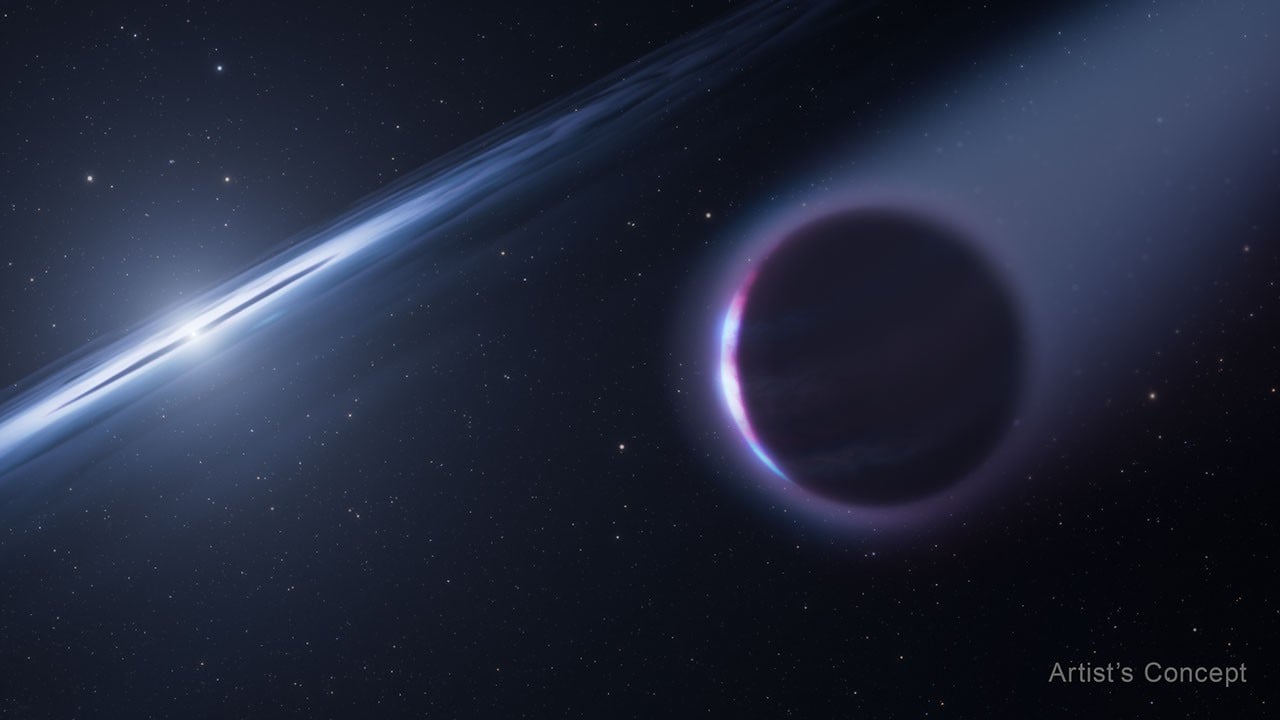
Astronomers revisiting decades-old Hubble Space Telescope data have discovered an unusual chemical signature around a white dwarf star, pointing to what researchers describe as the first known second-generation planet born from the ashes of a dead star.
When Sun-like stars exhaust their nuclear fuel, they swell into red giants and shed their outer layers into space before collapsing into dense, Earth-sized cooling cores known as white dwarfs. Traditional astronomical models suggest this violent lifecycle spells total destruction for any inner planets orbiting the host star. A study published on October 5, 2026, in Nature Astronomy (DOI: 10.1038/s41550-026-02983-7) upends that assumption by identifying chemical and orbital evidence of a Jupiter-sized gas giant that appears to have formed directly from the debris left behind by its dying sun.
Uncovering Niobium in White Dwarf HS 0209+0832
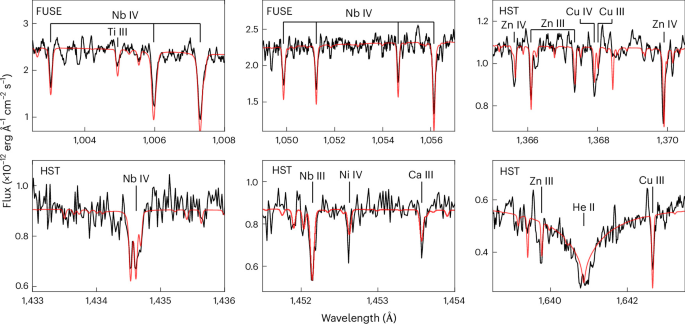
The discovery centers on the white dwarf HS 0209+0832, located roughly 270 light-years from Earth. When NASA’s Hubble Space Telescope first observed the star on January 10, 1999, using the FUV channel with HST/STIS, researchers recorded roughly 100 spectral features they could not identify.

What Hubble is showing us in this white dwarf system is something we haven't seen before: a high abundance of the element niobium, the signature of which I was unfamiliar with when I first found it in the archival data, Williams said
The analysis revealed a high abundance of niobium, a heavy element used on Earth in jewelry and medical imaging devices, alongside zinc and copper at levels more than 1,000 times greater than in our Sun. Because heavy elements typically sink rapidly toward the center of a white dwarf once its nuclear furnace turns off, the presence of surface niobium pointed away from primordial material and toward an external source raining down onto the stellar remnant.
“When [lead author] Jamie asked me about niobium in relation to this study I was truly gobsmacked, as that element had not been reported in any other white dwarf analyzed to date,”
Boris Gänsicke, co-author at the University of Warwick
TESS Data Indicates Planetary Candidate Orbits White Dwarf
To investigate whether a companion body was responsible for the elemental debris, researchers examined observations gathered by NASA’s TESS (Transiting Exoplanet Survey Satellite) during a four-month monitoring window. The spacecraft detected low-amplitude optical variability with a period of 4.399 ± 0.026 days, indicating a planetary candidate orbiting the white dwarf. The orbital distance measures approximately 3.7 million miles (6 million kilometers), placing the body far closer to its dead star than Mercury sits relative to our Sun.
Independent spacecraft archives added weight to the chemical findings. Data from NASA’s retired FUSE (Far Ultraviolet Spectroscopic Explorer) mission also displayed strong ultraviolet signatures of niobium in the HS 0209+0832 system. The research team notes that HS 0209+0832 is a particularly young white dwarf, burning at around 63,000 degrees Fahrenheit (35,000 degrees Celsius).
Implications for Reborn Planetary Systems
The research team points out that to form a disk of material necessary to birth a planet, HS 0209+0832 likely required a companion star that pulled the ejected material back into orbit rather than letting it escape. Previously, some of the authors spotted an alien world surrounding the white dwarf WDJ0914+1914 in 2019.
“In a sense, this system has given birth to a new world using the foundations of the old one.”
Boris Gänsicke, co-author at the University of Warwick
Finding this one example raises the question of how many more might be out there and might our own Solar System host a second-generation planet formed from the ashes of our Sun,
the authors noted in their study.
The research team plans to continue utilizing Hubble over the coming years and hopes to use the James Webb Space Telescope to further confirm their conclusions, determine how common these objects are, and understand how second-generation planets evolve in orbit around a dead star.
Spanish Archaeologists Catalog Neanderthal Wooden Tools at Abric Romaní
Spanish archaeologists have cataloged 597 wooden remains and imprints from Neanderthal living areas at Abric Romaní, dating between...
Curiosity Rover Captures Detailed Martian Dawn Panorama
NASA’s Curiosity rover has captured its most detailed panorama of distant Martian cliffs yet, photographing wind-carved yardangs under...
£15m Spent to Clean Hoads Wood Illegal Waste Site
Roughly 39,500 tonnes of illegally dumped waste have been removed from Hoads Wood in Kent following a 15-month,...
Abric Romaní Finds Reveal Advanced Neanderthal Woodworking Skills
Archaeologists at the Abric Romaní rock shelter near Barcelona, Spain, have recovered nearly 600 wooden artifacts dating from...