
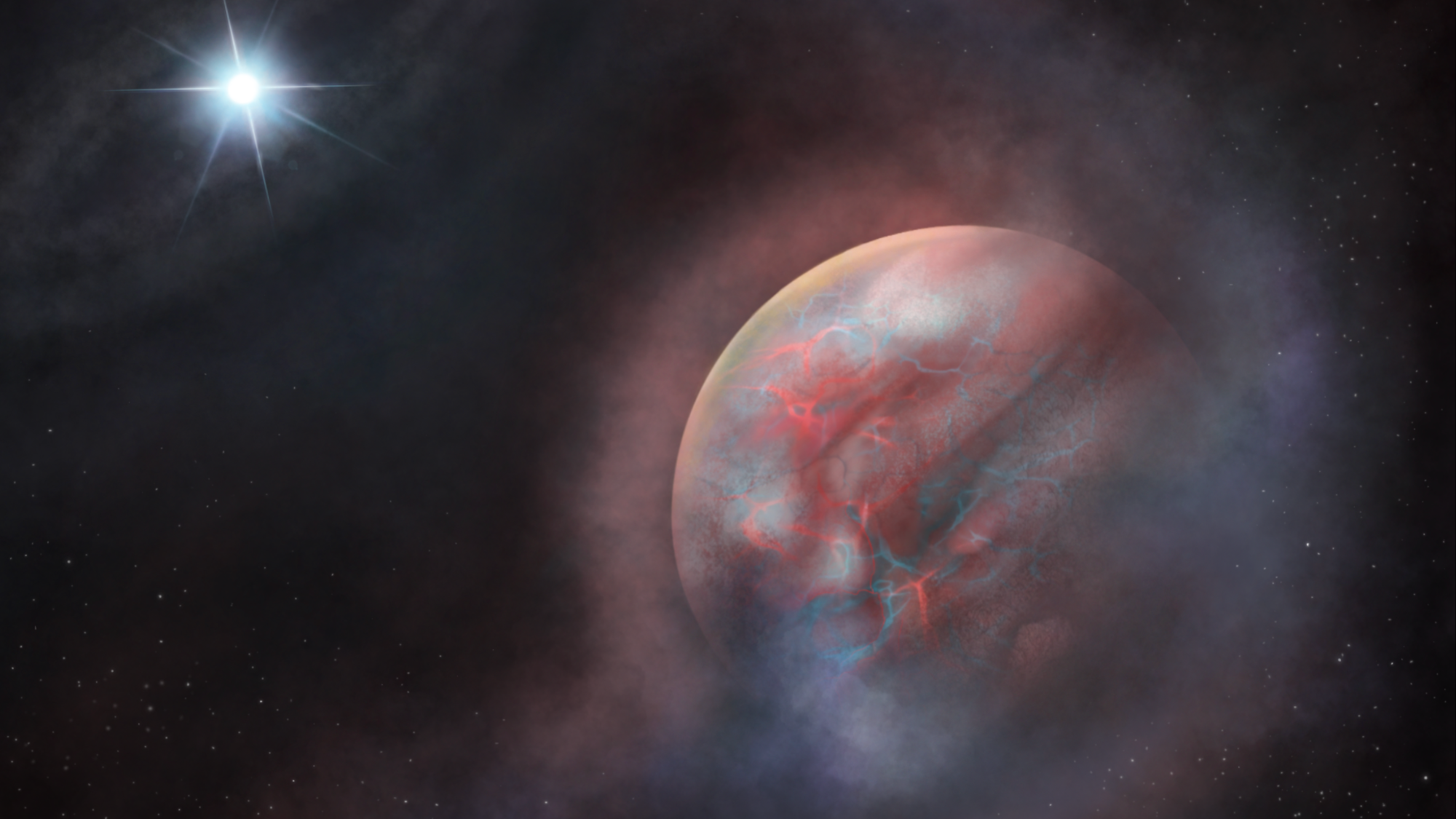
Circling its parent dead star every 4.4 days, a Jupiter-sized gas giant orbits the white dwarf HS 0209+0832 located roughly 270 light-years from Earth, according to findings published in Nature Astronomy announced in October.
For the first time, researchers have spotted an astronomical candidate that seemingly rose from the stellar wreckage of its predecessor. The object, orbiting a white dwarf designated as HS 0209+0832, is a Jupiter-sized gas giant.
While astronomers have previously found reborn worlds around dense neutron stars like pulsars, detecting one around a white dwarf is entirely unprecedented.
How Metal-Rich Debris Built a White Dwarf World
White dwarfs are the dense, hot cores left behind when stars roughly the mass of the sun exhaust their nuclear fuel, swell into red giants, and eventually shed their outer layers. Because these stellar remnants are exceptionally dense, heavy elements typically sink rapidly toward their centers, leaving behind pristine atmospheres composed almost entirely of hydrogen and helium.
The atmosphere contained trace amounts of silicon, almost no iron, but unusually high concentrations of heavy elements including zinc, copper, and niobium at levels roughly 1,000 times greater than those found in the sun.
“This pattern of elements is a telltale sign of the ‘s-process,’ a nuclear reaction that builds heavy elements inside dying stars during their bloated red giant phase. It’s a chemical signature no ordinary, ‘first-generation’ planet should carry, which told us that this new planet was something different.”
Dr. Jamie Williams, University of Warwick
This distinct isotopic fingerprint points to material raining down onto the white dwarf’s surface from a nearby source. Researchers conclude that this material formed a protoplanetary disk out of the very mass the star cast off during its death throes.
Detecting the 4.4-Day Orbit With NASA’s TESS
To verify the presence of a body feeding this stellar contamination, the team turned to NASA’s TESS exoplanet hunting spacecraft.
At such close proximity, the intense ultraviolet radiation emitted by the hot white dwarf is actively stripping the planet’s atmosphere. This boiled-off gas rains directly onto the stellar ember, creating the unique spectroscopic signature detected by the research team.

Why Companion Stars Are Required for Second-Generation Planets
Forming a new planetary system from stellar debris is exceptionally difficult. A single, isolated star typically sheds its mass in a roughly symmetrical outward flow, scattering dust and gas too widely for gravity to easily pull it back together.
To overcome this, the study authors suggest that HS 0209+0832 likely relied on a companion star. That stellar partner would have effectively pulled the ejected material back into orbit, creating the dense disk necessary for a new world to coalesce.
“What’s remarkable about the planet around HS 0209+0832 is that this isn’t a planet from somewhere else, or a survivor from the system’s birth; it looks like it was built from the very material its own star cast off as it died. In a sense, this system has given birth to a new world using the foundations of the old one.”
Boris Gänsicke, Department of Physics at the University of Warwick
Despite the compelling chemical and photometric evidence, researchers emphasize that the discovery remains only a candidate for now. Because white dwarfs cool gradually over time, any second-generation planet that forms within a stable habitable zone could theoretically remain there for tens of billions of years, though the intense heat of this young candidate currently rules out biological life.
Will subsequent observations confirm whether this Jupiter-sized candidate is definitively a second-generation planet born from stellar ash?

UK Proposes Norfolk Housing Levy to Unlock Stalled Homes
Environment Secretary Angela Eagle launched a public consultation on 17 September for a Norfolk pilot scheme requiring housing...

Wilkes Subglacial Basin Ice Could Raise Sea Levels by Four Meters
East Antarctica's Wilkes Subglacial Basin contains enough ice to raise global sea levels by up to four meters,...
Saturn Reaches Opposition on October 4 for Brightest Viewing of Year
Saturn reaches opposition on Sunday, October 4, 2026, sitting at its closest point to Earth for the year...

NASA Advances PRIMA Telescope to Phase B for Far-Infrared Research
NASA selected the PRobe far-Infrared Mission for Astrophysics, or PRIMA, to advance to Phase B development.