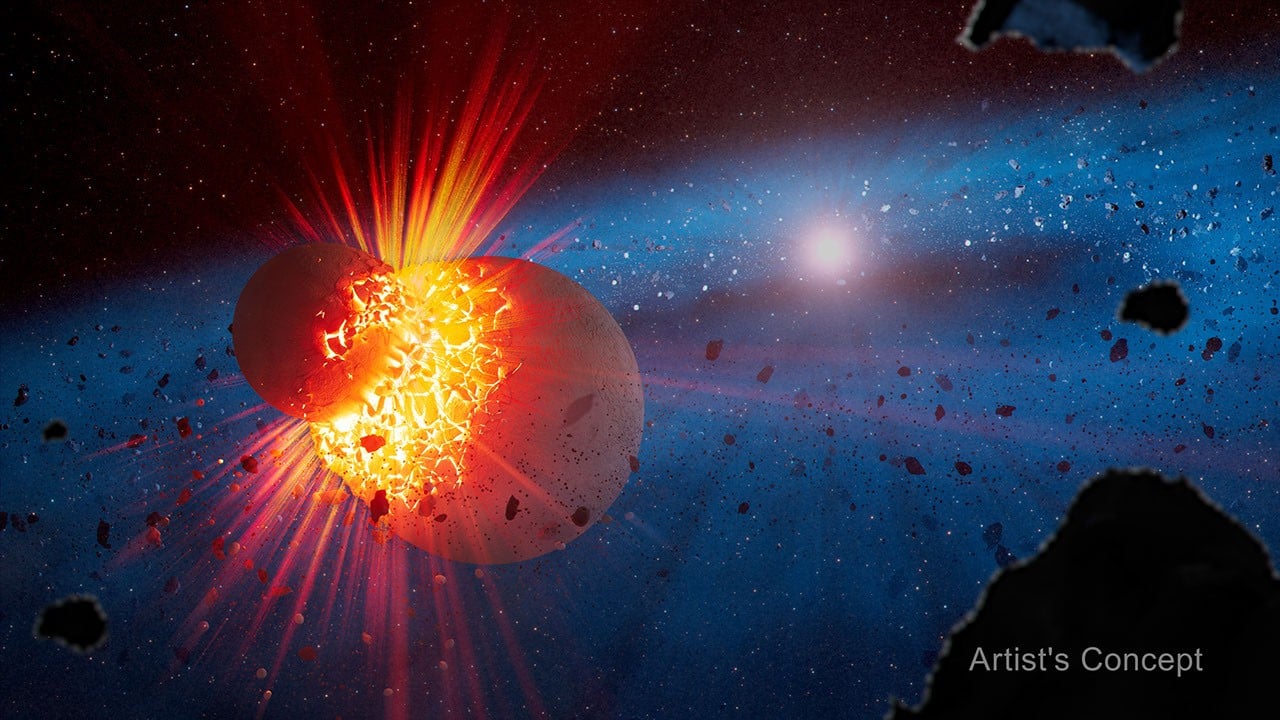
Astronomers using the James Webb Space Telescope and retired Spitzer archive data have identified 21 young star systems harboring extreme debris disks, revealing planetary smashups violent enough to vaporize rock.
In the infancy of our solar system, a Mars-sized body known as Theia crashed into the early Earth, melting rock and blasting debris into space that eventually coalesced to form the Moon. Researchers have long theorized that similar violent upheavals occurred elsewhere, but capturing direct evidence of these chaotic phases has proved difficult. By combining archival data from the retired Spitzer Space Telescope with fresh observations from the James Webb Space Telescope, astronomers have now cataloged 21 stellar systems experiencing this turbulent evolutionary stage.
These environments, which astronomers call extreme debris disks, feature unusually heavy concentrations of warm dust clustered right where rocky planets like Mercury, Venus, and Earth typically orbit. While theories suggested such chaotic systems should be widespread, observations show they are remarkably scarce, appearing around only about 1 percent of young stars.
Mineral Composition Reveals Energy of Planetary Impacts
To understand the mechanics behind these planetary impacts, the research team analyzed the mineral composition of the dust disks using mid-infrared spectra.
- Roughly one-third of the disks are silica-rich, containing volcanic glass-like obsidian.
- The remaining two-thirds are silica-poor, dominated by forsterite—a form of olivine recognizable on Earth as the green sand found on certain beaches in Hawaii.
Researchers tied the silica-rich dust to high-energy impacts between Mars-sized objects where the velocity of the collision actually vaporized rock. Meanwhile, the greener, silica-poor material originates from smaller, more modest grazing collisions between Moon-sized bodies.
We have no other way to study these planetary embryos directly because they are too small,
said Kate Su, lead author of the study, in a statement.
The chemical divide corresponds directly to the age of the host stars. Silica-rich debris disks appear exclusively around stars younger than 300 million years, matching computer models indicating that terrestrial planets finish forming within that initial window. In contrast, the systems with sandy, silica-poor dust persist across a broader age range and display wild brightness fluctuations.
Flickering Dust Clouds Suggest Hidden Giant Planets
The dust clouds in these extreme systems do not remain static. They dim and brighten over weeks, months, or years as fresh debris thickens and thins. Systems filled with sandy dust flicker the most, and some circle stars old enough that planet building should have long since finished.
Astronomers suspect that hidden, giant planets in those mature systems continue shifting orbits, acting like cosmic billiards and hurling smaller bodies into destructive paths. Despite the expanded catalog provided by Webb, significant gaps remain in researchers’ understanding of how these disks age and disperse.
“There’s many things we still don’t know about these disks.”
Attila Moor, Konkoly Observatory
With only three observed examples of extreme debris disks around stars older than 300 million years, researchers emphasize that more telescope time is needed to confirm whether high-energy, glassy impacts truly vanish after that threshold. For now, the expanded sample bridges a critical gap in reconstructing the rough final stretch of planetary system architecture.
Related reading
SpaceX Launches First Falcon Heavy Mission for National Reconnaissance Office
SpaceX launched a classified National Reconnaissance Office payload aboard a Falcon Heavy rocket from Florida on Thursday night,...
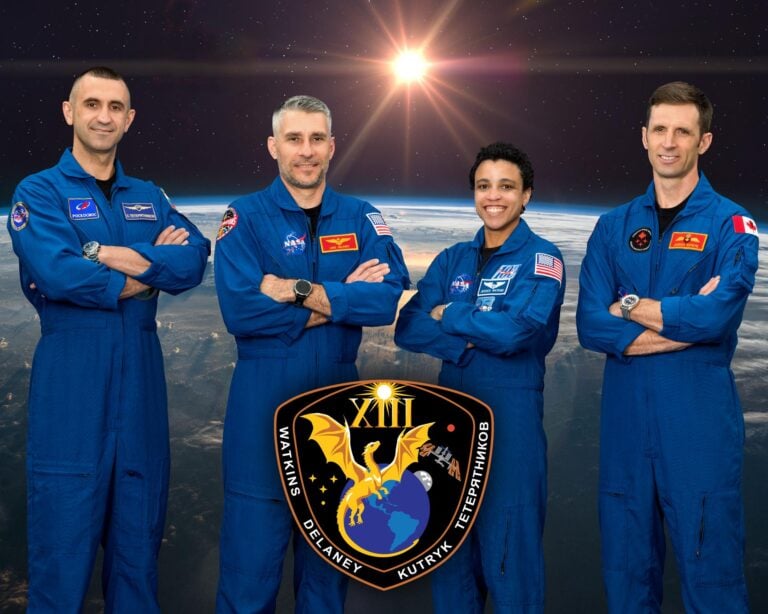
SpaceX Crew-13 Docks at ISS After Record-Breaking Flight
Four astronauts docked at the International Space Station on Thursday following a record-breaking eight-hour express flight from Florida.
Singapore Researchers Build Most Precise Atomic Clock Using Lutetium
Researchers in Singapore have unveiled a record-breaking atomic clock built from lutetium, achieving precision to 19 decimal places.

University of Sydney Researchers Identify New Giant Stick Insect Species
Researchers at the University of Sydney have discovered two new giant stick insect species in Australia and reinstated...