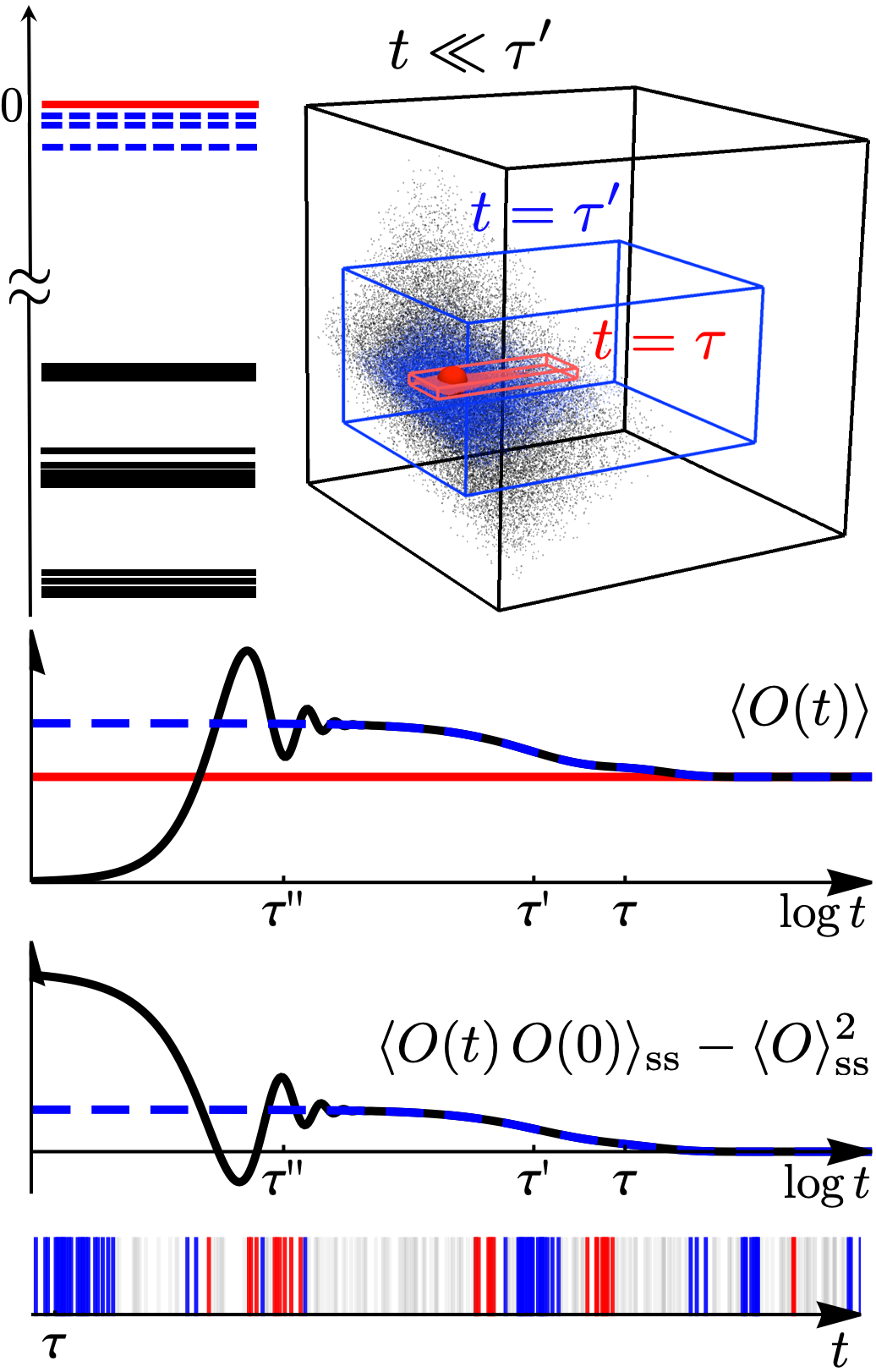
Researchers at Harvard University, Tampere University, and TU Dresden published findings in Physical Review X on October 11, 2026, showing that isolated quantum systems retain statistical traces of their initial states.
Stir a drop of milk into a cup of tea and watch it vanish. Very quickly the pattern blends, widens, and smooths out, so that no amount of gazing into the vessel will ever reveal the exact entry point of the liquid.
In classical physics, chaos acts as a universal eraser, scrambling initial conditions until systems achieve ergodicity, the statistical property where long-term behavior conceals starting points. New mathematical and theoretical work proves otherwise.
Quantum Stadium Billiards Reveal Persistent Memory
To expose this persistent memory, the research team turned to a curved-walled enclosure known as a quantum stadium billiard. Picture a projectile careening indefinitely inside a chamber bounded by curved barriers, deflecting along an altered trajectory at every collision, much like a pool table outfitted with rounded margins.
In classical mechanics, a ball bouncing endlessly inside such a table explores every region with equal frequency, entirely forgetting its launch point. Quantum wave packets, however, refuse to wipe their slates clean.
When the team averaged the motion of these wave packets over extended periods, a stubborn bias emerged. The system remained at least twice as likely to be found back in its original condition as in any comparable random configuration.
This partiality does not fade with time, defying the expectation that chaotic dynamics must dilute every trace of initial positioning.
The discovery represents a distinct form of ergodicity breaking that appears as a universal property of quantum evolution rather than a rare anomaly.
Mathematical Framework Defines Universal Memory Factors
The mathematical framework developed by the investigators divides this retention effect into two distinct components. The first is a universal memory factor governed by system symmetries, while the second is a revival factor driven by early-time recurrences linked to phenomena such as quantum scarring.
The study originated from a fundamental contradiction inherent in quantum chaos: while classical ergodic models naturally erase starting parameters, quantum mechanics can preserve historical markers via phase coherence.
Joonas Keski-Rahkonen, senior author of the paper, told Phys.org.
Early recurrences slow the exploration of new regions in phase space, strengthening the overall imprint left by the system’s early development.
Study Builds Upon 1984 Quantum Scarring Discoveries
The new findings build upon foundational observations made decades ago. In 1984, Harvard professor and co-author Eric Heller discovered that quantum systems sometimes retain sharp imprints of repeating classical paths, a phenomenon termed quantum scarring.
For generations, scarring was treated as an isolated curiosity. The current study establishes that scarring is merely the most visible expression of a universal rule.
All quantum systems carry a birthmark from its beginnings, linking isolated particle behavior to questions of thermalization, many-body localization, and how macroscopic classical reality emerges from underlying microscopic quantum laws.
Persistence of Imprints Matters for Nanoelectronics
Beyond theoretical physics, the persistence of these imprints matters for physical hardware. Modern quantum simulators and nanoscale electronics are built at scales where coherence effects and memory retention directly alter how devices settle into equilibrium.
As Dr. Joonas Keski-Rahkonen of Tampere University explains, it matters that a system which quietly remembers its starting point behaves differently from one that forgets.
Harnessing these birthmarks alongside quantum scars could eventually inform the design of next-generation quantum technologies.
The research team plans to refine their theoretical framework further, investigating explicit implications for thermalization and exploring extensions where entire regions of Hilbert space remain statistically favored, a concept they designate as a quantum birthmark.
Related reading
NASA Releases Artemis II Lunar Science Data and Farside Images
NASA released nearly a terabyte of Artemis II science data and reports on Wednesday, featuring 11,000 images, audio...

UK Skies Illuminated by Northern Lights as Geomagnetic Storms Continue
Skies across the UK lit up with the aurora borealis on Friday and Saturday evening as energetic solar...

Hubble Data Points to First Potential Planet Born From Dead White Dwarf Star
Astronomers revisiting decades-old Hubble Space Telescope data have discovered an unusual chemical signature around a white dwarf star,...
Spanish Archaeologists Catalog Neanderthal Wooden Tools at Abric Romaní
Spanish archaeologists have cataloged 597 wooden remains and imprints from Neanderthal living areas at Abric Romaní, dating between...