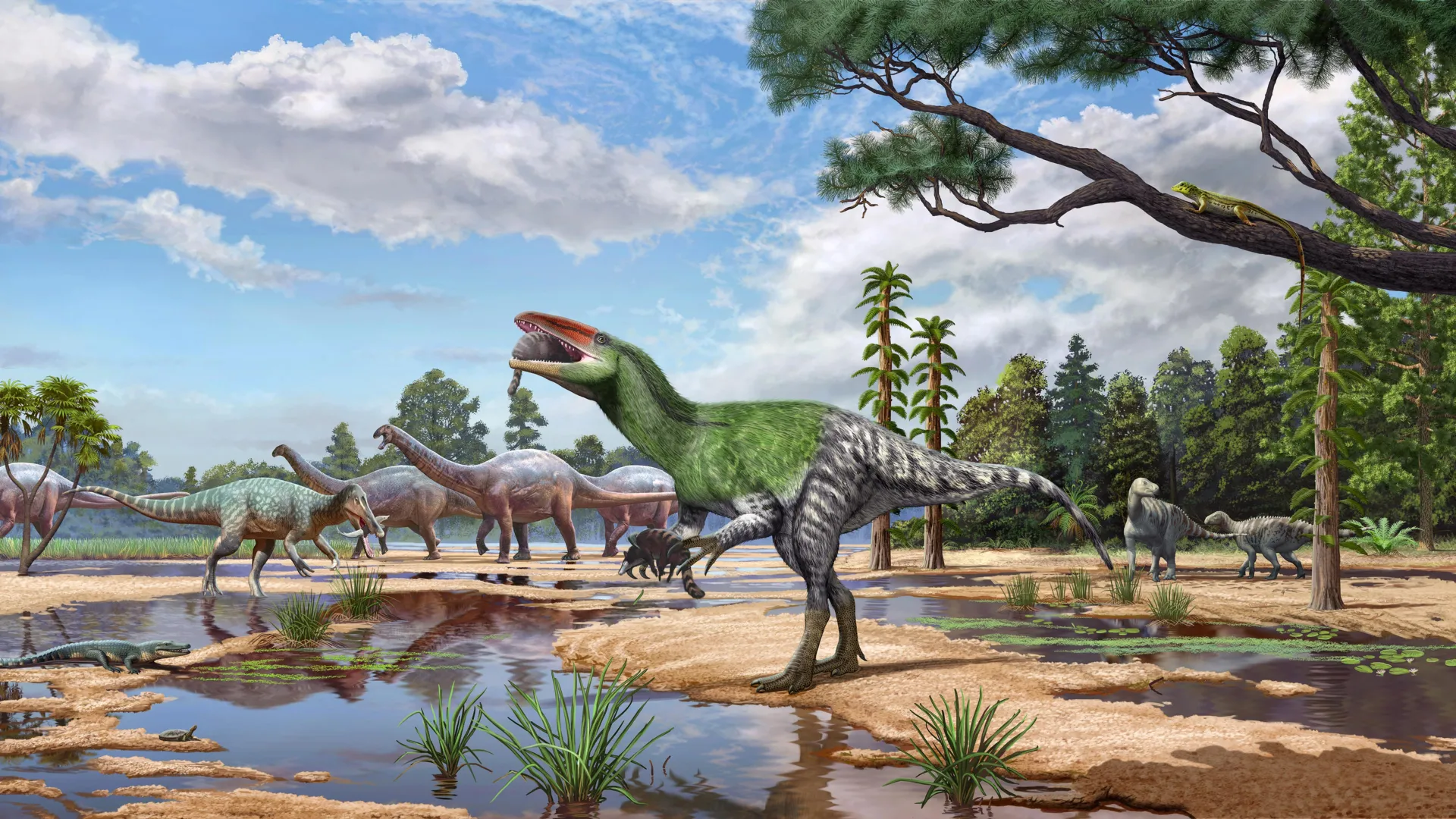
Researchers have identified Europe’s first megaraptoran dinosaur, named Invictibellatrix amberina, from a fossil skull fragment acquired by London’s Natural History Museum in 1924. The tiger-sized, long-clawed predator roamed the Isle of Wight about 120 million years ago during the Early Cretaceous period.
A weathered piece of dinosaur skull sat unnoticed in a museum drawer for nearly a century before scientists recognized its true identity. Acquired by the Natural History Museum in London after the death of amateur fossil collector Reginald Walter Hooley, the fragment had arrived among a batch of more than 1,000 unstudied specimens collected from the Isle of Wight. The discovery was formally described in a study published on October 14, 2026, in the journal Royal Society Open Science.
Anatomy and Lifestyle of Invictibellatrix amberina
The newly named genus translates to unconquered female warrior,
recognizing the eventual rise of megaraptorans to apex predator status in southern continents, while the species name amberina honors the amber embedded within the plant debris beds of the Wessex Formation where the fossil was found.
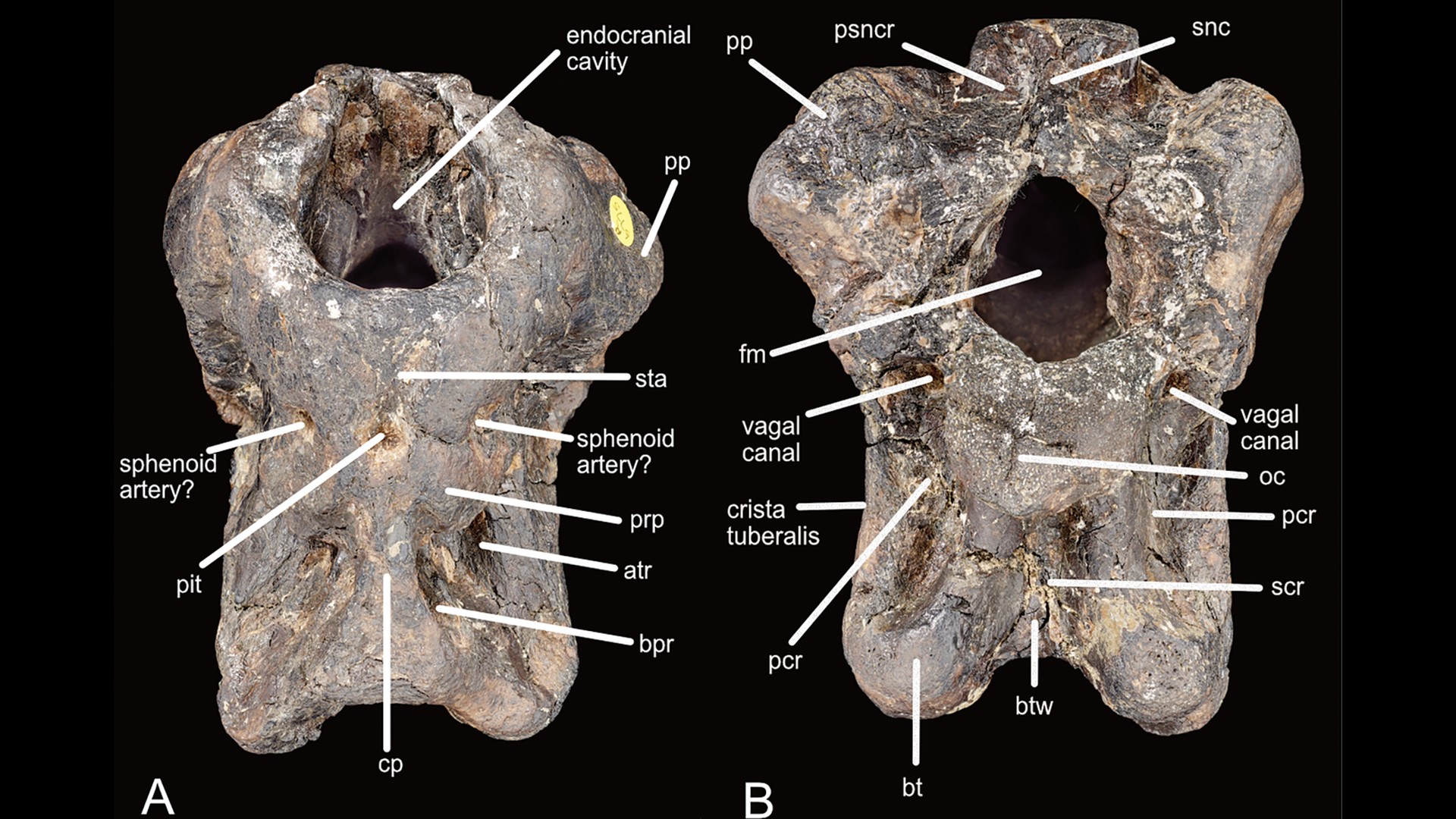
Although the specimen consists only of a fragment from the rear of the skull, researchers used micro-CT scanning to build detailed 3D digital models of the bone and the interior braincase. By comparing these structures with related theropods, the team estimated the physical dimensions and ecological role of the animal.

Based on what we know about its closest relatives, Invictibellatrix would have been three to four meters long and just over a meter and a half in height — about as tall as a human. It would likely have had feathers and its claws might have been about 10cm to 20cm long. It would have eaten small dinosaurs, lizards and mammals — occupying a similar role in the food chain to the hyena today.
Dr Cassius Morrison, University College London (UCL) Earth Sciences
Unlike tyrannosaurs, which relied on massive crushing jaws and tiny arms, megaraptorans featured slender skulls and seized prey using long arms and huge curved claws. While later southern megaraptorans such as Maip macrothorax grew to the size of an elephant with claws up to 35 centimeters long, Invictibellatrix sat at the smaller, earlier end of the group’s size spectrum.
Resolving a Continental Migration Gap
The identification solves a longstanding geographical puzzle in dinosaur evolution. Megaraptorans have remained among the least understood groups of large meat eaters because their remains are exceptionally rare. Paleontologists previously theorized that the group originated in Asia, moved through Europe, and eventually reached Gondwana, the southern supercontinent comprising Africa, South America, and Antarctica. However, without a confirmed European fossil, that migration pathway lacked physical proof.
Co-author Charlie Scherer, a PhD student at UCL Earth Sciences, noted that the discovery provides the first tangible evidence linking the northern and southern distributions. The research team used mathematical modelling to test how ancient climates, geography, and evolutionary trees influenced the spread of megaraptorans over tens of millions of years.
This new species is the first proof we have that megaraptorans were also present in Europe and that they reached Gondwana this way rather than island-hopping further south.
Charlie Scherer, a PhD student at UCL Earth Sciences
While the models produced different reconstructions of early origins depending on the variables used, the fossil establishes that Europe served as a plausible corridor during the Early Cretaceous. Later in the Cretaceous period, northern megaraptoran populations disappeared, while southern lineages continued to diversify.
Reassessing Museum Collections on the Isle of Wight
Carnivorous dinosaur remains have historically been particularly elusive on the Isle of Wight, despite more than two centuries of fossil collecting across the region’s eroding cliffs.
It is a real mystery that this fossil was overlooked for so long, sitting in a drawer for nearly 100 years. Lots of bones are found on the Isle of Wight – who knows what else is waiting to be discovered.
Professor Paul Barrett, Natural History Museum
Researchers emphasized that the discovery highlights the scientific value hidden inside historical archives. Professor Paul Barrett noted that museum drawers still hold uncatalogued specimens capable of reshaping our understanding of prehistoric ecosystems.
>
Keep reading

Dr. Ramya Anche to head NASA’s $20 Million PUFFINS Space Telescope Mission
Bengaluru-born astronomer Dr. Ramya Anche has been selected as principal investigator for NASA’s $20 million PUFFINS space telescope...

Japan to Launch Historic Round-Trip Mission to Mars Moon
Japan’s unmanned Martian Moons eXploration spacecraft is scheduled to launch from the Tanegashima Space Center on Tuesday to...

Cassini Finds Salt Diversity in Enceladus Ice
Saturn’s moon Enceladus concentrates and segregates ocean compounds into distinct ice grains during space eruptions.

Mangroves Rebound After Decades of Loss
Global mangrove cover grew by 477 square kilometers between 1985 and 2025, marking a modest 0.3 percent net...