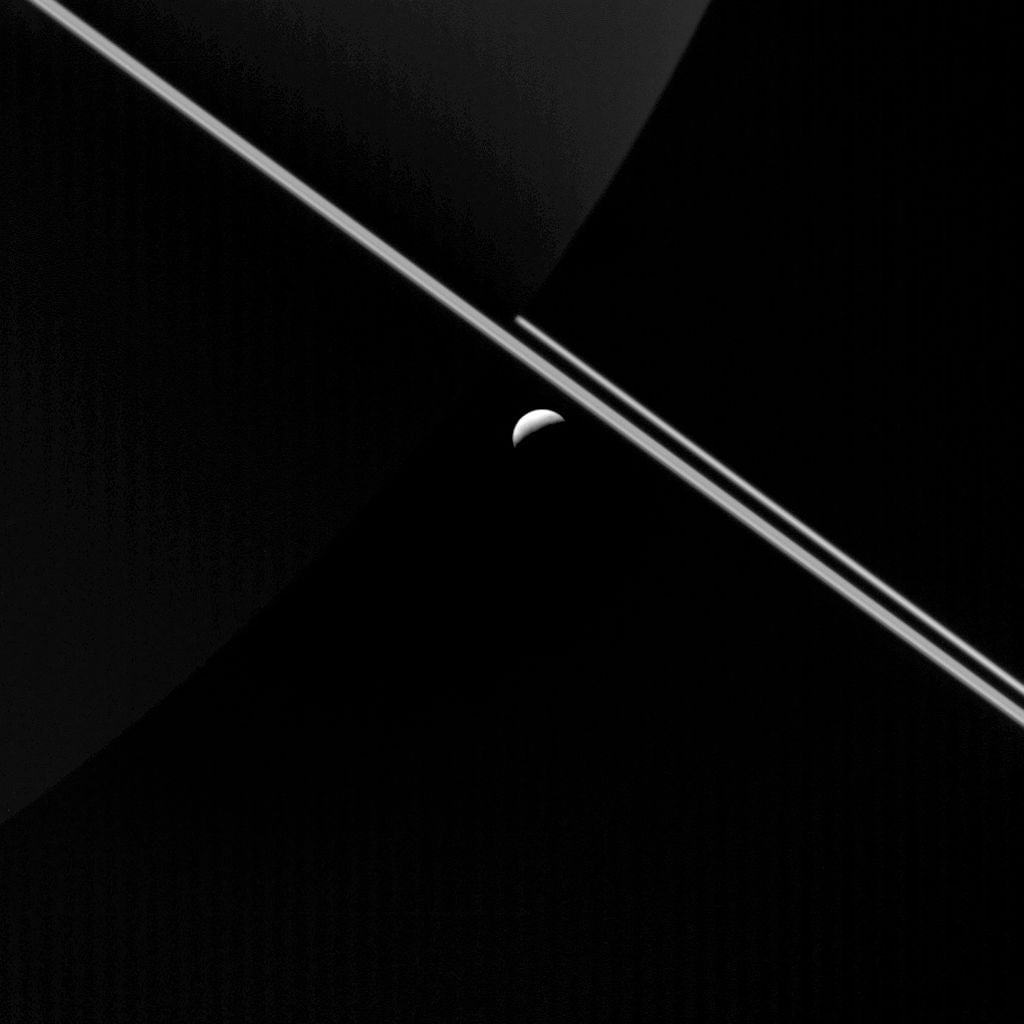
Saturn’s moon Enceladus concentrates and segregates ocean compounds into distinct ice grains during space eruptions. A study published Sept. 25 in Science Advances shows that slow freezing and wall collisions inside the moon’s vents break ocean spray into micrometer-scale fragments, helping future spacecraft detect potential biosignatures.
Saturn’s moon Enceladus harbors a global liquid ocean beneath a thick ice shell. This ocean regularly vents material into space. Geysers of water vapor and tiny ice particles shoot hundreds of miles upward at the moon’s south pole. These geysers feed the planet’s E ring.
When NASA’s Cassini spacecraft arrived at Saturn in 2004, it repeatedly flew directly through this plume. It sampled ocean-derived material without requiring a landing or drilling through miles of ice.
Those flybys detected salts, organic compounds, and indicators of water-rock interactions occurring on the seafloor. Now, an examination of nearly 1,000 individual salt-rich ice grains recorded by Cassini’s Cosmic Dust Analyzer has taken place.
This examination shows that the plume’s particles possess a much greater compositional diversity than scientists previously recognized.
Freezing And Vent Collisions Segregate Ocean Salts
The research team combined archival spacecraft data with laboratory experiments, thermodynamic calculations, and droplet cooling models. These methods helped researchers understand how the ice grains formed. Researchers froze droplets of alkaline salt water in the laboratory. They formulated this water to match the chemical makeup of the Enceladus ocean. Larger droplets cooled slowly and developed distinct salt-rich regions. Rapidly frozen small droplets stayed uniform.
When these droplets freeze relatively slowly, different salts can separate into distinct regions within a single grain. For example, sodium chloride could concentrate in one region and potassium chloride in another. As the grain is accelerated through the vents, collisions with the icy walls can break it into smaller fragments with different compositions. This is the mechanism we propose.
The physical model starts when bursting bubbles at the ocean surface create spray droplets. Water vapor carries these droplets upward through the vents. They freeze slowly enough inside for various salts to separate.
Narrower passages closer to the surface then accelerate the vapor and frozen particles to hundreds of miles per hour. These passages smash the particles against the icy walls and shatter them into micrometer-scale fragments.
Compositional Diversity Across Salt-Rich Ice Grains
Analysis of the dust analyzer data revealed that individual grains varied widely in chemical composition. Some particles were dominated by sodium chloride. Others contained mostly carbonates, phosphates, hydroxides, or potassium-bearing salts.
This natural sorting mechanism means the moon essentially performs preliminary sample preparation in space. This task normally demands substantial effort in terrestrial chemical laboratories. Frank Postberg, a professor of planetary sciences at Freie Universität Berlin who led the study, noted that oceanic constituents separate and concentrate directly into individual ice particles.
Future Spacecraft Searching For Extraterrestrial Life
These findings alter how researchers should interpret plume samples collected during future missions. Mixing multiple particles together into a single measurement could erase natural chemical separations. Such mixing could also conceal rare compounds.
Analyzing grains individually preserves that fine-grained information. It also improves the odds of spotting unusual chemistry.
Researchers suggest that similar physical processes may concentrate organic molecules and potential molecular biosignatures into a tiny fraction of the ice grains. Because those signatures might be restricted to only a few isolated particles, future spacecraft visiting the Saturnian system will need to target and analyze individual grains specifically.
Analyzing a large number of individual grains increases our chances of finding interesting compositions and gives us a better picture of the ocean as a whole. The most useful information is in the differences from grain to grain. Future missions should analyze as many individual grains as possible.
Mangroves Rebound After Decades of Loss
Global mangrove cover grew by 477 square kilometers between 1985 and 2025, marking a modest 0.3 percent net...
Whitehead Researchers Recreate Planar Cell Polarity in Engineered Epithelial Cells
Researchers at the Whitehead Institute have recreated planar cell polarity in engineered epithelial cells, discovering that collective cell...
Thwaites Glacier Melts Faster Than Expected. Sea Levels Could Double by 2100
Thwaites Glacier in West Antarctica is melting faster than expected, with a new model showing sea level rise...
Japanese Researchers Guide Vortices via Atomic Steps
Under intermediate magnetic fields, vortices traveled more than 1,000 times more easily along surface steps just one atom...