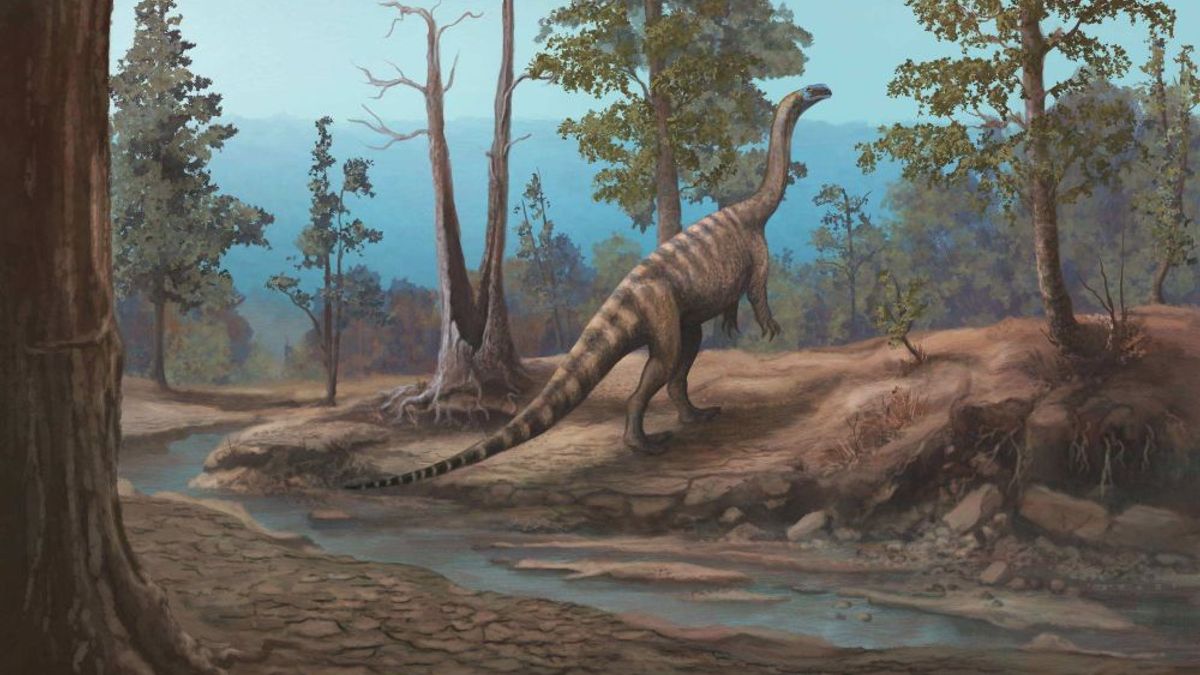
Unearthed in Zimbabwe and dating back 210 million years, a newly identified sauropodomorph dinosaur named Musango matusadonaensis is challenging long-held assumptions about prehistoric ecosystems in southern Africa, revealing that the ancient supercontinent Gondwana featured a patchwork of distinct regional communities rather than a single uniform fauna.
Fossil Discovery Along the Shores of Lake Kariba
The fossil remains that would become known as Musango matusadonaensis first emerged from the ground in 2018 during fieldwork conducted near Lake Kariba in northern Zimbabwe. Excavated by a team of researchers from the United Kingdom, South Africa, and Zimbabwe, the skeleton was initially mistaken for a nondinosaurian archosaur—a broader reptile group that includes both dinosaurs and crocodilians—due to its appearance in the surrounding rock. Once specialists freed the bones from the matrix, however, distinctive features in the hip structure confirmed they were looking at an entirely unknown dinosaur species, as Discovermagazine, a researcher at the Natural History Museum in London and the study’s lead author, explained.
The find follows the 2024 description of Musankwa sanyatiensis as the country’s fourth dinosaur, steadily expanding a paleodiversity record that has historically been far less studied than sites in Europe or North America.
Anatomy, Age, and Survival of a Triassic Sauropodomorph
Living roughly 210 million years ago during the Norian stage of the Late Triassic period, Musango trotted across a highly seasonal landscape of rivers and streams during an era when dinosaurs were just beginning to spread globally before becoming the dominant terrestrial animals. It belonged to the sauropodomorphs, a group of two-legged herbivores and omnivores that eventually evolved into the gigantic, long-necked sauropods such as Diplodocus.
Unlike those later titans, Musango was relatively lightly built. Researchers estimate the animal stretched about 4.5 meters (roughly 15 feet) in length—comparable to the size of a car—while weighing only about 222 kilograms (490 pounds), similar to a fully grown pig.
Though its skull remains missing, scientists recovered a remarkably complete partial skeleton preserving bones from the spine, ribs, shoulders, hips, arms, legs, and feet. A thin section analysis of its fibula revealed eight distinct growth marks, indicating the animal was at least eight years old and nearing full adult size when it died. That same bone also contained reactive tissue showing it had survived a serious prior injury or infection before normal bone growth resumed over the affected area.
Challenging Assumptions About Ancient Gondwana
The anatomical details are scientifically compelling, but the geographic implications carry even greater weight for paleontologists reconstructing the breakup of the ancient supercontinent Gondwana. Researchers historically assumed that Late Triassic dinosaurs roaming across southern Africa shared a broadly uniform ecosystem. Yet comparing Musango‘s locality near Lake Kariba with fossil deposits in South Africa’s Karoo Basin reveals a striking mismatch: scientists have yet to identify a single dinosaur taxon that appears in both regions.
“Until recently, it was assumed that the dinosaurs living across southern Africa were largely the same. However, these discoveries are showing that this part of the ancient supercontinent Gondwana was actually made of a series of smaller ecosystems – each with a different cast of characters.”
Paul Barrett, Merit Researcher at the Natural History Museum, London
Environmental differences likely drove this separation. While comparable South African fossil sites feature wetter river systems farther south, Musango’s northern Zimbabwean landscape was semi-arid, populated alongside the dinosaur by lungfish, crocodile-like phytosaurs, and fellow early dinosaurs such as NHM.
Etymology and the Tip of the Paleontological Iceberg
The species name carries local significance rooted in the geography and culture of the discovery site. The generic name Musango derives from the ChiShona word meaning living in the bush
, reflecting the remote landscape and proximity to Musango Island, while the specific epithet matusadonaensis honors the neighboring Matusadona National Park.

Researchers emphasize that this find represents only a fraction of what remains buried across the continent. Expedition leaders note that another new Zimbabwean species is already awaiting formal description, alongside reports of additional fossil deposits that have yet to be examined by scientific teams.
“New dinosaur species like Musango show the value of doing palaeontological fieldwork in remote, and often scenically beautiful, places. This study is the result of a thriving international collaboration between the UK, South Africa and Zimbabwe, and reinforces the importance of southern Africa in understanding dinosaur diversity.”
Professor Jonah Choiniere, leader of the expedition and co-author from Johannesburg’s Evolutionary Studies Institute
Keep reading

SpaceX Launches Final Three O3b mPOWER Satellites for SES
SpaceX successfully launched the final three O3b mPOWER satellites for SES on September 13, 2026, from Cape Canaveral...

Japan Launches Kaguya Spacecraft to Map Moon in 2007
On September 13, 2007, Japan launched its advanced Kaguya spacecraft from the Tanegashima Space Centre aboard an H-IIA...

Astronomers Identify Eos, a Massive Molecular-Hydrogen Cloud Near the Sun
Astronomers have identified Eos, a massive molecular-hydrogen cloud located roughly 300 light-years away and spanning 40 full-Moon widths...
Researchers Find Diamond Melting Point Is Lower Than Previously Measured
Researchers zapping synthetic diamond plates with a powerful ultraviolet laser discovered the mineral's melting point is more than...