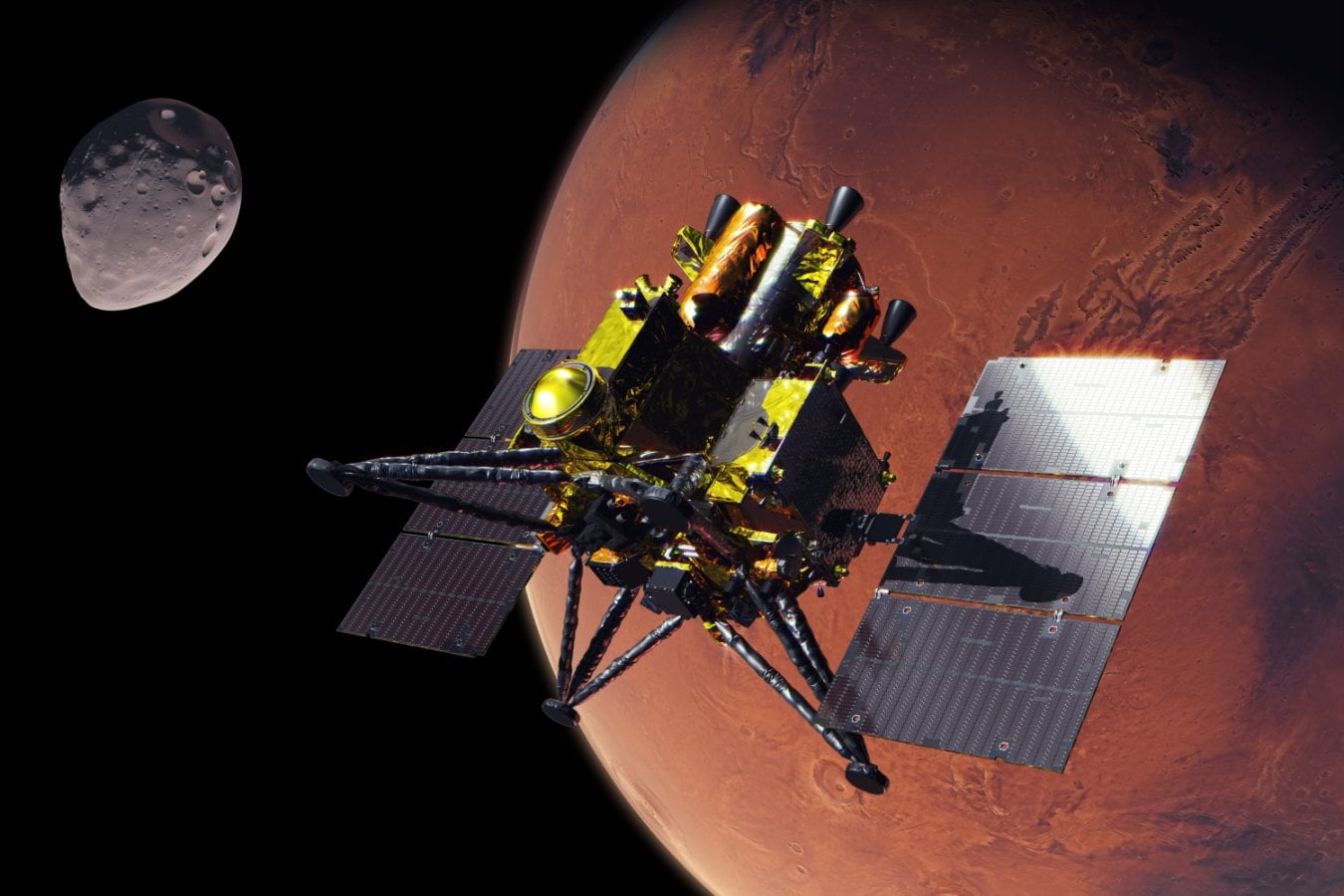
Japan’s unmanned Martian Moons eXploration spacecraft is scheduled to launch from the Tanegashima Space Center on Tuesday to conduct the first round-trip mission to the Martian system. The flight targets the moon Phobos to retrieve soil samples and help resolve enduring scientific debates over how Mars acquired its two natural satellites.
Japanese scientists are readying a mission to Mars’s moons to retrieve samples that could help unlock the origins of the Solar System and life on Earth. The H3 rocket carrying the Martian Moons eXploration probe is set to blast off from the Tanegashima Space Center on Tuesday at 4:41 am local time, according to the Japan Aerospace Exploration Agency. The spacecraft’s operators at the space agency will guide the probe toward Mars arriving in August 2027 to enter an orbit alongside the larger moon, Phobos.
While past missions brought back samples from distant asteroids, such as the Hayabusa-2 probe, project manager Yasuhiro Kawakatsu noted that this venture requires traveling very close to Mars and returning against the planet’s powerful gravitational pull. Going deep into what scientists call the gravity well demands precise maneuvering and strong engineering, particularly for the landing gear designed to touch down on a body with extremely weak gravity.
Exploring Phobos and Releasing the IDEFIX Rover
Once the spacecraft reaches the Martian system, it will map the surface of Phobos in detail and observe the smaller moon, Deimos, without landing on it. Operators will then select a touchdown site on Phobos for one or two brief landing attempts. During these operations, the lander will deploy a small rover named IDEFIX, which shares its moniker with the French name for the comic hero Asterix’s dog.
The spacecraft carries two distinct sampling systems. A pneumatic device will shoot a puff of gas to blow dust and pebbles into a container, while a corer will blast a hollow cylinder into the ground to collect deeper material. The mission aims to collect at least 10 grams of surface material before storing the payload for the journey home.
Resolving the Giant Impact Versus Captured Asteroid Theories
For more than a century, astronomers have debated whether Phobos and Deimos originated as ancient asteroids captured by gravity or formed from debris sent into orbit by a massive impact on Mars. Their asteroid-like shapes favor capture, but their circular equatorial orbits align better with the impact hypothesis.
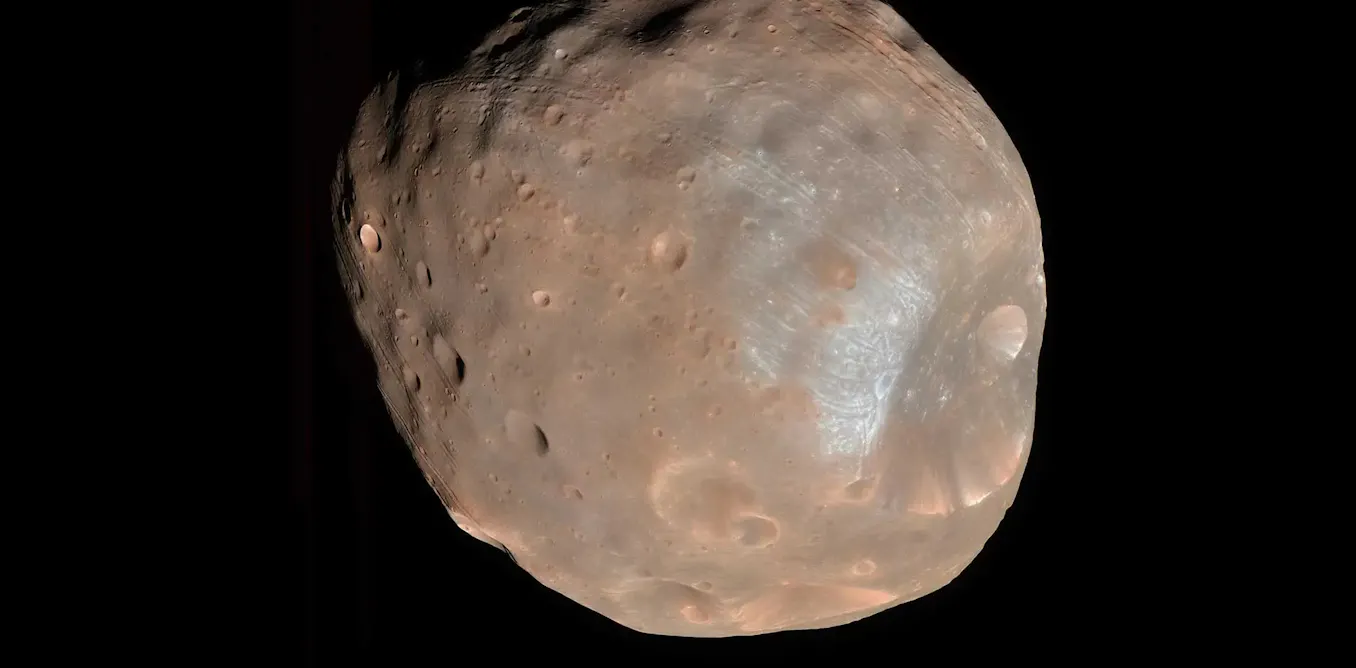
Phobos and Deimos may be remnants of a huge impact on Mars that sent material into orbit around the planet, or ancient asteroids captured by Mars’ gravity billions of years ago. The answer will help illuminate that early epoch, when Earth and the other inner planets may have received much of their water and organic compounds.
Tom Statler, MMX program executive and program scientist, NASA headquarters
Determining the composition of these bodies will clarify how the inner rocky planets acquired vital compounds. Researchers suggest that impacts on Mars may have launched planetary material onto Phobos, preserving bonus debris from the planet itself.
International Partnership and Curation Plans for Returned Samples
The mission involves broad international cooperation, bringing together space agencies from the United States and Europe alongside roughly twenty universities and technology companies. NASA contributes scientific instrumentation, including the MEGANE spectrograph developed by the Johns Hopkins Applied Physics Laboratory to measure gamma rays and neutrons, as well as a pneumatic sampler built by Honeybee Robotics.
Under an agreed sample curation partnership, NASA will receive and analyze about 15% of the returned material at the Johnson Space Center Astromaterials Lab in Houston. European officials point out that Earth laboratories offer unmatched analytical precision for these unique planetary materials.
Bringing samples to our most sophisticated laboratories on Earth is a multiplier of discovery, because our most precise instruments are too large, too complex or too sensitive to send into space.
Elliot Sefton-Nash, European scientist
While the spacecraft embarks on its multi-year journey, timelines among partner agencies vary slightly regarding specific operational milestones. NASA projects sample collection no earlier than December 2028, while European mission schedules place the landing in 2030. The return capsule carrying the precious payload is expected to touch down in Australia in 2031 before moving to Japan for cataloging and international study.
More on Mars
Cassini Finds Salt Diversity in Enceladus Ice
Saturn’s moon Enceladus concentrates and segregates ocean compounds into distinct ice grains during space eruptions.

Mangroves Rebound After Decades of Loss
Global mangrove cover grew by 477 square kilometers between 1985 and 2025, marking a modest 0.3 percent net...
Whitehead Researchers Recreate Planar Cell Polarity in Engineered Epithelial Cells
Researchers at the Whitehead Institute have recreated planar cell polarity in engineered epithelial cells, discovering that collective cell...

Thwaites Glacier Melts Faster Than Expected. Sea Levels Could Double by 2100
Thwaites Glacier in West Antarctica is melting faster than expected, with a new model showing sea level rise...