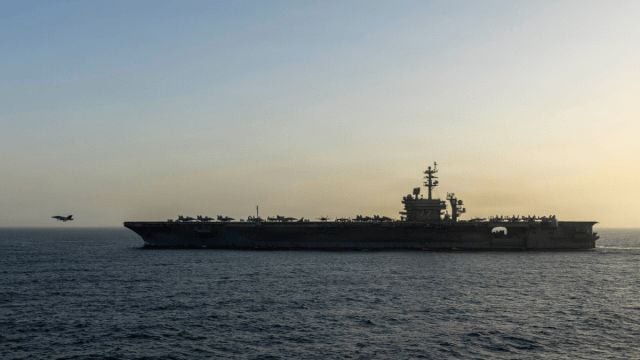
Thousands of sailors aboard the USS Abraham Lincoln docked at Thailand’s Laem Chabang Port on Wednesday for a scheduled break after enduring a 286-day deployment in the Middle East, a stretch that brought intense mental health strains, supply shortages, and at-sea rescues.
A Deployment and the Journey to Thailand
The Nimitz-class nuclear-powered aircraft carrier reached eastern Thailand after completing its first full port stop 286 days after the deployment began. The vessel initially left San Diego last November for the Pacific before operations related to the war with Iran altered its course and sent it to the Middle East.
The carrier’s roughly 5,000 service members arrived following a protracted operational tempo that far exceeded standard deployment schedules. According to Bloomberg, the ship docked at Laem Chabang Port, situated approximately 30 kilometers (19 miles) from the resort city of Pattaya, where some 5,000 sailors and Marines will take a five-day break following prolonged operations in the Middle East.
Scrutiny Over Living Conditions and Mental Health Strain
The prolonged absence of port visits sparked widespread attention and concern regarding life aboard the carrier. Published reports documented shortages of food, basic hygiene products, and reliable mail service, alongside plumbing failures and water contamination issues cited in congressional letters.

Several sailors aboard the USS Abraham Lincoln reportedly attempted to go overboard this month. The carrier has remained deployed for more than 250 days, well beyond its original seven-month schedule. CNN stated that one sailor went overboard on Aug. 3. However, he was rescued within an hour by an air wing search-and-rescue helicopter. Three U.S. officials told the outlet the sailor wore a life vest and suffered no injuries. One official described the incident as a mental health episode. The ship’s medical department treated the sailor before transferring them off the vessel for additional care.
Conversation over the pounding music was challenging. One older crew member told us they really needed the break. The news says we've been at sea for nine months. To be honest I've lost track of time
, he said. It got boring. It's never big enough on board. It's big but it still feels a boat, especially when you're sharing it with thousands of people.
How long would it take them to get home to California? “Too long” he said.
Shakeira Fairfax, the mother of 25-year-old crew member Jada Fairfax, told Reuters there had been moments over the past few months when “morale was low. She described the period after hostilities broke out in the Middle East as an
uncertain” and “scary” time.
I just can't wait to see her smile. I can't wait to hear 'mum', I know that's the first thing she's gonna say,
Fairfax added.
Family members voiced similar anxieties. Bonnie York, whose stepson is serving on the USS Abraham Lincoln, told MS Now that morale has declined significantly during the lengthy deployment.
The morale is not good,
York said. Apparently, the ship's doctor or therapist said they need to hit port soon or people are going to start, you know, losing their minds.
Official Responses to Mounting Pressure
Lawmakers took notice of the conditions. Sen. Richard Blumenthal sent a letter to Defense Secretary Pete Hegseth and Acting Navy Secretary Hung Cao. He cited reports of deteriorating mental health, water contamination, plumbing failures, shortages of basic supplies, and disruptions to the ship’s mail service.
California Rep. Mike Levin also pointed to troubling living conditions aboard the carrier. He cited issues including broken toilets, moldy showers, limited hot water, and shortages of basic hygiene products.
The Navy, however, disputed claims that there has been a rise in suicide-related incidents, emphasizing that medical, religious, and mental health professionals remained accessible to the crew. In a statement to Straight Arrow, a Navy official said the service organizes carrier strike groups’ maintenance, training and deployments within a standard 36-month rotation. The official said the Navy is fully committed to the mental, emotional and spiritual well-being
of sailors and provides support before, during and after deployments.
Pattaya Prepares for an Economic Boost
For the thousands of sailors stepping onto solid ground, the immediate focus centered on rest, shopping, and visits to the resort city. Many of the service members are expected to spend part of the break in Pattaya, about 40 minutes from the port. Local officials estimate the visit could bring roughly $3 million into the tourism-dependent city’s economy.

To maintain order during the port call, the Navy deployed its Shore Liaison Group. Visible everywhere in Pattaya were the men wearing t-shirts emblazoned with the letters SLG, or Shore Liaison Group. It is their job to maintain discipline on land, to watch out for the crew members, some of whom are very young and inexperienced, and to co-ordinate with the local authorities during port calls.
Thai authorities have also stepped up security while the carrier group is in the area, including increased police patrols and road checks around Pattaya. US Naval Attache Kristopher Robinson did not answer questions from the BBC about activities that soldiers were banned from doing while in Pattaya, saying that we're trying to give the sailors as much opportunity for rest as they can
. US personnel, he added, would conduct themselves in accordance with US law, US naval regulations, and the laws of Thailand
.
The Road Home to San Diego
The Lincoln left San Diego last November for the Pacific before the war with Iran changed the course of its deployment. The carrier was later sent to the Middle East to support U.S. operations in the war with Iran. The USS George Washington relieved the Lincoln there in August, allowing it to begin the trip home. The Lincoln’s stop in Thailand is scheduled to last four days before the carrier continues its journey home to San Diego.
Keep reading

Macron Seeks Oil Supplies from UAE
French President Emmanuel Macron began a four-nation Gulf tour in Kuwait and Abu Dhabi on Monday, October 19,...

IMF World Bank Meetings Warn of Global Stability Threats
Global finance leaders wrapping up the annual IMF and World Bank meetings in Bangkok on October 18, 2026,...

Israel Flight Diverted to Bulgaria After Bomb Threat
An Austrian Airlines flight carrying 57 people from Tel Aviv to Vienna diverted to Sofia, Bulgaria, on October...

Pakistan to Head International Monetary Fund and World Bank
Pakistan has been selected to chair the Boards of Governors of the International Monetary Fund and the World...